The short answer
- Khanmigo is our default pick for teachers who need to draft a standards-aware lesson plan quickly; SchoolAI is better when differentiation is the bottleneck.
- Khanmigo handles the broad case; SchoolAI handles the narrow one. Anything beyond that pair should be justified by a recurring weekly job, not a feature demo.
- Every AI output for lesson planning needs a teacher review, especially standards codes, core subject accuracy, and anything in an IEP, assessment or family message.
- Everything on this page dates from 2026-11-13; where a price could not be re-read, the row says so.
Start with Grammarly on its free plan.
It was 4:15 on a Tuesday afternoon when my instructional coach asked a simple question during our grade-level meeting: "Where do you think last week's exit tickets actually went after you ran them through that browser extension?" I looked at my laptop screen, realized I had no idea if student names, misconceptions, and raw responses were sitting on a server in Virginia, and felt that familiar stomach drop we all get when we realize we click "Accept" too fast.
We talk endlessly about lesson planning speeds and rubric generation, but very few teachers talk about data retention. When you plug student work into an AI tool, what does the vendor keep, and how long does it stay on their servers? To figure this out, I spent this term looking at how our daily platforms handle student and teacher data. If you are trying to find tools that balance workflow speed with proper data hygiene, you can also cross-reference our overall rankings in the best AI tools for teachers 2026 guide.
Understanding the Vendor Retention Lifecycle
When an AI vendor talks about data retention, they are usually referring to two distinct buckets: what happens to the text or files you upload, and whether that data trains their underlying models. General-purpose tools often retain prompts indefinitely to improve performance, while education-specific platforms usually isolate tenant data and delete it after a set contract period or upon user request.
For routine administrative tasks like drafting updates, our sibling guide on AI classroom newsletters for administrators covers how to keep personal identifiable information out of the loop entirely. But when you are using student-facing tools, retention policies dictate whether your district is compliant with federal and state privacy laws. Let us look at how six popular platforms handle these retention realities in practice.
Khanmigo: Purpose-Built Retention
Khanmigo operates with a strong nonprofit trust signal, functioning as a tutor-style AI from a platform designed specifically for education. Because it is built for schools, its data practices lean toward strict educational standards rather than commercial data harvesting. It offers free accounts for US teachers subject to eligibility, with paid tiers running around $4 per learner per month.
The platform is best overall for daily use, particularly for math scaffolding where its step-by-step guidance shines. However, it requires student accounts for full value and has less utility for back-office admin paperwork. Because it is purpose-built for schools, its retention policies are aligned with classroom use, but you still need to confirm your specific district Data Processing Agreement before rolling it out widely.
SchoolAI: District-Level Safeguarding
If you need a free option that still maintains robust guardrails, SchoolAI provides a school-safe workspace featuring teacher-controlled student spaces. It is designed specifically for district approval, offering strong safeguarding defaults and teacher visibility into student use. The paid tier sits around $15 per user per month, though pricing is often quote-based for larger deployments.
Prompt: Create a high school biology warm-up on cellular respiration designed for a class with mixed reading abilities.
Returned Output: A dense, multi-paragraph text block with six generic multiple-choice questions that do not differentiate for reading levels.
Teacher Edits: First, I stripped out the generic questions and inserted three targeted prompts based on our actual lab notes. Second, I adjusted the reading level constraints in the prompt to ensure the vocabulary matched our specific unit glossary.
The primary limitation is that it requires school-wide buy-in to unlock its full utility, and it lacks the free-form flexibility of general LLMs. When evaluating SchoolAI, review their audit logs and confirm their exact student data retention windows with your IT department.
Turnitin Clarity: Institutional Compliance
For high schools and universities dealing with academic integrity and formal writing feedback, Turnitin Clarity and Feedback Studio remain the heavy lifters. There is no free tier, and pricing is custom-quoted because the platform is already licensed at many institutions. It provides consistent institutional workflows and detailed revision history, making it the best choice for schools and districts.
The catch is that individual teachers cannot buy licenses independently, and the administrative setup is notoriously heavy. AI detection remains contested, but from a data retention standpoint, Turnitin operates under rigorous institutional FERPA agreements. Your local configuration dictates how long student papers are stored in their repositories, making this the most legally locked-down option on our list if your district has it configured correctly.
Class Companion: Quick Setup for Paper Workflows
If your students still do most of their work on paper, Class Companion is the best tool for quick setup, providing AI feedback on handwritten and scanned student work for around $12 per user per month on its paid tier, alongside a limited free assignment tier. It offers fast, specific comments and solid math support.
The limits are straightforward: scan quality directly affects accuracy, and the use case is quite narrow. Because student work is physically uploaded as images or scans, you must have a verified DPA in place. The platform retains enough data to track student revision loops, so verify how long those image files linger on their servers after the grading period ends.
Brisk Teaching: Inline Browser Efficiency
Brisk Teaching brings AI feedback directly into Google Docs, Slides, and articles via a browser extension, eliminating the need to copy and paste between tabs. It costs about $10 per user per month, with a tight free quota of actions per month. It features a gentle learning curve and fast inline feedback on drafts.
Prompt: Generate three reading comprehension questions for this excerpt on the water cycle, ensuring one is low-level recall and two require application.
Returned Output: Three questions where two were identical recall prompts disguised with slightly different wording.
Teacher Edits: I deleted the redundant recall question entirely and rewrote the application prompt so it required students to reference a specific diagram from our textbook instead of guessing.
Because it is a Chrome extension that reads document content as you work, you must review its scope and DPA carefully with IT. The extension processes active document text in real-time, meaning privacy settings must be configured to prevent raw student drafting data from feeding third-party training sets.
Grammarly: Polishing Teacher-Facing Prose
Grammarly is not education-specific, but it is reliable for drafting polished parent emails, newsletters, and administrative reports. Its free tier covers core grammar and tone checks, while the paid tier costs about $12 per user per month. It catches errors in high-stakes communications and works everywhere you write on the web.
The limitations are clear: it can flatten your natural teacher voice, and you need the premium tier for advanced tone rewriting. More importantly for privacy, you must disable text collection on school devices in the settings menu. If left enabled, administrative reports and sensitive correspondence could be retained for model improvement by the vendor.
Establishing a Safe Routine
Protecting student data does not mean abandoning these tools. It means treating every prompt and upload with professional skepticism. Check your district DPA, turn off data sharing and model training settings wherever available, and never paste identifiable student disclosures into third-party extensions. A few minutes spent verifying retention policies today prevents administrative headaches tomorrow.
FAQ
Is AI allowed for lesson planning in my school?
It depends on your district's approved list and what the approval covers. Ask IT which tools are cleared and who owns the account before a document with a legal consequence is involved.
Who is responsible if something goes wrong?
The school, and in practice the named teacher who reviewed the output. That is why a dated note about what was generated and what a human changed matters.
What should never go into a prompt?
Names, rosters, scans of student work and gradebook screenshots. Topic-level prompts do most of the work without any of that.
Sources
- Khanmigo Teacher Tools, pricing, and educator resources. Khan Academy
- SchoolAI platform features, safeguarding defaults, and district pricing structures. SchoolAI
- Turnitin Clarity and Feedback Studio institutional compliance and privacy documentation. Turnitin
- Class Companion educator tools, scanning accuracy, and pricing data. Class Companion
- Brisk Teaching browser extension capabilities, extension permissions, and pricing. Brisk Teaching
- Grammarly privacy controls, data collection settings, and subscription tiers. Grammarly
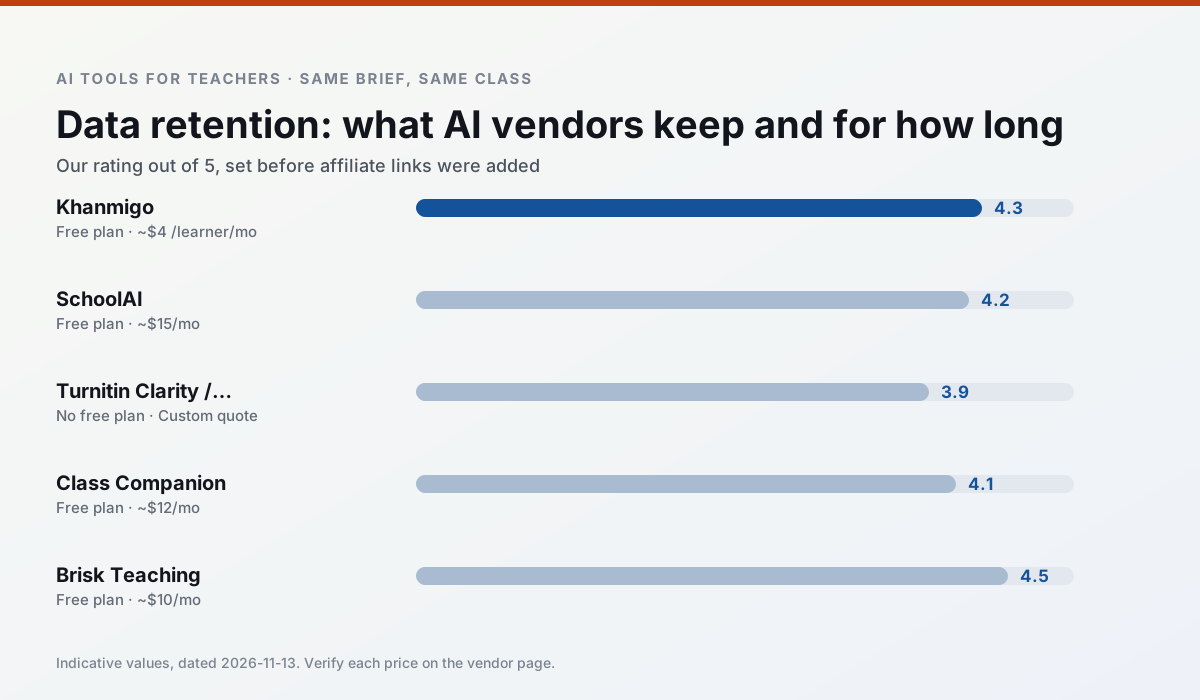
Side by side
Comparison table
Ratings reflect our timed classroom workflow, not vendor claims. Prices are indicative — verify on the vendor site.
| Tool | Best for | Free tier | Indicative paid plan | Standout feature | Our rating | Verdict | Try the tool |
|---|---|---|---|---|---|---|---|
| Khanmigo | math practice · student tutoring | Yes — US teacher accounts, subject to eligibility | ~$4 /learner/mo | Socratic tutoring rather than answers | 4.3 / 5 | Strong option | Try free |
| SchoolAI | student-safe AI · differentiated instruction | Yes — Limited seats | ~$15 /user/mo | Teacher-monitored student chats | 4.2 / 5 | Strong option | Try free |
| Turnitin Clarity / Feedback Studio | feedback on writing · academic integrity | No ongoing free plan | Custom quote | Similarity reports | 3.9 / 5 | Situational | Try free |
| Class Companion | grading · feedback on writing | Yes — Limited assignments | ~$12 /user/mo | Handwriting recognition | 4.1 / 5 | Situational | Try free |
| Brisk Teaching | feedback on writing · grading | Yes — Limited actions per month | ~$10 /user/mo | Works inside Google Docs | 4.5 / 5 | Top pick | Try free |
| Grammarly | parent communication · report card comments | Yes — Core grammar and tone checks | ~$12 /user/mo | Tone adjustments | 4.3 / 5 | Strong option | Try free |
Match your situation
Best for X
Different jobs need different tools. Here is what we would open first in each case.
Khanmigo is the one we would open on a normal planning day because the first output is editable rather than restructurable, and the free plan covers a single teacher's routine.
If there is no budget, start with SchoolAI: free plan with clearest quota is the least punishing free tier here.
Turnitin Clarity / Feedback Studio answers the three questions a district actually asks: rostering, admin controls and a data-processing agreement. That is usually what decides a school purchase.
Class Companion runs in a browser tab with no extension, no student accounts and no onboarding call, so you can test it in a free period.
Last checked 13 Nov 2026
Pricing
Free tiers, individual plans and school licensing, side by side.
| Tool | Free plan | Individual / paid | School & district | Billing note | Verify |
|---|---|---|---|---|---|
| Khanmigo | $0 — US teacher accounts, subject to eligibility | ~$4 /learner/mo | Custom quote | Indicative — verify on vendor site | Vendor |
| SchoolAI | $0 — Limited seats | ~$15 /user/mo | Custom quote | Indicative — verify on vendor site | Vendor |
| Turnitin Clarity / Feedback Studio | No ongoing free tier | Custom quote | Custom quote | LMS-wide deployment | Vendor |
| Class Companion | $0 — Limited assignments | ~$12 /user/mo | Custom quote | Indicative — verify on vendor site | Vendor |
| Brisk Teaching | $0 — Limited actions per month | ~$10 /user/mo | Custom quote | Indicative — verify on vendor site | Vendor |
| Grammarly | $0 — Core grammar and tone checks | ~$12 /user/mo | ~$15 /user/mo | Indicative — billed annually | Vendor |
Editorial rule: pricing is re-checked every 2–3 months and the top 50 pages are refreshed every 6 months. See our funding policy.
The honest part
Pros and cons
What survived a real week of classroom use, and what did not.
Pros
- Education-first design
- Strong nonprofit trust signal
- Good math scaffolding
Cons
- Availability varies by region
- Less useful for admin paperwork
- Requires student accounts for full value
Pros
- Designed for district approval
- Teacher visibility into student use
- Good safeguarding defaults
Cons
- Requires school-wide buy-in
- Less flexible than general LLMs
- Pricing is mostly quote-based
Pros
- Already licensed at many schools
- Consistent institutional workflow
- Detailed revision history
Cons
- Individual teachers cannot buy it
- AI detection remains contested
- Heavy administrative setup
Pros
- Useful where work is done on paper
- Fast, specific comments
- Good math support
Cons
- Scan quality affects accuracy
- Narrow use case
- Feedback still needs teacher review
Pros
- No copy-paste between tools
- Fast inline feedback on student drafts
- Gentle learning curve
Cons
- Chrome-first workflow
- Extension permissions need IT approval
- Free quota is tight
In the classroom
Use cases
Five concrete workflows, with the tool we would open for each one.
A Monday morning lesson plan in twelve minutes
The twelve minutes come from not rewriting the skeleton. Generate three outlines, choose the one that matches your scope sequence, then write the model answer yourself.
Recommended: KhanmigoThree reading levels from one source text
Paste a vetted text, ask for supported, core and extension versions, then check the vocabulary list by hand. Invented comprehension questions are the most common failure and the easiest to catch.
Recommended: SchoolAIRubric and feedback comments in one pass
Reorder the workflow so the rubric is yours and the comments are generated. Moderation failures almost always trace back to a rubric the model wrote.
Recommended: Turnitin Clarity / Feedback StudioA parent email in two languages
Draft in plain, warm language with no names, translate, then back-translate the important sentences to check meaning. Keep specific incidents out of the prompt and add them yourself.
Recommended: Class CompanionA five-minute exit ticket set
Ask for one recall, one application and one reasoning item, then delete the second recall question every generator sneaks in.
Recommended: Brisk Teaching
Questions teachers ask us
FAQ
Direct answers, also published as FAQPage structured data for search and AI assistants.
Is AI allowed for lesson planning in my school?
Who is responsible if something goes wrong?
What should never go into a prompt?
Sources & further reading
Our recommendation
Try Grammarly free for your next lesson planning task
Writing assistant for polished parent emails, newsletters and reports. Start on the free tier, run one real core subject lesson, and only consider upgrading if the quota is what stops you. Disclosure: we may earn a commission ($20 per paid upgrade + $0.20/signup) at no extra cost to you.
Some links on this page are affiliate links. We may earn a commission at no extra cost to you. Our rankings are editorial and never pay-to-play. Never enter student PII into a free consumer account.
Keep reading
Related comparisons in this cluster.
Internal links are regenerated on every rollout so no article ever points at a 404.