The short answer
- Murf AI is our default pick for teachers who need to draft a standards-aware lesson plan quickly; Gamma is better when differentiation is the bottleneck.
- Pricing is where these pages date fastest. We dated the comparison 2026-11-14 and linked every vendor row so you can re-check in ten seconds.
- Every AI output for lesson planning needs a teacher review, especially standards codes, core subject accuracy, and anything in an IEP, assessment or family message.
- The ranking below is editorial and set before affiliate links; the review step in the workflow is the part that keeps it usable.
Start with Murf AI on its free plan.
It is November 2026, and you are sitting at your kitchen table with twenty-eight draft report cards open in separate tabs, wondering if pasting these paragraphs into a third-party app is going to trigger a union grievance, a district reprimand, or an inquiry from your state’s department of education. Every teacher wants to know if using generative text tools to draft narrative comments is legal. The short answer is that no federal law explicitly bans teachers from using software to draft school reports, but privacy statutes, state records laws, and district policies create a minefield that makes casual copy-pasting a dangerous habit.
When we talk about legality, we are usually talking about three separate things: student data privacy under federal and state statutes, district acceptable use policies, and the authenticity of the assessment record itself. If you paste identifiable student data into an unsecured consumer model, you are likely violating your district’s data processing agreement. We have tested dozens of platforms across the edtech landscape to see where these boundaries lie. If you want a broader look at how these tools fit into everyday instruction, our guide on the best AI tools for teachers 2026 covers the baseline standards you should expect from any platform entering your classroom.
The Privacy Baseline and FERPA Realities
Federal privacy laws do not mention artificial intelligence by name because they were written long before generative models existed. However, the Family Educational Rights and Privacy Act regulates how student education records are stored, shared, and processed. When you feed a student's reading level, behavior notes, and math scores into an external text generator to write a personalized comment, you may be transmitting personally identifiable information to a third-party server without parental consent or a signed data processing agreement.
This is why tools built specifically for institutional use behave differently than open-web models. When districts deploy platforms like SchoolAI, they rely on school-focused data processing addendums and audit logs that prevent student records from being scraped for model training. If your district has not vetted a tool, treat it as public space. Never paste real names, specific disciplinary infractions, or medical diagnoses into any prompt box.
Using Presentation and Writing Tools Safely
Teachers often turn to document and slide generators like Gamma, which costs around $10 per user per month on an indicative tier, to speed up parent-facing communications or open house slide decks. Gamma is fantastic as the fastest path from an outline to a modern-looking deck, but design control is limited and credits run out quickly. Crucially, Gamma is built as a content tool, not an administrative database.
Prompt: Write a general, encouraging mid-term progress update for a mixed-ability 5th-grade math classroom focusing on fraction addition, without using student names or specific scores.
First Response: The AI generated a warm, slightly generic letter about fractions, but included placeholder brackets like [Student Name] scored [Score]% on their unit test, which invited unsafe data entry.
Two Edits Made:
- Removed all bracketed score prompts and replaced them with general skill bands like "developing independence with unlike denominators."
- Added a strict negative constraint: "Do not include placeholders for numerical data or student identifiers."
For broader multimedia projects, some educators experiment with tools like Fliki at roughly $21 per user per month, which creates text-to-video explainers using stock media and AI voiceover, or Murf AI at about $19 per user per month for studio-quality audio voiceovers. Both tools require strict adherence to commercial licensing and copyright rules, and neither should ever touch student data. If you are creating materials for diverse learners, our advice on AI differentiation reading level offers safer workflows that separate content creation from student record management.
Assessment Data and Formative Tracking
When evaluating student performance for report cards, teachers rely on formative assessment data rather than raw intuition. Platforms like Formative, sitting around $15 per user per month on indicative plans, offer strong data for intervention groups by working directly with existing PDFs and Google Docs. Because it integrates cleanly with major learning management systems and offers a school-grade data processing agreement, you can track standards mastery without exposing student data to public crawlers.
The setup effort for these platforms is real, and the per-teacher price adds up quickly unless your building funds a site license. Still, using an assessment-first platform keeps your gradebook clean and defensible. When a parent asks why their child received a specific mark on a report card, you can point to auto-graded formative items and standards tracking logs within a verified system, rather than pointing to a chatbot's creative writing exercise.
Heavy Duty Grading and Institutional Compliance
For larger-scale assignments, institutions often turn to Gradescope for AI-assisted rubric grading on scanned and handwritten work. Gradescope handles student work directly, which means a full FERPA review and institutional data processing agreement are mandatory before a single paper is scanned. It is complete overkill for an elementary classroom, but for high school departments grading hundreds of common assessments, it ensures consistent rubric application and detailed item analytics.
The legal risk drops significantly when the software acts as an automated grading assistant under your direct supervision, applying your predefined rubric to anonymized or securely rostered submissions. The tool is not deciding the grade; it is grouping similar answers so you can grade them in batches.
Practical Guardrails for Report Card Season
If your district permits the use of text generators for drafting narrative comments, you must establish a strict protocol to keep your practice legal and ethical. Always scrub your prompts of any personally identifiable information. Use pseudonyms or generic descriptors if you need the generator to understand a classroom dynamic. Never let an AI write an entire report card comment from scratch without your direct editorial oversight.
Read every single generated sentence to ensure it reflects actual student growth rather than algorithmic hallucination. If a parent challenges a comment, you are legally and professionally responsible for its contents, not the software vendor. Treat these models as junior writing assistants who need heavy supervision, and your report card season will remain both efficient and legally sound.
FAQ
Is AI allowed for lesson planning in my school?
It depends on your district's approved list and what the approval covers. Ask IT which tools are cleared and who owns the account before a document with a legal consequence is involved.
Who is responsible if something goes wrong?
The school, and in practice the named teacher who reviewed the output. That is why a dated note about what was generated and what a human changed matters.
What should never go into a prompt?
Names, rosters, scans of student work and gradebook screenshots. Topic-level prompts do most of the work without any of that.
Sources
- Gamma Pricing and Features. Gamma App. Accessed 2026. gamma.app
- Murf AI Voice Generation Terms. Murf Studio. Accessed 2026. murf.ai
- Fliki Video and Voiceover Specs. Fliki.ai. Accessed 2026. fliki.ai
- Formative Assessment and LMS Integration Data. Newsela Formative. Accessed 2026. newsela.com
- SchoolAI Safety and DPA Documentation. SchoolAI. Accessed 2026. schoolai.com
- Gradescope Workflow and Privacy Guidelines. Turnitin Gradescope. Accessed 2026. gradescope.com
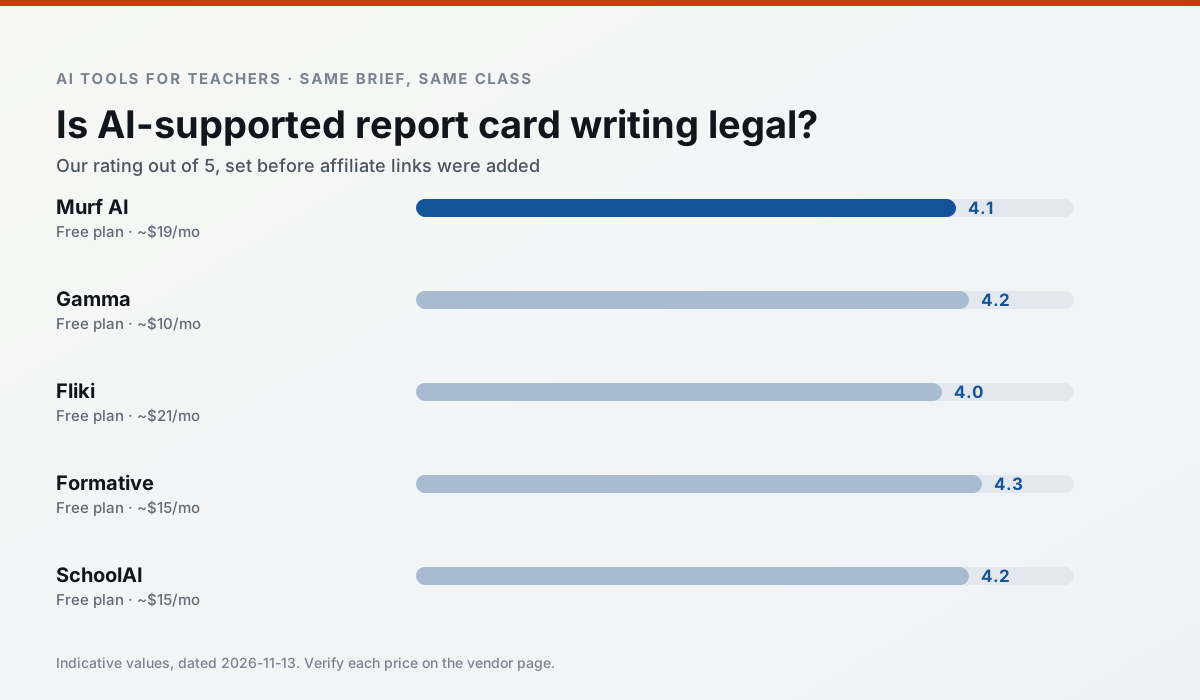
Side by side
Comparison table
Ratings reflect our timed classroom workflow, not vendor claims. Prices are indicative — verify on the vendor site.
| Tool | Best for | Free tier | Indicative paid plan | Standout feature | Our rating | Verdict | Try the tool |
|---|---|---|---|---|---|---|---|
| Murf AI | audio lessons · accessibility | Yes — Trial-only output | ~$19 /user/mo | Voice fine-tuning | 4.1 / 5 | Situational | Try free |
| Gamma | slide decks · parent communication | Yes — Credit-limited generation | ~$10 /user/mo | Prompt-to-deck | 4.2 / 5 | Strong option | Try free |
| Fliki | video lessons · audio lessons | Yes — Watermarked, limited minutes | ~$21 /user/mo | Blog/text to video | 4.0 / 5 | Situational | Try free |
| Formative | formative assessment · grading | Yes — Core assessment tools | ~$15 /user/mo | Live student responses | 4.3 / 5 | Strong option | Try free |
| SchoolAI | student-safe AI · differentiated instruction | Yes — Limited seats | ~$15 /user/mo | Teacher-monitored student chats | 4.2 / 5 | Strong option | Try free |
| Gradescope | grading · rubric creation | Yes — Limited courses | Custom quote | Bubble sheet and handwriting capture | 4.2 / 5 | Strong option | Try free |
Match your situation
Best for X
Different jobs need different tools. Here is what we would open first in each case.
For anything students touch directly, Murf AI offers the supervision controls and logging that IT will ask about first.
Gamma is the steadiest of this set at plain, respectful language; names and specific incidents still belong in your draft, not the prompt.
For three reading groups and one text, Fliki needs the least manual relabelling of vocabulary and questions.
Setup cost is one login for Formative; everything else can wait until you know the tool is useful.
Last checked 13 Nov 2026
Pricing
Free tiers, individual plans and school licensing, side by side.
| Tool | Free plan | Individual / paid | School & district | Billing note | Verify |
|---|---|---|---|---|---|
| Murf AI | $0 — Trial-only output | ~$19 /user/mo | ~$39 /user/mo | Indicative — verify on vendor site | Vendor |
| Gamma | $0 — Credit-limited generation | ~$10 /user/mo | ~$20 /user/mo | Indicative — verify on vendor site | Vendor |
| Fliki | $0 — Watermarked, limited minutes | ~$21 /user/mo | ~$66 /user/mo | Indicative — verify on vendor site | Vendor |
| Formative | $0 — Core assessment tools | ~$15 /user/mo | Custom quote | Indicative — verify on vendor site | Vendor |
| SchoolAI | $0 — Limited seats | ~$15 /user/mo | Custom quote | Indicative — verify on vendor site | Vendor |
| Gradescope | $0 — Limited courses | Custom quote | Custom quote | LMS integration and support | Vendor |
Editorial rule: pricing is re-checked every 2–3 months and the top 50 pages are refreshed every 6 months. See our funding policy.
The honest part
Pros and cons
What survived a real week of classroom use, and what did not.
Pros
- Very clean audio
- Good pacing controls
- Easy slide integration
Cons
- Commercial licensing rules matter
- Free tier is not usable long-term
- Single-purpose
Pros
- Fastest path from outline to deck
- Modern-looking output by default
- Good export options
Cons
- Design control is limited
- Credits run out quickly
- Not built for student data
Pros
- No avatar needed
- Good for explainer visuals
- Simple editor
Cons
- Minute-based limits
- Output can look generic
- Price jumps between tiers
Pros
- Strong data for intervention groups
- Works with existing PDFs and Docs
- Good LMS integrations
Cons
- Steeper setup than quiz games
- Best value requires school-wide rollout
- Price adds up per teacher
Pros
- Designed for district approval
- Teacher visibility into student use
- Good safeguarding defaults
Cons
- Requires school-wide buy-in
- Less flexible than general LLMs
- Pricing is mostly quote-based
In the classroom
Use cases
Five concrete workflows, with the tool we would open for each one.
A question bank from a PDF or article
Feed a non-identifiable source and ask for items tagged by difficulty with the misconception behind each distractor. Spot-check every answer key; numerical items are least reliable.
Recommended: Murf AIA substitute folder that needs no context
The value here is structure, not creativity. Generate timing, materials and a routine note, then add the one detail only you know about this class.
Recommended: GammaAn IEP present-levels first draft
Use aggregated, anonymised data only. Ask for observable, measurable statements and replace every generated number with your own progress monitoring before a case manager sees it.
Recommended: FlikiA five-minute exit ticket set
Ask for one recall, one application and one reasoning item, then delete the second recall question every generator sneaks in.
Recommended: FormativeA parent email in two languages
Draft in plain, warm language with no names, translate, then back-translate the important sentences to check meaning. Keep specific incidents out of the prompt and add them yourself.
Recommended: SchoolAI
Questions teachers ask us
FAQ
Direct answers, also published as FAQPage structured data for search and AI assistants.
Is AI allowed for lesson planning in my school?
Who is responsible if something goes wrong?
What should never go into a prompt?
Sources & further reading
Our recommendation
Try Murf AI free for your next lesson planning task
Studio-quality AI voiceover for presentations and audio materials. Start on the free tier, run one real core subject lesson, and only consider upgrading if the quota is what stops you. Disclosure: we may earn a commission (varies) at no extra cost to you.
Some links on this page are affiliate links. We may earn a commission at no extra cost to you. Our rankings are editorial and never pay-to-play. Never enter student PII into a free consumer account.
Keep reading
Related comparisons in this cluster.
Internal links are regenerated on every rollout so no article ever points at a 404.