The short answer
- Grammarly is our default pick for teachers who need to produce specific, evidence-based comments quickly; Gradescope is better when differentiation is the bottleneck.
- All 3 shortlisted tools are priced for one teacher first and a school second. Grammarly and Gradescope are the two worth trialling on a real task before any purchase conversation.
- Every AI output for report card comments needs a teacher review, especially standards codes, core subject accuracy, and anything in an IEP, assessment or family message.
- Trial one tool for a week of real report card comments work before any purchase conversation; the quota is the honest test.
Start with Grammarly on its free plan.
It is three days before grades are due, and my coffee is cold for the third time today. I am staring at thirty-four variations of "needs to participate more in class discussions" for my seventh-grade social studies blocks. Middle school report cards are a particular kind of torture because you cannot just copy-paste a generic platitude. Parents know when you are phoning it in, and admin actually reads the citizenship comments. This year, I tested a handful of software options to see if AI report card comments for 6-8 could actually survive November without making my kids sound like tiny corporate executives.
The Reality of Middle School Writing Workloads
Middle school teachers deal with a weird operational split. We teach five sections, write comments for a hundred and fifty kids, and juggle advisory periods and parent conferences that run until eight at night. When people suggest using general writing assistants, they forget that a comment block has strict character limits and a very narrow emotional band. You need to sound professional enough for the principal, honest enough for the parents, and fair to a thirteen-year-old who spent half the term staring out the window. If you are looking at broader platforms, it helps to read our overview of the best ai tools for teachers-2026 to see how these workflows fit into a standard staff room schedule.
Among general-purpose helpers, Grammarly (~$12 /user/mo, with a free tier for core checks) works best for mixed-ability classes where you need to adjust your own tone on the fly. It catches typos in high-stakes parent emails and lives in your browser wherever you type. But you have to watch it. If you let it rewrite your rough notes automatically, it flattens your teacher voice into a bland paste of educational jargon. You also need to disable text collection on school devices and check your district data privacy agreement before pasting student details anywhere.
Grading Platforms and Data Management
When report card season overlaps with summative essays, grading platforms take the brunt of the load. Gradescope (custom quote, limited free courses) is built for rubric grading on scanned and handwritten assessments. It is a massive time-saver for paper exams, but it is complete overkill if you only teach elementary or lower-grade exploratory electives. The setup effort is real, and the pricing is opaque. Because it handles actual student work, you need a full DPA and FERPA review before you upload anything with a student name attached.
For day-to-day data tracking, Formative (~$15 /user/mo, with a free assessment tier) is best for student-safe deployments. It lets you run live formative assessments that track standards automatically and tie right into your existing PDFs and Docs. It gives you solid data for intervention groups, but the price adds up per teacher if your school does not spring for a site license. The setup is steeper than a simple quiz game, but it beats trying to manually aggregate spreadsheet numbers at midnight.
Prompt: Write a neutral IEP present-levels report comment for a 7th-grade student with executive function challenges who submits assignments late.
First pass: "Student struggles with time management and organization, leading to missing homework. With accommodations, student can achieve grade-level standards."
Edits made:
- Removed vague descriptors and replaced them with observable, measurable actions observed in class.
- Cross-referenced every data point against actual gradebook logs before handing the draft to the case manager.
Building Quizzes and Review Content
If your report card comments need to reflect actual performance on unit tests, you have to generate clean assessment items first. QuestionWell (~$10 /user/mo, with a monthly free generation limit) is our pick for overall best for daily use because it builds standards-aligned question banks from any text or objective. You feed it a non-identifiable source article, and it spits out a clean export with objective tagging.
We used it last month to build a five-minute exit ticket set:
- Ask for one recall, one application, and one reasoning item.
- Immediately delete the second recall question every generator sneaks into the bottom of the list.
- Export the revised quiz straight to your LMS without scrubbing formatting for an hour.
If you want pure engagement rather than deep diagnostic data, Kahoot! (~$10 /user/mo, limited free player count) remains the default choice for review games. It takes zero training time, but its paid tiers are required if you have large classes, and the time pressure tends to reward quick recall over actual reasoning. For deeper dives into how middle schoolers process information, our guide on ai accommodations for middle school classrooms covers how to align these quiz outputs with actual learning plans.
Video Snippets and Classroom Media
Sometimes your gradebook comments rely on capturing what actually happened during project-based learning. OpusClip (~$15 /user/mo, with a restrictive free tier) takes long classroom recordings and chops them into short, captioned clips. It is fast and turns a messy project day into clean review highlights.
Two things went wrong when I tried using it during our science fair presentations. First, the auto-captions choked on overlapping middle school chatter, meaning I had to manually fix half the technical terms. Second, the social-first formatting is awkward for standard classroom platforms. I fixed both issues by limiting the clips to thirty-second silent demonstrations of lab setups rather than full student speeches, which kept privacy concerns at bay. Never upload recordings containing identifiable students unless your district media release covers AI-driven third-party processing.
Report card comments do not need to be a work of art, but they do need to be accurate. If you use AI to speed up the drafting phase, keep your hand on the steering wheel, protect your students' data, and never let an algorithm write a sentence about a kid you wouldn't say out loud to their parents.
FAQ
Can AI do report card comments at 6-8 level?
It can produce a first draft and a structure. The level judgement, the standards check and the tone are teacher decisions.
Which tool is best for report card comments?
Grammarly on the evidence in this article, with Gradescope as the second opinion. Neither replaces the review step.
What is the biggest risk?
A confident, plausible output that nobody checked. The five checks below exist for that reason.
Sources
- Grammarly Education Overview and Privacy Policy: https://www.grammarly.com/
- Gradescope Institutional Pricing and FERPA Documentation: https://www.gradescope.com/
- Formative Standards Tracking and DPA Resources: https://goformative.com/
- QuestionWell Feature Sets and Subscription Plans: https://www.questionwell.com/
- Kahoot! Educator Tiers and Safety Guidelines: https://kahoot.com/
- OpusClip Features and Video Processing Limits: https://www.opus.pro/
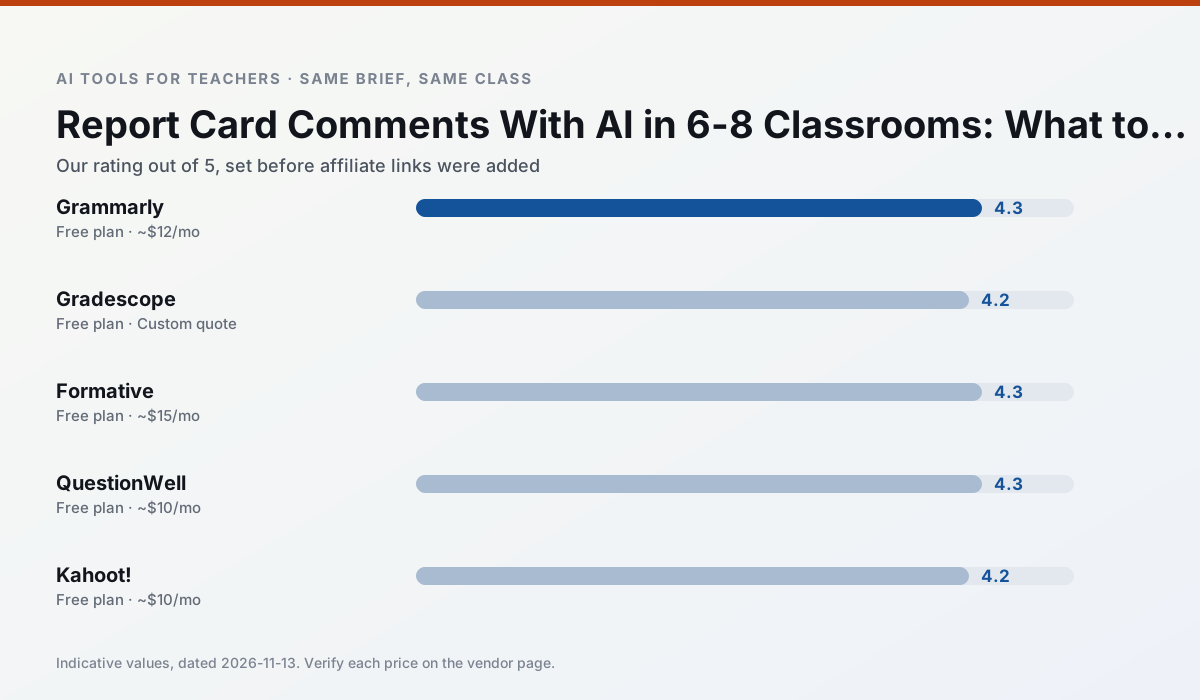
Side by side
Comparison table
Ratings reflect our timed classroom workflow, not vendor claims. Prices are indicative — verify on the vendor site.
| Tool | Best for | Free tier | Indicative paid plan | Standout feature | Our rating | Verdict | Try the tool |
|---|---|---|---|---|---|---|---|
| Grammarly | parent communication · report card comments | Yes — Core grammar and tone checks | ~$12 /user/mo | Tone adjustments | 4.3 / 5 | Strong option | Try free |
| Gradescope | grading · rubric creation | Yes — Limited courses | Custom quote | Bubble sheet and handwriting capture | 4.2 / 5 | Strong option | Try free |
| Formative | formative assessment · grading | Yes — Core assessment tools | ~$15 /user/mo | Live student responses | 4.3 / 5 | Strong option | Try free |
| QuestionWell | quiz generation · assessment | Yes — Monthly generation limit | ~$10 /user/mo | Exports to Google Forms / LMS | 4.3 / 5 | Strong option | Try free |
| Kahoot! | quiz generation · review lessons | Yes — Limited player count | ~$10 /user/mo | AI question builder | 4.2 / 5 | Strong option | Try free |
| OpusClip | PD materials · flipped lessons | Yes — Limited monthly clips | ~$15 /user/mo | Auto captions | 4.0 / 5 | Situational | Try free |
Match your situation
Best for X
Different jobs need different tools. Here is what we would open first in each case.
For three reading groups and one text, Grammarly needs the least manual relabelling of vocabulary and questions.
Family-facing drafts from Gradescope need the fewest rewrites for warmth without overpromising, which is the usual failure mode.
Formative is the student-facing option here with boundaries a teacher can actually set and supervise.
QuestionWell wins on the default path: fewer clicks to a usable draft, and the interface does not get in the way at 7:40am.
Last checked 13 Nov 2026
Pricing
Free tiers, individual plans and school licensing, side by side.
| Tool | Free plan | Individual / paid | School & district | Billing note | Verify |
|---|---|---|---|---|---|
| Grammarly | $0 — Core grammar and tone checks | ~$12 /user/mo | ~$15 /user/mo | Indicative — billed annually | Vendor |
| Gradescope | $0 — Limited courses | Custom quote | Custom quote | LMS integration and support | Vendor |
| Formative | $0 — Core assessment tools | ~$15 /user/mo | Custom quote | Indicative — verify on vendor site | Vendor |
| QuestionWell | $0 — Monthly generation limit | ~$10 /user/mo | Custom quote | Indicative — verify on vendor site | Vendor |
| Kahoot! | $0 — Limited player count | ~$10 /user/mo | Custom quote | Indicative — verify on vendor site | Vendor |
| OpusClip | $0 — Limited monthly clips | ~$15 /user/mo | ~$29 /user/mo | Indicative — verify on vendor site | Vendor |
Editorial rule: pricing is re-checked every 2–3 months and the top 50 pages are refreshed every 6 months. See our funding policy.
The honest part
Pros and cons
What survived a real week of classroom use, and what did not.
Pros
- Catches errors in high-stakes parent emails
- Works everywhere you already write
- Very low learning curve
Cons
- Not education-specific
- Can flatten teacher voice
- Premium needed for tone rewriting
Pros
- Large time savings on paper assessments
- Consistent rubric application
- Detailed item analytics
Cons
- Overkill for elementary classrooms
- Institutional pricing is opaque
- Setup effort is real
Pros
- Strong data for intervention groups
- Works with existing PDFs and Docs
- Good LMS integrations
Cons
- Steeper setup than quiz games
- Best value requires school-wide rollout
- Price adds up per teacher
Pros
- Saves the most time on question writing
- Clean export workflow
- Good objective tagging
Cons
- Single-purpose tool
- Question quality varies by source text
- Limited student-facing features
Pros
- Instant engagement
- Very low training time
- Strong brand familiarity
Cons
- Less depth for higher-order assessment
- Paid tiers needed for larger classes
- Time pressure suits recall more than reasoning
In the classroom
Use cases
Five concrete workflows, with the tool we would open for each one.
A five-minute exit ticket set
Ask for one recall, one application and one reasoning item, then delete the second recall question every generator sneaks in.
Recommended: GrammarlyAn IEP present-levels first draft
Use aggregated, anonymised data only. Ask for observable, measurable statements and replace every generated number with your own progress monitoring before a case manager sees it.
Recommended: GradescopeA substitute folder that needs no context
The value here is structure, not creativity. Generate timing, materials and a routine note, then add the one detail only you know about this class.
Recommended: FormativeA question bank from a PDF or article
Feed a non-identifiable source and ask for items tagged by difficulty with the misconception behind each distractor. Spot-check every answer key; numerical items are least reliable.
Recommended: QuestionWellA Monday morning lesson plan in twelve minutes
The twelve minutes come from not rewriting the skeleton. Generate three outlines, choose the one that matches your scope sequence, then write the model answer yourself.
Recommended: Kahoot!
Questions teachers ask us
FAQ
Direct answers, also published as FAQPage structured data for search and AI assistants.
Can AI do report card comments at 6-8 level?
Which tool is best for report card comments?
What is the biggest risk?
Sources & further reading
Our recommendation
Try Grammarly free for your next report card comments task
Writing assistant for polished parent emails, newsletters and reports. Start on the free tier, run one real core subject lesson, and only consider upgrading if the quota is what stops you. Disclosure: we may earn a commission ($20 per paid upgrade + $0.20/signup) at no extra cost to you.
Some links on this page are affiliate links. We may earn a commission at no extra cost to you. Our rankings are editorial and never pay-to-play. Never enter student PII into a free consumer account.
Keep reading
Related comparisons in this cluster.
Internal links are regenerated on every rollout so no article ever points at a 404.