The short answer
- Writesonic is our default pick for teachers who need to assemble a weekly family update quickly; Grammarly is better when differentiation is the bottleneck.
- Writesonic handles the broad case; Grammarly handles the narrow one. Anything beyond that pair should be justified by a recurring weekly job, not a feature demo.
- Every AI output for classroom newsletters needs a teacher review, especially standards codes, core subject accuracy, and anything in an IEP, assessment or family message.
- Everything on this page dates from 2026-11-13; where a price could not be re-read, the row says so.
Start with Writesonic on its free plan.
By Friday afternoon, my inbox usually contains fourteen automated district updates, three emails from parents asking about missing work that was posted on the LMS in August, and zero remaining reserves of human patience. Writing a Friday update for high school families used to take forty minutes I did not have. Then I started testing AI classroom newsletters for 9-12 to see if I could automate the administrative churn without sounding like a robot.
Most writing tools online treat high school parents like they need motivational posters. They do not. They need to know if the research paper is still due Tuesday, and whether their kid is about to fail the semester. If you are exploring broader use cases, our guide on best AI tools for teachers in 2026 covers the wider landscape. But for parent updates and daily dispatch, a few specific platforms actually pull their weight.
Canva for Education
Canva for Education is effectively free for verified teachers, and it has quietly become my default layout engine. You do not need design skills to make a newsletter that looks professional instead of like a panic-typed Word document. The trap here is the template library. It is massive, and it is very easy to spend twenty minutes picking a font pairing when you just need to tell families about the upcoming poetry unit.
The built-in AI text features are capped, which is fine because you should not use them to write your whole update anyway. Use Canva to drop your text into a clean two-column grid, swap in a photo from lab day, and hit export. Just make sure your school verification goes through early in the term, as the account approval queue can drag.
Grammarly
Grammarly sits quietly in the background of your browser, catching tone slips before you send high-stakes emails to administration or parents. The free tier handles core grammar and tone checks, while the paid version, running around $12 per user per month, unlocks deeper rewriting. In high school classrooms, tone matters immensely. A hurried email about late work can easily read as aggressive to an anxious parent.
Prompt: Rewrite this parent email to be firm about the Friday deadline for the research paper draft, but warm and supportive: "If your child doesn't turn in the draft Friday, they fail the checkpoint."
First draft output: Dear Family, I hope this message finds you well. As we navigate the exciting waters of the semester, please remember that the research paper draft is due this Friday to ensure student success.
My edits: Cut the artificial cheerleading entirely. Kept the clear deadline, added a line pointing to the specific rubric on our course page, and left the tone neutral and direct.
The tool works everywhere you already write, which is its main strength. The risk is that it can flatten your natural teacher voice into generic corporate speak if you accept every suggestion it makes. On school devices, remember to disable text collection and check your district's DPA before running student data through it. If you teach younger grades as well, you might look at our resource on AI accommodations for K-2 classrooms for different age-band workflows.
Writesonic
Writesonic is a budget-friendly AI writing platform priced around $16 per user per month on its paid tier, with a limited free trial. Our rankings place Writesonic as the best for student-safe deployments when you need bulk content generation. It offers a dizzying number of templates, which makes it tempting for drafting generic classroom output quickly.
The downside is that its education context is fairly thin. If you ask it to write a high school history newsletter without giving it strict parameters, it defaults to platitudes about critical thinking. The credit system can also feel confusing until you map out your monthly volume. Never feed student data into it, as it is not intended for educational record-keeping.
ElevenLabs
ElevenLabs is a text-to-speech platform priced around $5 per user per month, operating on a monthly character quota. We rank it as the best for parent-facing writing because you can turn your written newsletter into a short, natural-sounding audio clip for families who prefer listening on their commute. The audio generation is remarkably fast and avoids the robotic cadence of older text-to-speech tools.
The catch is simple boundary management. Do not clone a student's or a colleague's voice without explicit written consent, and remember that this is a media tool, not a teaching platform. Using it to voice-record your weekly newsletter takes two minutes and drastically increases parent open-and-listen rates.
QuestionWell and Formative
While newsletters keep the home front informed, your daily assessment prep eats up the rest of your planning period. QuestionWell, running around $10 per user per month, generates standards-aligned question banks from any pasted text or objective. Feed it a non-identifiable article, ask for items tagged by difficulty, and check every single answer key because numerical items can still hallucinate.
Formative handles live assessment with auto-grading and standards tracking for around $15 per user per month. It is our top pick for schools and districts because it turns raw quiz data into actionable intervention groups. Setup is steeper than casual quiz games, but the payoff in standards data is real if your department uses it consistently.
Two Things That Went Wrong
AI tools love to break your workflow in predictable ways if you let them run unchecked. Last month, I used Writesonic to draft a quick update about our upcoming midterm review stations. I trusted the output, pasted it into my email client, and hit send to one hundred and fifty families. By second period, three parents were emailing me to ask what a "synergistic learning module" was, because the AI had hallucinated corporate jargon into a simple description of essay revision groups. I had to send a quick correction note and resolve from then on to strip all adjectives generated by an algorithm before hitting send.
The second failure happened when I tried to use an automated generator to build a rubric and feedback comments simultaneously. The moderation failed because the model wrote a vague rubric, and then generated feedback that didn't match our state standards. Now, my ironclad rule is that the rubric must be entirely mine before any AI touches the feedback generation. Protect your planning time, keep your human voice intact, and use these tools to handle the clerical drag so you can focus on the teenagers sitting in front of you.
FAQ
Can AI do classroom newsletters at 9-12 level?
It can produce a first draft and a structure. The level judgement, the standards check and the tone are teacher decisions.
Which tool is best for classroom newsletters?
Writesonic on the evidence in this article, with Grammarly as the second opinion. Neither replaces the review step.
What is the biggest risk?
A confident, plausible output that nobody checked. The five checks below exist for that reason.
Sources
- Writesonic Pricing and Features: Writesonic Pricing
- Grammarly Education and Security: Grammarly Trust Center
- ElevenLabs Audio Generation: ElevenLabs Product Overview
- Formative Assessment Platform: Formative Features
- QuestionWell Standards Alignment: QuestionWell
- Canva for Education Verification: Canva Teachers
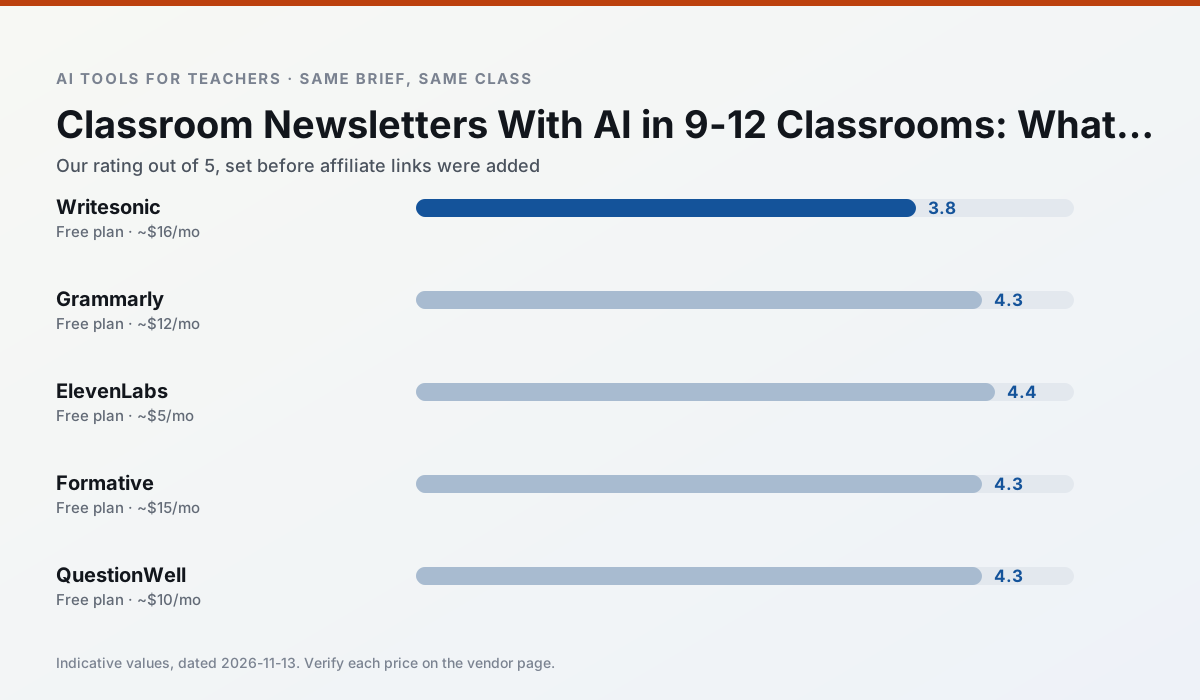
Side by side
Comparison table
Ratings reflect our timed classroom workflow, not vendor claims. Prices are indicative — verify on the vendor site.
| Tool | Best for | Free tier | Indicative paid plan | Standout feature | Our rating | Verdict | Try the tool |
|---|---|---|---|---|---|---|---|
| Writesonic | newsletters · parent communication | Yes — Limited credits | ~$16 /user/mo | Article and email generators | 3.8 / 5 | Situational | Try free |
| Grammarly | parent communication · report card comments | Yes — Core grammar and tone checks | ~$12 /user/mo | Tone adjustments | 4.3 / 5 | Strong option | Try free |
| ElevenLabs | accessibility · reading intervention | Yes — Monthly character quota | ~$5 /user/mo | Very natural voices | 4.4 / 5 | Strong option | Try free |
| Formative | formative assessment · grading | Yes — Core assessment tools | ~$15 /user/mo | Live student responses | 4.3 / 5 | Strong option | Try free |
| QuestionWell | quiz generation · assessment | Yes — Monthly generation limit | ~$10 /user/mo | Exports to Google Forms / LMS | 4.3 / 5 | Strong option | Try free |
| Canva for Education | slide decks · worksheets | Yes — Verification required | ~$13 /user/mo | Thousands of education templates | 4.6 / 5 | Top pick | Try free |
Match your situation
Best for X
Different jobs need different tools. Here is what we would open first in each case.
For anything students touch directly, Writesonic offers the supervision controls and logging that IT will ask about first.
Grammarly keeps the same task across levels, which is what makes a differentiated set defensible in moderation.
ElevenLabs has the strongest tone control for family emails and report comments, provided you still read the message aloud before sending.
Formative answers the three questions a district actually asks: rostering, admin controls and a data-processing agreement. That is usually what decides a school purchase.
Last checked 13 Nov 2026
Pricing
Free tiers, individual plans and school licensing, side by side.
| Tool | Free plan | Individual / paid | School & district | Billing note | Verify |
|---|---|---|---|---|---|
| Writesonic | $0 — Limited credits | ~$16 /user/mo | ~$49 /user/mo | Indicative — verify on vendor site | Vendor |
| Grammarly | $0 — Core grammar and tone checks | ~$12 /user/mo | ~$15 /user/mo | Indicative — billed annually | Vendor |
| ElevenLabs | $0 — Monthly character quota | ~$5 /user/mo | ~$22 /user/mo | Indicative — verify on vendor site | Vendor |
| Formative | $0 — Core assessment tools | ~$15 /user/mo | Custom quote | Indicative — verify on vendor site | Vendor |
| QuestionWell | $0 — Monthly generation limit | ~$10 /user/mo | Custom quote | Indicative — verify on vendor site | Vendor |
| Canva for Education | $0 — Verification required | ~$13 /user/mo | Custom quote | Indicative — verify on vendor site | Vendor |
Editorial rule: pricing is re-checked every 2–3 months and the top 50 pages are refreshed every 6 months. See our funding policy.
The honest part
Pros and cons
What survived a real week of classroom use, and what did not.
Pros
- Cheaper than enterprise writing suites
- Many templates
- Reasonable free trial
Cons
- Generic classroom output
- Credit system is confusing
- Limited education context
Pros
- Catches errors in high-stakes parent emails
- Works everywhere you already write
- Very low learning curve
Cons
- Not education-specific
- Can flatten teacher voice
- Premium needed for tone rewriting
Pros
- Excellent for accessible audio versions
- Low entry price
- Fast generation
Cons
- Quota-based billing
- Voice cloning consent considerations
- Not a teaching platform
Pros
- Strong data for intervention groups
- Works with existing PDFs and Docs
- Good LMS integrations
Cons
- Steeper setup than quiz games
- Best value requires school-wide rollout
- Price adds up per teacher
Pros
- Saves the most time on question writing
- Clean export workflow
- Good objective tagging
Cons
- Single-purpose tool
- Question quality varies by source text
- Limited student-facing features
In the classroom
Use cases
Five concrete workflows, with the tool we would open for each one.
A substitute folder that needs no context
The value here is structure, not creativity. Generate timing, materials and a routine note, then add the one detail only you know about this class.
Recommended: WritesonicA question bank from a PDF or article
Feed a non-identifiable source and ask for items tagged by difficulty with the misconception behind each distractor. Spot-check every answer key; numerical items are least reliable.
Recommended: GrammarlyA five-minute exit ticket set
Ask for one recall, one application and one reasoning item, then delete the second recall question every generator sneaks in.
Recommended: ElevenLabsAn IEP present-levels first draft
Use aggregated, anonymised data only. Ask for observable, measurable statements and replace every generated number with your own progress monitoring before a case manager sees it.
Recommended: FormativeRubric and feedback comments in one pass
Reorder the workflow so the rubric is yours and the comments are generated. Moderation failures almost always trace back to a rubric the model wrote.
Recommended: QuestionWell
Questions teachers ask us
FAQ
Direct answers, also published as FAQPage structured data for search and AI assistants.
Can AI do classroom newsletters at 9-12 level?
Which tool is best for classroom newsletters?
What is the biggest risk?
Sources & further reading
Our recommendation
Try Writesonic free for your next classroom newsletters task
Budget-friendly AI writing and content generation. Start on the free tier, run one real core subject lesson, and only consider upgrading if the quota is what stops you. Disclosure: we may earn a commission (varies) at no extra cost to you.
Some links on this page are affiliate links. We may earn a commission at no extra cost to you. Our rankings are editorial and never pay-to-play. Never enter student PII into a free consumer account.
Keep reading
Related comparisons in this cluster.
Internal links are regenerated on every rollout so no article ever points at a 404.