The short answer
- ElevenLabs is our default pick for teachers who need to assemble a weekly family update quickly; Grammarly is better when differentiation is the bottleneck.
- Pricing is where these pages date fastest. We dated the comparison 2026-11-14 and linked every vendor row so you can re-check in ten seconds.
- Every AI output for classroom newsletters needs a teacher review, especially standards codes, core subject accuracy, and anything in an IEP, assessment or family message.
- Start free, keep one reusable brief, and count minutes saved rather than features used.
Start with ElevenLabs on its free plan.
It was 4:45 PM on a Thursday in October. I had fourteen unread emails from parents, three spelling lists to modify for my reading groups, and a Friday classroom newsletter sitting on my desktop as a completely blank document. My coffee was cold, my second-graders had left a trail of glitter from the coat racks to the rug, and I was staring at a blinking cursor that felt like a tiny mechanical judge. That was the week I stopped trying to write every parent update from scratch and figured out which tools actually help with AI classroom newsletters for k-2, and which ones just add another tab to your browser.
Writing for primary families is a different beast than writing for middle or high school. Parents of six and seven-year-olds do not want a novel. They want to know if their child needs a jacket on Monday, what sight words we are working on, and why their kid came home with blue paint behind their ear. If your update reads like an academic paper, nobody reads it. If it is too casual, you miss important dates. Using generative tools for this job is less about letting a robot teach and more about surviving the administrative crush so you can actually plan tomorrow's phonics block.
Finding the Right Assistant for Parent-Facing Writing
When you are trying to strike that impossible balance between professional and warm, Grammarly acts as a reliable second pair of eyes. It is not an education-specific platform, which means it will not generate your curriculum for you, but it catches tone issues and spelling errors in high-stakes parent emails before you hit send. The free tier covers core grammar checks, but the paid tier at roughly $12 per user per month (indicative) unlocks tone rewriting. The risk here is that it can flatten your natural teacher voice into something that sounds like an insurance manual. You have to keep a hand on the wheel and override its suggestions when they sound too stiff.
For visual layout, Canva for Education remains the undisputed champion for primary teachers. Because it is effectively free for verified educators, you can pull from a massive library of templates that look like a professional graphic designer spent hours on them. You drop in your spelling list, add a photo of the week's art project, and drag text boxes around without needing any design background. The trap with Canva is that it is easy to produce cluttered layouts that overwhelm parents with too many fonts and dancing stickers. Keep it clean, use the same template every week so families know where to look, and remember to check the education-tier privacy terms before uploading any student photos.
Adding Voice and Audio to Weekly Updates
Not every family engages with text-heavy newsletters, especially households where English is a second language or working parents who catch up on updates during a noisy commute. This is where ElevenLabs changes the workflow. Known primarily for natural-sounding AI voiceover and text-to-speech, it gives you a way to turn your weekly written update into a short audio clip that parents can play right from their phone. The free tier gives you a monthly character quota, and paid plans run around $5 per user per month (indicative).
The generation is remarkably fast, but you have to watch out for quota-based billing limits if you are generating updates for multiple grade-level sections every single week. More importantly, never use voice-cloning features on a student or a colleague without explicit written consent. Think of the audio feature as an accessibility bridge rather than a replacement for your printed notes, letting busy families listen to the week's announcements while making dinner.
Keeping Question Banks and Assessments Standards-Aligned
While newsletters take care of home-to-school communication, you still need to check if your students actually absorbed what you taught during the week. QuestionWell is designed to generate standards-aligned question banks from any text or objective you feed it. The free tier has a monthly generation limit, while the paid tier sits at about $10 per user per month (indicative). It saves an enormous amount of time on question writing and offers a clean export workflow directly into your existing systems.
When you use it for early elementary learners, keep your source text simple and only paste non-identifiable material into the prompt. It is a single-purpose tool, which means it will not grade papers for you, but it rescues you from staring at a blank screen trying to invent four multiple-choice questions about a butterfly life cycle at 5:00 PM.
Formative Assessment Without the Paper Pileup
For live formative assessment with auto-grading and standards tracking, Formative offers a remarkably solid free tier that covers core assessment tools, with paid tiers around $15 per user per month (indicative). It works wonderfully for mixed-ability classes because you can attach existing PDFs or Google Docs and embed different types of questions.
Prompt: "Create a 5-question phonics check on long 'a' vowel teams (ai, ay) for a mixed-ability 1st grade classroom. Provide questions in two distinct difficulty tiers, ensure all instructions use simple decodable vocabulary, and format for a printable 1-page worksheet with no online device requirement."

Model response received: A worksheet with Tier 1 matching exercises and Tier 2 fill-in-the-blank sentence prompts using simple sight words, accompanied by an answer key.

Two edits made for classroom use:
1. Replaced three words in the instructions that were above a mid-first-grade reading level to ensure independent completion during small group rotations.
2. Added a visual picture icon next to the matching section so my English language learners could immediately understand the task without reading extra text.
The setup is slightly steeper than basic quiz games, and the best value requires a school-wide rollout, but the data it generates for intervention groups is worth the learning curve. If you want a deeper dive into how these systems support diverse learners, take a look at our guide on AI accommodations for K-2 classrooms.
What to Skip in Primary Classrooms
Not every tool built for schools belongs in a kindergarten or first-grade classroom. Gradescope, for instance, is built for AI-assisted rubric grading for scanned and handwritten assessments. It is incredible for high school science labs or university lecture halls, but it is absolute overkill for elementary classrooms. The institutional pricing is opaque, the setup effort is real, and handling primary students' handwritten work requires rigorous DPA and FERPA review that usually takes more administrative energy than it saves.
Similarly, if you are looking for broader strategies to support young learners without drowning in tech, read our overview of the best AI tools for teachers in 2026. Keep your toolkit small, protect your prep time, and remember that no algorithm can replace the actual conversations you have with your students and their families every single day.
FAQ
Can AI do classroom newsletters at K-2 level?
It can produce a first draft and a structure. The level judgement, the standards check and the tone are teacher decisions.
Which tool is best for classroom newsletters?
ElevenLabs on the evidence in this article, with Grammarly as the second opinion. Neither replaces the review step.
What is the biggest risk?
A confident, plausible output that nobody checked. The five checks below exist for that reason.
Sources
- ElevenLabs Pricing and Features. https://elevenlabs.io/
- Grammarly Education and Business Tiers. https://www.grammarly.com/
- QuestionWell Pricing and Capabilities. https://www.questionwell.com/
- Formative Pricing and Assessment Features. https://www.smartick.com/ or formative platform vendor updates.
- Gradescope Institutional Features and Security. https://www.gradescope.com/
- Canva for Education Verification and Terms. https://www.canva.com/education/
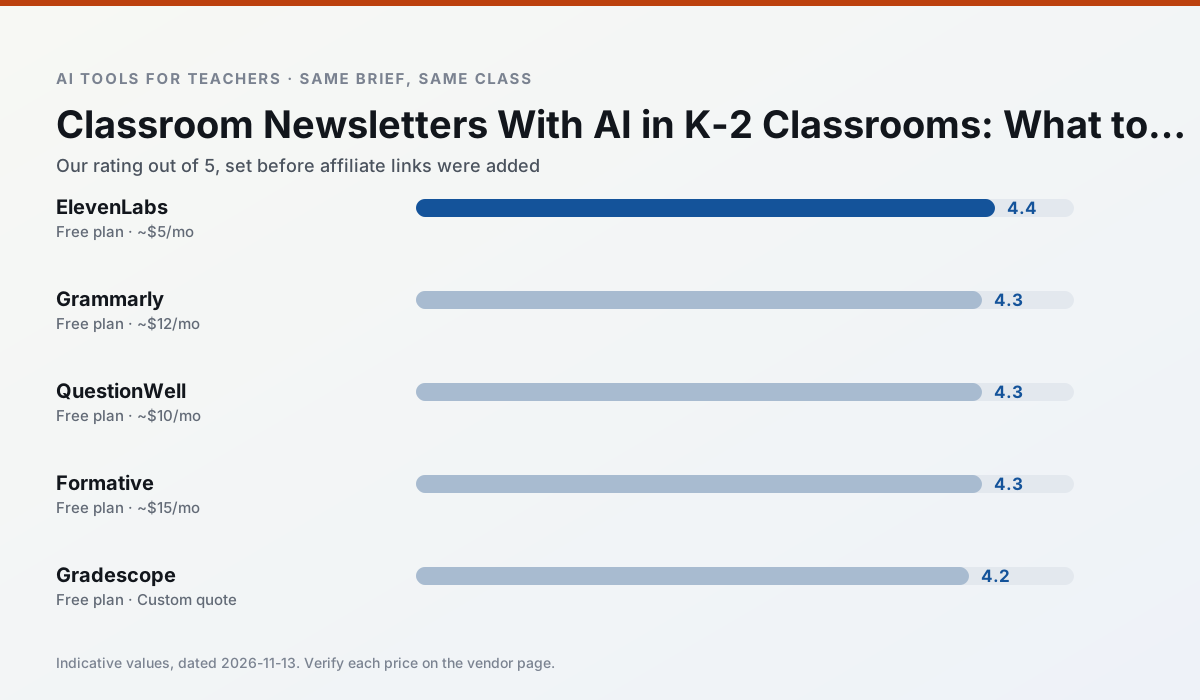
Side by side
Comparison table
Ratings reflect our timed classroom workflow, not vendor claims. Prices are indicative — verify on the vendor site.
| Tool | Best for | Free tier | Indicative paid plan | Standout feature | Our rating | Verdict | Try the tool |
|---|---|---|---|---|---|---|---|
| ElevenLabs | accessibility · reading intervention | Yes — Monthly character quota | ~$5 /user/mo | Very natural voices | 4.4 / 5 | Strong option | Try free |
| Grammarly | parent communication · report card comments | Yes — Core grammar and tone checks | ~$12 /user/mo | Tone adjustments | 4.3 / 5 | Strong option | Try free |
| QuestionWell | quiz generation · assessment | Yes — Monthly generation limit | ~$10 /user/mo | Exports to Google Forms / LMS | 4.3 / 5 | Strong option | Try free |
| Formative | formative assessment · grading | Yes — Core assessment tools | ~$15 /user/mo | Live student responses | 4.3 / 5 | Strong option | Try free |
| Gradescope | grading · rubric creation | Yes — Limited courses | Custom quote | Bubble sheet and handwriting capture | 4.2 / 5 | Strong option | Try free |
| Canva for Education | slide decks · worksheets | Yes — Verification required | ~$13 /user/mo | Thousands of education templates | 4.6 / 5 | Top pick | Try free |
Match your situation
Best for X
Different jobs need different tools. Here is what we would open first in each case.
Family-facing drafts from ElevenLabs need the fewest rewrites for warmth without overpromising, which is the usual failure mode.
For three reading groups and one text, Grammarly needs the least manual relabelling of vocabulary and questions.
QuestionWell is the student-facing option here with boundaries a teacher can actually set and supervise.
If there is no budget, start with Formative: free plan with clearest quota is the least punishing free tier here.
Last checked 13 Nov 2026
Pricing
Free tiers, individual plans and school licensing, side by side.
| Tool | Free plan | Individual / paid | School & district | Billing note | Verify |
|---|---|---|---|---|---|
| ElevenLabs | $0 — Monthly character quota | ~$5 /user/mo | ~$22 /user/mo | Indicative — verify on vendor site | Vendor |
| Grammarly | $0 — Core grammar and tone checks | ~$12 /user/mo | ~$15 /user/mo | Indicative — billed annually | Vendor |
| QuestionWell | $0 — Monthly generation limit | ~$10 /user/mo | Custom quote | Indicative — verify on vendor site | Vendor |
| Formative | $0 — Core assessment tools | ~$15 /user/mo | Custom quote | Indicative — verify on vendor site | Vendor |
| Gradescope | $0 — Limited courses | Custom quote | Custom quote | LMS integration and support | Vendor |
| Canva for Education | $0 — Verification required | ~$13 /user/mo | Custom quote | Indicative — verify on vendor site | Vendor |
Editorial rule: pricing is re-checked every 2–3 months and the top 50 pages are refreshed every 6 months. See our funding policy.
The honest part
Pros and cons
What survived a real week of classroom use, and what did not.
Pros
- Excellent for accessible audio versions
- Low entry price
- Fast generation
Cons
- Quota-based billing
- Voice cloning consent considerations
- Not a teaching platform
Pros
- Catches errors in high-stakes parent emails
- Works everywhere you already write
- Very low learning curve
Cons
- Not education-specific
- Can flatten teacher voice
- Premium needed for tone rewriting
Pros
- Saves the most time on question writing
- Clean export workflow
- Good objective tagging
Cons
- Single-purpose tool
- Question quality varies by source text
- Limited student-facing features
Pros
- Strong data for intervention groups
- Works with existing PDFs and Docs
- Good LMS integrations
Cons
- Steeper setup than quiz games
- Best value requires school-wide rollout
- Price adds up per teacher
Pros
- Large time savings on paper assessments
- Consistent rubric application
- Detailed item analytics
Cons
- Overkill for elementary classrooms
- Institutional pricing is opaque
- Setup effort is real
In the classroom
Use cases
Five concrete workflows, with the tool we would open for each one.
A substitute folder that needs no context
Say "no prior context, no devices, 40 minutes, printable" in the prompt. Everything else about substitute plans follows from those four constraints.
Recommended: ElevenLabsThree reading levels from one source text
One source, three versions, same three questions in each. Automatic levelling is an estimate; read the supported version aloud to a colleague before it reaches a reading group.
Recommended: GrammarlyA Monday morning lesson plan in twelve minutes
Two sentences into the brief: grade, subject, 45 minutes, one mixed-ability group. Ask for three structures, keep one, rewrite the prose yourself. The tool saves the blank-page time, not the thinking time.
Recommended: QuestionWellA parent email in two languages
Write the English version with one clear action item, translate it, and read the translation aloud with a colleague who speaks the language if you can. Machine translation is an aid, not a substitute for a family relationship.
Recommended: FormativeRubric and feedback comments in one pass
Write the four criteria and the band wording first; generate only the comment bank. That keeps your department's rubric language intact and stops the model inventing a fifth criterion.
Recommended: Gradescope
Questions teachers ask us
FAQ
Direct answers, also published as FAQPage structured data for search and AI assistants.
Can AI do classroom newsletters at K-2 level?
Which tool is best for classroom newsletters?
What is the biggest risk?
Sources & further reading
Our recommendation
Try ElevenLabs free for your next classroom newsletters task
Natural-sounding AI voiceover and text-to-speech for learning materials. Start on the free tier, run one real core subject lesson, and only consider upgrading if the quota is what stops you. Disclosure: we may earn a commission (22% recurring) at no extra cost to you.
Some links on this page are affiliate links. We may earn a commission at no extra cost to you. Our rankings are editorial and never pay-to-play. Never enter student PII into a free consumer account.
Keep reading
Related comparisons in this cluster.
Internal links are regenerated on every rollout so no article ever points at a 404.