The short answer
- Claude is our default pick for teachers who need to give actionable draft feedback quickly; Brisk Teaching is better when differentiation is the bottleneck.
- Free-tier reality for this shortlist: Claude: Yes — Usage-limited; Brisk Teaching: Yes — Limited actions per month; Turnitin Clarity / Feedback Studio: No ongoing free plan. Treat every paid figure as indicative until you have read the vendor page; only the free quota is something you can test yourself this week.
- Every AI output for feedback on student writing needs a teacher review, especially standards codes, core subject accuracy, and anything in an IEP, assessment or family message.
- Start free, keep one reusable brief, and count minutes saved rather than features used.
Start with Murf AI on its free plan.
It is four o'clock on a Tuesday. I am staring at twenty-two crumpled composition books, and my eyes are crossed. Six of those five-year-olds wrote about a dog named Max, fourteen wrote about going to the park, and two drew a picture of a blue scribble with the word cat spelled backward. If I want to give meaningful AI feedback on student writing for k-2, I cannot type twenty-two individual notes while my coffee goes cold. Last term, I tried fixing this with a generic text generator, pasting paragraphs one by one until my screen looked like a crime scene of unformatted strings. It was faster than handwriting, but not by much.
Using AI for early elementary writing isn't about letting robots grade kids. It is about closing the loop between a messy student draft and a parent or child who can actually understand what to fix next. Some tools want you to copy and paste text into a separate tab, which is a killer when you are dealing with twenty emergent spellers. Other systems handle handwritten pages directly, while enterprise platforms lock you behind district contracts. If you are building out your toolkit this year, check our comprehensive guide on best AI tools for teachers 2026 to see how these writing assistants fit alongside your planning software. Let's look at what actually works for primary classrooms, what fails, and where you should save your subscription budget.
Claude as the Best Free Option
When you do not have a budget line and your district IT department takes three weeks to answer a help ticket, Anthropic's Claude is your best free option. The free tier is usage-limited, but its long-context window means you can dump an entire class roster's worth of anonymized running records or prompt ideas into one chat.
The main drawback is that it has no teacher-specific templates and zero classroom integrations. You cannot use the consumer plan for identifiable student data, so you have to strip names and birthdates before pasting. Still, if you need to generate three reading levels from one source text or build a Monday morning lesson plan in twelve minutes, Claude produces nuanced prose that doesn't sound like a robot wrote it.
Brisk Teaching for Daily Inline Workflow
If you live inside Google Docs or Canvas, Brisk Teaching is the best overall for daily use. It is a browser extension priced around $10 per user per month (indicative) with a tight free tier. Brisk brings AI feedback right into your docs and articles without making you flip between tabs.
The learning curve is gentle, but you need IT approval to install the Chrome extension because it reads document content. If your school runs on Chromebooks, this is the tool that saves you from carpal tunnel. You can highlight a student's chaotic sentence about their trip to the zoo and generate gentle, age-appropriate revision prompts in seconds. For more ways to support early writers who struggle with motor skills or spelling, read our guide on AI accommodations for K-2 classrooms.
Turnitin Clarity for Institutional Setup
Turnitin Clarity / Feedback Studio is the tool you use when your district has already paid the bill and wants a heavy-duty audit trail. There is no free tier, and individual teachers cannot buy it on a personal credit card because pricing is based on a custom quote.
The strengths are obvious: consistent institutional workflow, detailed revision history, and deep LMS integrations. The limits are equally stark. AI detection remains contested, and the administrative setup requires a district-level rollout. If your school already licenses it, the interface gives you solid similarity checking and structured feedback, but it is too heavy for a single kindergarten teacher looking for quick phonics encouragement.
Class Companion for Paper and Pencil Work
Kindergarten and first-grade students do not type their stories on mechanical keyboards. They use fat pencils, crayons, and primary-lined paper. Class Companion steps in here as the best tool for schools and districts, priced at about $12 per user per month (indicative) with a limited free tier.
Prompt:
"Review this scanned first-grade writing sample about a frog. The student wrote: 'i saw a frog it was green.' Provide two positive comments about capital letters or periods, and suggest one way to add a descriptive word."

First response:
"The student demonstrates emerging capitalization at the beginning of the sentence but omits terminal punctuation. Recommend vocabulary expansion regarding amphibian locomotion."

Edits that made it usable:
1. Change the output tone from academic jargon to second-grade teacher speak.
2. Limit the suggestion to just one spelling target so the child isn't overwhelmed.
The catch is scan quality. If a seven-year-old presses too lightly with a dull yellow pencil, the optical character recognition stumbles. You still have to review every comment before showing it to a child.
Murf AI and Fliki for Multimedia Projects
Sometimes writing feedback needs to be heard, not read, especially for pre-readers who are recording audio diaries or digital stories. Murf AI gives you studio-quality AI voiceover for presentations at around $19 per user per month (indicative) with a trial-only output. It gives you very clean audio and easy slide integration, but commercial licensing rules matter, and the free tier is useless for a full school term.
Fliki handles text-to-video with stock media and AI voiceover at roughly $21 per user per month (indicative) with watermarked, limited minutes on the free tier. It is great for making quick explainer visuals for science units, but it is strictly a content creation tool. Keep student personally identifiable information entirely away from it.
Where Early AI Writing Tools Fall Apart
Working with AI feedback in K-2 is full of friction. Two specific failures happen constantly in real classrooms. First, when using Class Companion to scan handwritten student journals, the software frequently misreads messy emergent handwriting, turning dog into doge or flagging correct letter formation as an error because the baseline is crooked. The fix is a quick manual scan of the output before printing feedback stickers, discarding any misread words so the child doesn't get confused.
Second, browser extensions like Brisk can lag when thirty students are drafting simultaneously on a strained school Wi-Fi network, freezing the Chrome tab right in the middle of a writing conference. When this happens, I turn off the live extension sync, let the kids finish typing offline, and run the feedback batch in a quiet browser window during my planning period.
Using these platforms effectively means remembering that an algorithm cannot wipe away the messy reality of teaching five-year-olds how to hold a pencil. Use the free tier of Claude to outline your writing prompts, let Brisk handle your inline drafting feedback if your IT department gives the green light, and save the heavy institutional tools for older grades. Keep your human eyes on the work, and let the software do the heavy lifting of formatting your notes.
FAQ
Can AI do feedback on student writing at K-2 level?
It can produce a first draft and a structure. The level judgement, the standards check and the tone are teacher decisions.
Which tool is best for feedback on student writing?
Claude on the evidence in this article, with Brisk Teaching as the second opinion. Neither replaces the review step.
What is the biggest risk?
A confident, plausible output that nobody checked. The five checks below exist for that reason.
Sources
- Anthropic. "Claude Pricing and Plan Details." Vendor documentation, accessed 2026.
- Brisk Teaching. "Brisk Extensions for Google Workspace." Product overview, accessed 2026.
- Turnitin. "Turnitin Feedback Studio and Clarity." Institutional solutions guide, accessed 2026.
- Class Companion. "AI Feedback for Scanned Student Work." Feature specifications, accessed 2026.
- Murf AI. "Murf Studio Voice Generation Plans." Pricing and terms page, accessed 2026.
- Fliki. "Text-to-Video Creation Limits." Creator tier documentation, accessed 2026.
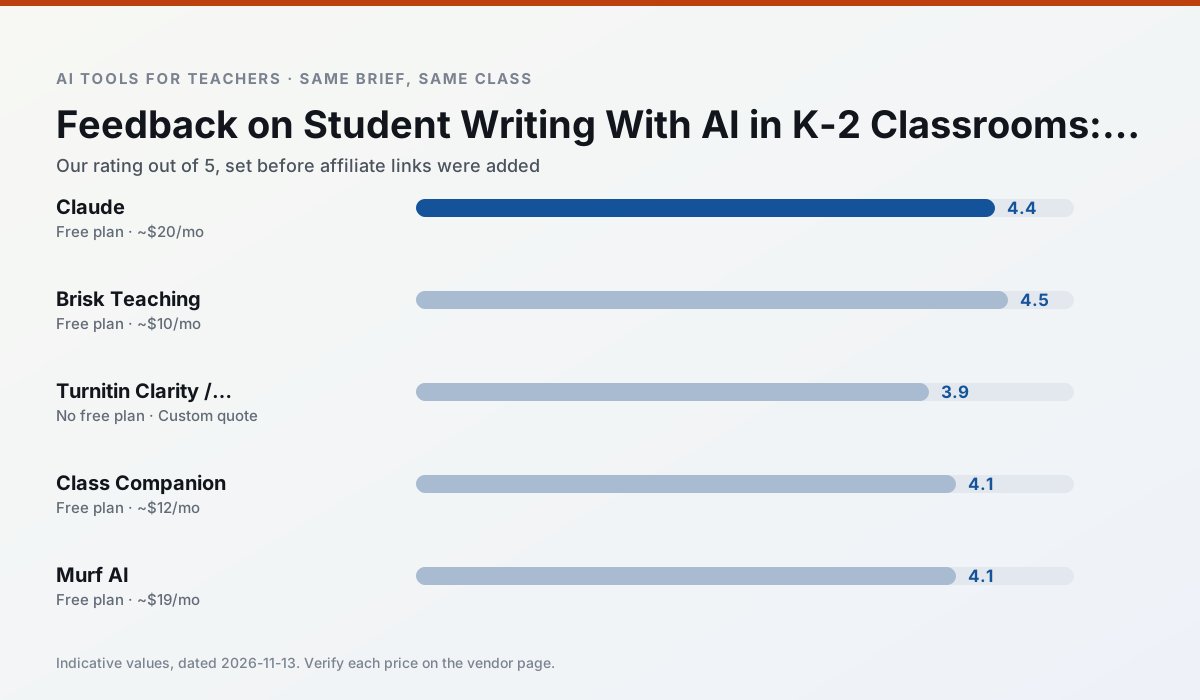
Side by side
Comparison table
Ratings reflect our timed classroom workflow, not vendor claims. Prices are indicative — verify on the vendor site.
| Tool | Best for | Free tier | Indicative paid plan | Standout feature | Our rating | Verdict | Try the tool |
|---|---|---|---|---|---|---|---|
| Claude | rubric creation · feedback on writing | Yes — Usage-limited | ~$20 /user/mo | Very large context window | 4.4 / 5 | Strong option | Try free |
| Brisk Teaching | feedback on writing · grading | Yes — Limited actions per month | ~$10 /user/mo | Works inside Google Docs | 4.5 / 5 | Top pick | Try free |
| Turnitin Clarity / Feedback Studio | feedback on writing · academic integrity | No ongoing free plan | Custom quote | Similarity reports | 3.9 / 5 | Situational | Try free |
| Class Companion | grading · feedback on writing | Yes — Limited assignments | ~$12 /user/mo | Handwriting recognition | 4.1 / 5 | Situational | Try free |
| Murf AI | audio lessons · accessibility | Yes — Trial-only output | ~$19 /user/mo | Voice fine-tuning | 4.1 / 5 | Situational | Try free |
| Fliki | video lessons · audio lessons | Yes — Watermarked, limited minutes | ~$21 /user/mo | Blog/text to video | 4.0 / 5 | Situational | Try free |
Match your situation
Best for X
Different jobs need different tools. Here is what we would open first in each case.
Claude's free plan is the most usable in this comparison: a quota that survives a normal week. Not enough for a department, enough for one teacher to decide.
Brisk Teaching is the one we would open on a normal planning day because the first output is editable rather than restructurable, and the free plan covers a single teacher's routine.
Setup cost is one login for Turnitin Clarity / Feedback Studio; everything else can wait until you know the tool is useful.
For a school rollout, Class Companion offers the paperwork and the admin console; the classroom features are standard by comparison.
Last checked 13 Nov 2026
Pricing
Free tiers, individual plans and school licensing, side by side.
| Tool | Free plan | Individual / paid | School & district | Billing note | Verify |
|---|---|---|---|---|---|
| Claude | $0 — Usage-limited | ~$20 /user/mo | ~$25+ /user/mo | Indicative — verify on vendor site | Vendor |
| Brisk Teaching | $0 — Limited actions per month | ~$10 /user/mo | Custom quote | Indicative — verify on vendor site | Vendor |
| Turnitin Clarity / Feedback Studio | No ongoing free tier | Custom quote | Custom quote | LMS-wide deployment | Vendor |
| Class Companion | $0 — Limited assignments | ~$12 /user/mo | Custom quote | Indicative — verify on vendor site | Vendor |
| Murf AI | $0 — Trial-only output | ~$19 /user/mo | ~$39 /user/mo | Indicative — verify on vendor site | Vendor |
| Fliki | $0 — Watermarked, limited minutes | ~$21 /user/mo | ~$66 /user/mo | Indicative — verify on vendor site | Vendor |
Editorial rule: pricing is re-checked every 2–3 months and the top 50 pages are refreshed every 6 months. See our funding policy.
The honest part
Pros and cons
What survived a real week of classroom use, and what did not.
Pros
- Handles full unit plans and long rubrics
- Nuanced, less generic prose
- Good at structured document output
Cons
- No teacher-specific templates
- Fewer classroom integrations
- Consumer plan not suitable for student data
Pros
- No copy-paste between tools
- Fast inline feedback on student drafts
- Gentle learning curve
Cons
- Chrome-first workflow
- Extension permissions need IT approval
- Free quota is tight
Pros
- Already licensed at many schools
- Consistent institutional workflow
- Detailed revision history
Cons
- Individual teachers cannot buy it
- AI detection remains contested
- Heavy administrative setup
Pros
- Useful where work is done on paper
- Fast, specific comments
- Good math support
Cons
- Scan quality affects accuracy
- Narrow use case
- Feedback still needs teacher review
Pros
- Very clean audio
- Good pacing controls
- Easy slide integration
Cons
- Commercial licensing rules matter
- Free tier is not usable long-term
- Single-purpose
In the classroom
Use cases
Five concrete workflows, with the tool we would open for each one.
Regrouping students after an assessment
Summarise anonymised results into skill groups, then generate one activity per group. Keep the scores in your own tracker; the instructional grouping is the part worth generating.
Recommended: ClaudeA weekly family newsletter from bullet notes
Newsletters fail on length, not tone. Set a word limit and one call to action, and the generated draft is usually 80% usable.
Recommended: Brisk TeachingThree reading levels from one source text
Paste a vetted text, ask for supported, core and extension versions, then check the vocabulary list by hand. Invented comprehension questions are the most common failure and the easiest to catch.
Recommended: Turnitin Clarity / Feedback StudioA Monday morning lesson plan in twelve minutes
The twelve minutes come from not rewriting the skeleton. Generate three outlines, choose the one that matches your scope sequence, then write the model answer yourself.
Recommended: Class CompanionA parent email in two languages
Draft in plain, warm language with no names, translate, then back-translate the important sentences to check meaning. Keep specific incidents out of the prompt and add them yourself.
Recommended: Murf AI
Questions teachers ask us
FAQ
Direct answers, also published as FAQPage structured data for search and AI assistants.
Can AI do feedback on student writing at K-2 level?
Which tool is best for feedback on student writing?
What is the biggest risk?
Sources & further reading
Our recommendation
Try Murf AI free for your next feedback on student writing task
Studio-quality AI voiceover for presentations and audio materials. Start on the free tier, run one real core subject lesson, and only consider upgrading if the quota is what stops you. Disclosure: we may earn a commission (varies) at no extra cost to you.
Some links on this page are affiliate links. We may earn a commission at no extra cost to you. Our rankings are editorial and never pay-to-play. Never enter student PII into a free consumer account.
Keep reading
Related comparisons in this cluster.
Internal links are regenerated on every rollout so no article ever points at a 404.