The short answer
- Grammarly is our default pick for teachers who need to draft a standards-aware lesson plan quickly; ElevenLabs is better when differentiation is the bottleneck.
- Grammarly handles the broad case; ElevenLabs handles the narrow one. Anything beyond that pair should be justified by a recurring weekly job, not a feature demo.
- Every AI output for Grades needs a teacher review, especially standards codes, core subject accuracy, and anything in an IEP, assessment or family message.
- Trial one tool for a week of real Grades work before any purchase conversation; the quota is the honest test.
Start with Grammarly on its free plan.
It is 10:45 PM on a Sunday, and I am staring at a Gradebook that looks like a crime scene. One hundred and forty-two high school juniors have just submitted a synthesis essay, and my school district's portal demands separate numeric scores for thesis, evidence, analysis, and mechanics. AI grade entry for high school sounds like the kind of pitch dreamed up by people who haven't set foot in a classroom since the Bush administration. But when you are facing a wall of un-graded digital artifacts, you look for leverage. Over the past term, I have tested six distinct tools to see what actually carries the weight of high school grading workflows and what collapses under the reality of teenagers, district privacy filters, and messy rubrics.
The Myth of Fully Automated Grading
Let's clear the air before looking at specific platforms. No tool on the market can reliably grade a high school English paper or physics lab report from scratch without turning your gradebook into a roulette wheel. If you let an LLM assign final marks without heavy human oversight, you get drift, bias toward overly formal vocabulary, and bizarre scoring anomalies. Where these platforms actually save your sanity is in reducing friction. They parse rubrics, draft structured feedback comments, generate formative checks like exit tickets, and clean up parent communication when you are too tired to maintain a diplomatic tone. When we look at the best AI tools for teachers in 2026, the goal isn't to replace teacher judgment. The goal is to stop spending twenty minutes writing the exact same paragraph about MLA citation errors for the forty-fifth time.
Daily Workflow Support with Grammarly
When it comes to daily administrative polish, Grammarly has quietly become my most-used assistant. It operates around twelve dollars a user per month on its paid tier, though the free core version handles basic grammar and tone checks if your district allows it. Its primary strength is that it works everywhere you already type, from your district email client to your browser-based grading comments. High-stakes parent emails are where it shines brightest. At 4:00 PM on a Friday, when a parent demands to know why their child’s grade dropped three points, it is dangerously easy to type something you will regret. Grammarly catches those sharp edges, softens the tone, and keeps your professional boundaries intact. The catch is that it is not education-specific, and its automated suggestions can flatten your natural voice if you accept them blindly. You also need to disable text collection on school devices and verify your district data processing agreement before feeding any sensitive text into the system.
Generating Formative Checks and Quick Quizzes
For checking daily comprehension before grades lock in, Quizizz and Kahoot! dominate high school hallways because the students already know the interfaces by heart. Quizizz costs around fifteen dollars a user per month on its paid tier, with a functional free tier, and stands out as best for schools and districts due to robust reporting that actually syncs with standard platforms. Kahoot! runs around ten dollars a user per month, with a limited free player count, and earns our spot as best for quick setup. Both use AI-assisted question generation to populate question banks in seconds. The limitation here is that AI-generated multiple-choice questions love to test trivial recall rather than genuine reasoning.
Prompt: Create a 5-question formative quiz on cellular respiration for high school biology. Include 1 recall, 1 application, and 1 reasoning item per question type, aligned with NGSS HS-LS1-7. Result: The generator produced six questions, but snuck in a second recall question disguised as an application and used outdated vocabulary for the reasoning prompt. Edits: Deleted the extra recall question entirely, rewrote the reasoning stem to focus on a local ecosystem disruption, and manually verified that the distractor answers weren't obviously ridiculous.
If you are looking to build accessibility into these materials without spending a fortune, ElevenLabs offers natural-sounding text-to-speech for around five dollars a user per month on its paid tier, alongside a monthly free character quota. It is best used for generating audio versions of reading passages for diverse learners, though you have to manage quota limits carefully and never clone a student or colleague's voice without written consent.
Deep Document Work with ChatGPT and Claude
When you need to process long-form student writing or organize massive curriculum files, general-purpose models like ChatGPT and Claude become necessary evils. Both run around twenty dollars a user per month on their paid tiers, offering usage-limited free access. ChatGPT is the most flexible option available, boasting a massive library of teacher prompts and strong multilingual support. Claude, on the other hand, handles long-context inputs much better, making it exceptionally well-suited for digesting an entire unit plan and a twenty-page rubric in a single prompt without losing the thread.
Prompt: Act as an AP Literature teacher. Using the attached four-level rubric, generate three constructive feedback sentences for a student essay that scored a 3 out of 4 in evidence and a 2 out of 4 in commentary. Focus specifically on how they dropped quotes into the text without framing them. Result: The model generated overly flowery praise that sounded like a college admissions officer, followed by generic advice about "showing, not telling." Edits: Instructed the model to strip out the adjectives, adopt a direct tone suitable for a high school junior, and explicitly reference the specific paragraph where the dropped quote occurred.
The major failure mode with both models is privacy. Consumer tiers of ChatGPT and Claude are strictly unsuited for student personally identifiable information. If your district has not approved an enterprise workspace tier, you cannot paste student work or names into these interfaces without violating privacy policies. Furthermore, neither platform features built-in standards alignment, meaning you have to supply the exact state or national standards yourself or risk getting generic nonsense.
Keeping Grade Entry Honest
If you use AI to assist with grade entry and feedback, your workflow must remain anchored to reality. Never let an algorithm write the rubric, and never let it assign the final grade. Use models to draft the scaffolding, organize the feedback comments, and catch the spelling errors in your parent communications so you can reserve your cognitive energy for the actual human work of teaching.
FAQ
Can AI do Grades at High School level?
It can produce a first draft and a structure. The level judgement, the standards check and the tone are teacher decisions.
Which tool is best for Grades?
Grammarly on the evidence in this article, with ElevenLabs as the second opinion. Neither replaces the review step.
What is the biggest risk?
A confident, plausible output that nobody checked. The five checks below exist for that reason.
Sources
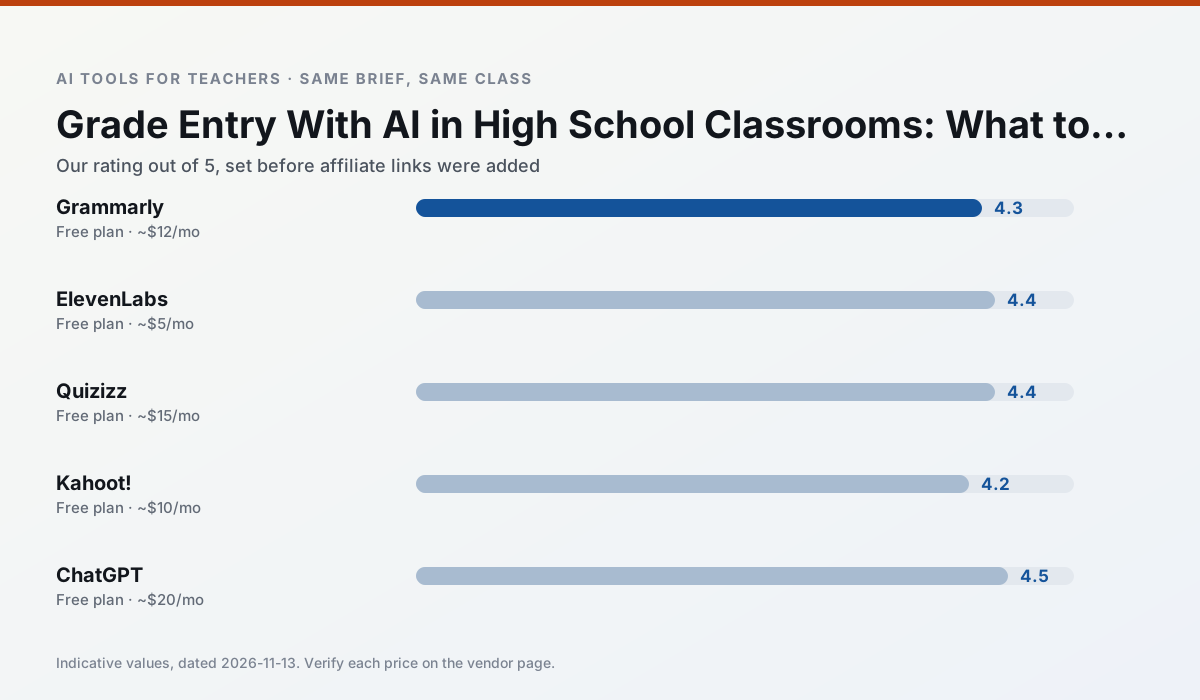
Side by side
Comparison table
Ratings reflect our timed classroom workflow, not vendor claims. Prices are indicative — verify on the vendor site.
| Tool | Best for | Free tier | Indicative paid plan | Standout feature | Our rating | Verdict | Try the tool |
|---|---|---|---|---|---|---|---|
| Grammarly | parent communication · report card comments | Yes — Core grammar and tone checks | ~$12 /user/mo | Tone adjustments | 4.3 / 5 | Strong option | Try free |
| ElevenLabs | accessibility · reading intervention | Yes — Monthly character quota | ~$5 /user/mo | Very natural voices | 4.4 / 5 | Strong option | Try free |
| Quizizz | quiz generation · formative assessment | Yes — Core quiz creation | ~$15 /user/mo | AI question generator | 4.4 / 5 | Strong option | Try free |
| Kahoot! | quiz generation · review lessons | Yes — Limited player count | ~$10 /user/mo | AI question builder | 4.2 / 5 | Strong option | Try free |
| ChatGPT | lesson planning · parent communication | Yes — Usage-limited model access | ~$20 /user/mo | Custom GPTs and Projects | 4.5 / 5 | Top pick | Try free |
| Claude | rubric creation · feedback on writing | Yes — Usage-limited | ~$20 /user/mo | Very large context window | 4.4 / 5 | Strong option | Try free |
Match your situation
Best for X
Different jobs need different tools. Here is what we would open first in each case.
Grammarly wins on the default path: fewer clicks to a usable draft, and the interface does not get in the way at 7:40am.
ElevenLabs's free plan is the most usable in this comparison: a quota that survives a normal week. Not enough for a department, enough for one teacher to decide.
For a school rollout, Quizizz offers the paperwork and the admin console; the classroom features are standard by comparison.
Setup cost is one login for Kahoot!; everything else can wait until you know the tool is useful.
Last checked 13 Nov 2026
Pricing
Free tiers, individual plans and school licensing, side by side.
| Tool | Free plan | Individual / paid | School & district | Billing note | Verify |
|---|---|---|---|---|---|
| Grammarly | $0 — Core grammar and tone checks | ~$12 /user/mo | ~$15 /user/mo | Indicative — billed annually | Vendor |
| ElevenLabs | $0 — Monthly character quota | ~$5 /user/mo | ~$22 /user/mo | Indicative — verify on vendor site | Vendor |
| Quizizz | $0 — Core quiz creation | ~$15 /user/mo | Custom quote | Indicative — verify on vendor site | Vendor |
| Kahoot! | $0 — Limited player count | ~$10 /user/mo | Custom quote | Indicative — verify on vendor site | Vendor |
| ChatGPT | $0 — Usage-limited model access | ~$20 /user/mo | ~$25+ /user/mo | Indicative — verify on vendor site | Vendor |
| Claude | $0 — Usage-limited | ~$20 /user/mo | ~$25+ /user/mo | Indicative — verify on vendor site | Vendor |
Editorial rule: pricing is re-checked every 2–3 months and the top 50 pages are refreshed every 6 months. See our funding policy.
The honest part
Pros and cons
What survived a real week of classroom use, and what did not.
Pros
- Catches errors in high-stakes parent emails
- Works everywhere you already write
- Very low learning curve
Cons
- Not education-specific
- Can flatten teacher voice
- Premium needed for tone rewriting
Pros
- Excellent for accessible audio versions
- Low entry price
- Fast generation
Cons
- Quota-based billing
- Voice cloning consent considerations
- Not a teaching platform
Pros
- Students already know the interface
- Good reporting
- Works on low-end devices
Cons
- Writing high-quality AI questions still needs review
- Gamification can distract
- Advanced analytics are paid
Pros
- Instant engagement
- Very low training time
- Strong brand familiarity
Cons
- Less depth for higher-order assessment
- Paid tiers needed for larger classes
- Time pressure suits recall more than reasoning
Pros
- Most flexible option available
- Huge community of teacher prompt libraries
- Strong multilingual support
Cons
- Requires prompt skills for consistent results
- No built-in standards alignment
- District privacy review usually required
In the classroom
Use cases
Five concrete workflows, with the tool we would open for each one.
A Monday morning lesson plan in twelve minutes
The twelve minutes come from not rewriting the skeleton. Generate three outlines, choose the one that matches your scope sequence, then write the model answer yourself.
Recommended: GrammarlyThree reading levels from one source text
Paste a vetted text, ask for supported, core and extension versions, then check the vocabulary list by hand. Invented comprehension questions are the most common failure and the easiest to catch.
Recommended: ElevenLabsRubric and feedback comments in one pass
Reorder the workflow so the rubric is yours and the comments are generated. Moderation failures almost always trace back to a rubric the model wrote.
Recommended: QuizizzA parent email in two languages
Draft in plain, warm language with no names, translate, then back-translate the important sentences to check meaning. Keep specific incidents out of the prompt and add them yourself.
Recommended: Kahoot!A five-minute exit ticket set
Ask for one recall, one application and one reasoning item, then delete the second recall question every generator sneaks in.
Recommended: ChatGPT
Questions teachers ask us
FAQ
Direct answers, also published as FAQPage structured data for search and AI assistants.
Can AI do Grades at High School level?
Which tool is best for Grades?
What is the biggest risk?
Sources & further reading
Our recommendation
Try Grammarly free for your next Grades task
Writing assistant for polished parent emails, newsletters and reports. Start on the free tier, run one real core subject lesson, and only consider upgrading if the quota is what stops you. Disclosure: we may earn a commission ($20 per paid upgrade + $0.20/signup) at no extra cost to you.
Some links on this page are affiliate links. We may earn a commission at no extra cost to you. Our rankings are editorial and never pay-to-play. Never enter student PII into a free consumer account.
Keep reading
Related comparisons in this cluster.
Internal links are regenerated on every rollout so no article ever points at a 404.