The short answer
- Diffit is our default pick for teachers who need to level one resource for three reading groups quickly; Brisk Teaching is better when differentiation is the bottleneck.
- The cheapest honest test is a week of real work on the free plans: Diffit: Yes — Limited generations per month; Brisk Teaching: Yes — Limited actions per month; SchoolAI: Yes — Limited seats. If a tool is still open on Friday, it has earned a paid conversation.
- Every AI output for differentiated instruction needs a teacher review, especially standards codes, core subject accuracy, and anything in an IEP, assessment or family message.
- Everything on this page dates from 2026-11-13; where a price could not be re-read, the row says so.
Start with ElevenLabs on its free plan.
Last Thursday, during our second reading rotation of the morning, I watched a fourth-grader stare blankly at a paragraph about ecosystems while his tablemate was finishing the same worksheet for the third time. My guided reading groups span three grade levels in Lexile range alone, and my school-issued curriculum provides exactly one version of the text. Standard differentiation means sitting at the small group table until my voice goes hoarse while twenty-two other nine-year-olds manage whatever independent work they can scrape together. AI differentiated instruction for 3-5 teachers stopped being a theoretical conversation in my classroom the afternoon I realized I could use targeted software to generate four leveled versions of a science passage in under two minutes.
The Reality of Mixed-Ability Literacy Blocks
The gap between a third-grade reading group reading at an end-of-second-grade level and an accelerated fifth-grader working independently is wider than most textbook publishers care to admit. When you try to bridge that gap manually, you spend your Sunday afternoons cutting paragraphs apart, rewriting vocabulary, and formatting three different worksheets that all look slightly different. That approach burns teachers out before Thanksgiving. The tools that actually survive daily use in an intermediate classroom are the ones that respect how fast you have to move between subjects.
Diffit remains our top pick for schools and districts because it levels any text or video into differentiated reading materials with minimal setup. You drop in an article or a YouTube link, select the target grade level, and it spits out a leveled reading passage with vocabulary definitions and comprehension questions. The free tier offers a limited number of generations per month, which you will burn through quickly if you rely on it daily, and the paid tier sits around $15 per user per month. The leveling is approximate, which means you still need to read through the output, but it saves hours of rewriting. Avoid pasting identifiable student work into it, as you should with any public-facing LLM unless your district has a specific data privacy agreement in place.
Inline Workflows With Brisk Teaching
If you live inside Google Docs and slides all day, jumping between an AI generator and your classroom materials creates too much friction. Brisk Teaching is a Chrome extension that brings AI feedback and content generation directly into Docs, Slides, and articles without forcing you to copy and paste. It earns our badge for quick setup because it lives right inside your browser toolbar. You can highlight a student draft in Google Docs and ask the extension to leave inline feedback, or generate a reading passage right inside an open tab.
Prompt: Act as an upper elementary reading specialist. Write three comprehension questions about the water cycle for a third-grade reading level, focusing on vocabulary terms: evaporation, condensation, and precipitation.
First output: The model provided three generic multiple-choice questions with answers that were too obvious and missed the specific context of our science unit.
Edit one: Added a constraint requiring one short-answer question that asks students to explain what happens to a puddle on a sunny day using the word evaporation.
Edit two: Specified that the reading level must align with the Lexile band for third-grade spring assessments. The final version was ready to drop into our slide deck.
The catch with Brisk is its Chrome-first workflow. Your school IT department will need to approve the extension permissions, and the free quota is tight enough that you will find yourself hitting limits by Thursday afternoon if you use it for every lesson. The paid tier costs around $10 per user per month, and because the extension reads document content directly, you need to review your district’s DPA before letting it touch student drafts. For a broader look at how these tools fit into daily routines, see our guide on the best AI tools for teachers 2026.
Creating Safe Student Spaces With SchoolAI
When you want students interacting directly with an AI tool rather than just using it to prep teacher materials, safety and monitoring become non-negotiable. SchoolAI is an AI workspace built specifically for schools, featuring teacher-controlled student spaces and robust safeguarding defaults. It is our best overall pick for daily use in intermediate classrooms because it gives you real-time visibility into what students are typing and receiving. You can set up a guided tutoring session about fractions or historical figures, and the system prevents students from wandering off into open-ended chatbot territory.
The platform requires school-wide buy-in rather than just a rogue teacher signup, and the pricing is mostly quote-based, though individual or small team tiers hover around $15 per user per month. It is less flexible than a general-purpose LLM, which is actually a feature rather than a bug when you have twenty-nine ten-year-olds logged in at once. School-focused data privacy agreements and audit logs are available, but you must confirm your district's specific data retention settings before launching student accounts. For younger learners down the hall, you might also look at our resource on AI accommodations for K-2 classrooms.
Accessible Audio and Presentation Tools
Differentiation isn't just about reading levels; it is also about access modalities. ElevenLabs provides natural-sounding AI voiceover and text-to-speech for learning materials, making it our top free option thanks to a generous monthly character quota. If you have struggling readers or English language learners who benefit from hearing a text read aloud with proper inflection rather than a robotic screen reader, you can paste your leveled passages here and export clean audio files. The paid tier sits around $5 per user per month. The main restriction here is consent: never clone a student's or a colleague's voice without written permission, and remember this is an audio utility, not an all-in-one teaching platform.
For building visual anchor charts and slide decks from scratch, Gamma lets you generate presentation decks and documents from a single text prompt. It takes you from a blank screen to a modern-looking layout in seconds, though design control is limited once the structure is generated. The free tier relies on credit-limited generation, and paid plans run about $10 per user per month. Meanwhile, tools like Colossyan focus on training and explainer videos built from documents and scripts, costing roughly $27 per user per month with no permanent free plan. Colossyan is better suited for staff training or school leadership presentations than K-12 student-facing instruction.
Where AI Fails in Upper Elementary
Every teacher who tries using these tools for differentiation hits a wall within the first two weeks. Two specific failures taught me to change my workflow permanently. First, when I tried to use Gamma to generate a complete slide deck for a social studies unit on state history without editing the output first, the visual hierarchy was a disaster for my visual learners, and key vocabulary terms were missing entirely. I now use the tool exclusively for structural outlines, replacing the AI-generated text with our actual curriculum definitions.
Second, when I let an LLM write a set of behavior-based accommodation rubrics for a small group project, the generated criteria were so vague that students had no idea what to do. Moderation failures almost always trace back to a rubric the model wrote from scratch. Now, the rule in my room is simple: the rubric is always mine, and the AI only generates the leveled practice activities underneath it. If you want to see how these strategies scale across different grade bands, check out our comparison of AI accommodations for middle school classrooms.
Differentiation in grades 3 through 5 is a juggling act, and AI will not wash your whiteboard or grade your math tests for you. But when you need four versions of a reading passage on colonial trades before the morning bell rings, knowing which tool to open keeps you from spending your lunch break at the copy machine.
FAQ
Can AI do differentiated instruction at 3-5 level?
It can produce a first draft and a structure. The level judgement, the standards check and the tone are teacher decisions.
Which tool is best for differentiated instruction?
Diffit on the evidence in this article, with Brisk Teaching as the second opinion. Neither replaces the review step.
What is the biggest risk?
A confident, plausible output that nobody checked. The five checks below exist for that reason.
Sources
- Diffit: diffit.me
- Brisk Teaching: briskteaching.com
- SchoolAI: schoolai.com
- ElevenLabs: elevenlabs.io
- Colossyan: colossyan.com
- Gamma: gamma.app
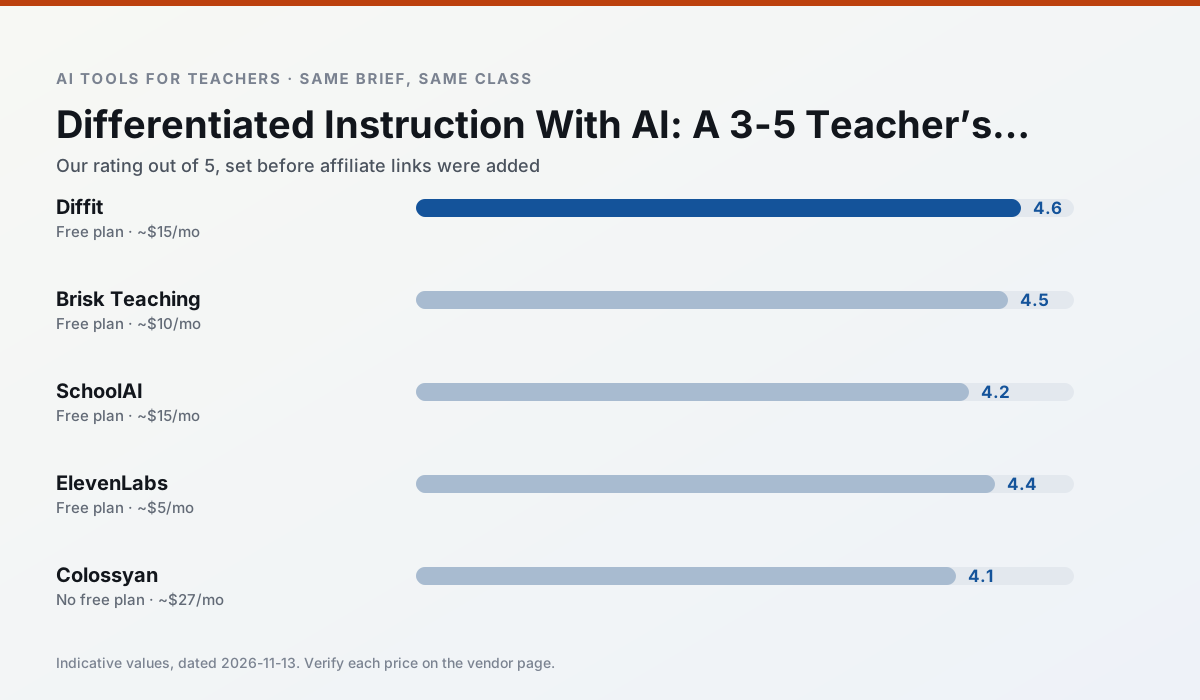
Side by side
Comparison table
Ratings reflect our timed classroom workflow, not vendor claims. Prices are indicative — verify on the vendor site.
| Tool | Best for | Free tier | Indicative paid plan | Standout feature | Our rating | Verdict | Try the tool |
|---|---|---|---|---|---|---|---|
| Diffit | differentiated instruction · reading intervention | Yes — Limited generations per month | ~$15 /user/mo | Lexile-style leveling | 4.6 / 5 | Top pick | Try free |
| Brisk Teaching | feedback on writing · grading | Yes — Limited actions per month | ~$10 /user/mo | Works inside Google Docs | 4.5 / 5 | Top pick | Try free |
| SchoolAI | student-safe AI · differentiated instruction | Yes — Limited seats | ~$15 /user/mo | Teacher-monitored student chats | 4.2 / 5 | Strong option | Try free |
| ElevenLabs | accessibility · reading intervention | Yes — Monthly character quota | ~$5 /user/mo | Very natural voices | 4.4 / 5 | Strong option | Try free |
| Colossyan | PD materials · video lessons | No ongoing free plan | ~$27 /user/mo | PDF/PPT-to-video | 4.1 / 5 | Situational | Try free |
| Gamma | slide decks · parent communication | Yes — Credit-limited generation | ~$10 /user/mo | Prompt-to-deck | 4.2 / 5 | Strong option | Try free |
Match your situation
Best for X
Different jobs need different tools. Here is what we would open first in each case.
Diffit answers the three questions a district actually asks: rostering, admin controls and a data-processing agreement. That is usually what decides a school purchase.
Setup cost is one login for Brisk Teaching; everything else can wait until you know the tool is useful.
SchoolAI wins on the default path: fewer clicks to a usable draft, and the interface does not get in the way at 7:40am.
Nothing on ElevenLabs's free tier is a teaser demo; the limits are documented and a normal week fits inside them.
Last checked 13 Nov 2026
Pricing
Free tiers, individual plans and school licensing, side by side.
| Tool | Free plan | Individual / paid | School & district | Billing note | Verify |
|---|---|---|---|---|---|
| Diffit | $0 — Limited generations per month | ~$15 /user/mo | Custom quote | Indicative — verify on vendor site | Vendor |
| Brisk Teaching | $0 — Limited actions per month | ~$10 /user/mo | Custom quote | Indicative — verify on vendor site | Vendor |
| SchoolAI | $0 — Limited seats | ~$15 /user/mo | Custom quote | Indicative — verify on vendor site | Vendor |
| ElevenLabs | $0 — Monthly character quota | ~$5 /user/mo | ~$22 /user/mo | Indicative — verify on vendor site | Vendor |
| Colossyan | No ongoing free tier | ~$27 /user/mo | Custom quote | Indicative — verify on vendor site | Vendor |
| Gamma | $0 — Credit-limited generation | ~$10 /user/mo | ~$20 /user/mo | Indicative — verify on vendor site | Vendor |
Editorial rule: pricing is re-checked every 2–3 months and the top 50 pages are refreshed every 6 months. See our funding policy.
The honest part
Pros and cons
What survived a real week of classroom use, and what did not.
Pros
- Excellent for mixed-ability classes
- Produces printable and digital versions
- Minimal setup
Cons
- Narrower scope than all-in-one suites
- Leveling is approximate, not a formal assessment
- Heavy use burns through the free quota
Pros
- No copy-paste between tools
- Fast inline feedback on student drafts
- Gentle learning curve
Cons
- Chrome-first workflow
- Extension permissions need IT approval
- Free quota is tight
Pros
- Designed for district approval
- Teacher visibility into student use
- Good safeguarding defaults
Cons
- Requires school-wide buy-in
- Less flexible than general LLMs
- Pricing is mostly quote-based
Pros
- Excellent for accessible audio versions
- Low entry price
- Fast generation
Cons
- Quota-based billing
- Voice cloning consent considerations
- Not a teaching platform
Pros
- Strong for staff training, not just lessons
- Good compliance/LMS export
- Fast document-to-video
Cons
- No permanent free plan
- Higher price point
- Less suited to K-12 student-facing content
In the classroom
Use cases
Five concrete workflows, with the tool we would open for each one.
A weekly family newsletter from bullet notes
Newsletters fail on length, not tone. Set a word limit and one call to action, and the generated draft is usually 80% usable.
Recommended: DiffitRegrouping students after an assessment
Summarise anonymised results into skill groups, then generate one activity per group. Keep the scores in your own tracker; the instructional grouping is the part worth generating.
Recommended: Brisk TeachingRubric and feedback comments in one pass
Reorder the workflow so the rubric is yours and the comments are generated. Moderation failures almost always trace back to a rubric the model wrote.
Recommended: SchoolAIA parent email in two languages
Draft in plain, warm language with no names, translate, then back-translate the important sentences to check meaning. Keep specific incidents out of the prompt and add them yourself.
Recommended: ElevenLabsA Monday morning lesson plan in twelve minutes
The twelve minutes come from not rewriting the skeleton. Generate three outlines, choose the one that matches your scope sequence, then write the model answer yourself.
Recommended: Colossyan
Questions teachers ask us
FAQ
Direct answers, also published as FAQPage structured data for search and AI assistants.
Can AI do differentiated instruction at 3-5 level?
Which tool is best for differentiated instruction?
What is the biggest risk?
Sources & further reading
Our recommendation
Try ElevenLabs free for your next differentiated instruction task
Natural-sounding AI voiceover and text-to-speech for learning materials. Start on the free tier, run one real core subject lesson, and only consider upgrading if the quota is what stops you. Disclosure: we may earn a commission (22% recurring) at no extra cost to you.
Some links on this page are affiliate links. We may earn a commission at no extra cost to you. Our rankings are editorial and never pay-to-play. Never enter student PII into a free consumer account.
Keep reading
Related comparisons in this cluster.
Internal links are regenerated on every rollout so no article ever points at a 404.