The short answer
- Formative is our default pick for teachers who need to summarise assessment results into groups quickly; Surfer SEO is better when differentiation is the bottleneck.
- Start with Formative on its free plan, keep Surfer SEO as the second opinion, and do not open a card until the quota, not the feature list, is what stops you.
- Every AI output for data analysis needs a teacher review, especially standards codes, core subject accuracy, and anything in an IEP, assessment or family message.
- Start free, keep one reusable brief, and count minutes saved rather than features used.
Start with Surfer SEO on its free plan.
At 8:40 on a Tuesday morning, I was staring at a spreadsheet containing seventy-two rows of junior English mid-term scores and wondering why forty percent of my third-period class missed question fourteen. The standard tested was CCSS.ELA-LITERACY.RL.11-12.3, which covers how complex characters develop over the course of a text. But the data was just a flat percentage. It told me they failed, but it did not tell me why. Spreadsheets are cold things when you need to plan a remediation block before lunch. If you teach grades nine through twelve, you know that finding actionable AI assessment data analysis for 9-12 is less about finding fancy charts and more about not spending your entire Sunday night cross-referencing answer keys with state standards.
We need tools that bridge the gap between raw student output and targeted intervention groups without requiring a degree in data science. Some platforms are built for this exact heavy lifting, while others belong strictly on a content creator's desk rather than inside a high school classroom. Let us look at what actually works for data analysis and formative tracking, what to skip, and how to keep student privacy intact under a school-grade DPA.
Why High School Assessment Data Breaks Standard Tools
High school assessment data is messy because the tasks are complex. Middle school quizzes often test recall, but by tenth and eleventh grade, we are grading argumentative essays, multi-step lab conclusions, and source-based historical analysis. When you feed that kind of qualitative output into generic writing software, the results are predictably vague. We tested a slate of platforms marketed for text generation and content optimization to see how they actually handle high school assessment workflows.
Writesonic is a budget-friendly AI writing tool that offers a reasonable free trial and paid plans around $16 per user per month. It has plenty of templates and is cheaper than enterprise writing suites. But for high school assessment data analysis, it falls short because its outputs are far too generic and its credit system is confusing. It lacks the deep education context needed to sort student misconceptions by standard. It is a content generator, not an analytics engine, and it should stay out of your gradebook.
Similarly, OpusClip is designed to repurpose long recordings into short clips for social media at about $15 per user per month. It has excellent captions and turns a recorded lecture into review snippets fast. The free plan is restrictive, and it is strictly a media tool rather than a lesson design or data suite. That said, if you record a review session for absent students, it can cut it down quickly, provided you never upload recordings containing identifiable students.
The Standout Choice for Live Formative Tracking
When it comes to tracking standards in real time, Formative is the heavy lifter for high school classrooms. It costs around $15 per user per month for paid tiers, though core assessment tools are available on the free tier. Its standout strength is generating strong data for intervention groups while working directly with existing PDFs and Docs. It also features solid LMS integrations. The setup is steeper than a simple quiz game, and the best value requires a school-wide rollout, but it remains our top pick for quick setup and standards tracking.
Prompt used in Formative for intervention grouping: "Analyze student responses for question set on RL.11-12.3. Group students into three tiers: intervention (scored under 60% or selected distractor B), on-track (scored 60-85%), and extension. Generate three specific small-group discussion prompts based on the primary misconception identified in distractor B."
First response: The tool generated three groups with names and basic score percentages, but the small-group prompts were generic restatements of the standard. Edits made:
- Pasted the exact text of distractor B (which confused chronological plot sequence with internal character motivation) directly into the prompt parameters.
- Restricted the extension group prompt to require textual evidence from page 42 of our core text. Final result: Usable intervention groups that matched my lesson plan for the next day's stations.
For a broader look at how these tools fit into your daily routine, check out our guide on best AI tools for teachers-2026. If you also support younger learners or collaborate across departments, you might find our breakdown of ai accommodations for middle school classrooms helpful for scaffolding these same standards downward.
Audio and Video Tools: Where Data Analysis Stops
A surprising number of edtech lists suggest using text-to-video or voiceover software for assessment feedback. We tested Murf AI, which provides studio-quality voiceover for presentations at about $19 per user per month. It gives you clean audio and good pacing controls, but it is a single-purpose tool. Its commercial licensing rules matter, and the free trial is essentially useless for long-term work. It will not analyze your quiz data.
Fliki offers text-to-video capabilities with stock media and AI voiceover starting around $21 per user per month. It is useful for creating explainer visuals without an avatar, but it relies on strict minute-based limits and its outputs can look remarkably generic. Neither Murf nor Fliki has any business touching student assessment data. They are content creation tools, plain and simple, and should be kept entirely separate from your data privacy workflows.
Misplaced Tools: When Content Optimisation is Not Assessment
One of the strangest recommendations floating around teacher forums is using SEO tools for classroom data. Surfer SEO is designed for content optimisation, specifically for teachers who publish and sell resources online through marketplaces like Teachers Pay Teachers. It costs roughly $79 per month and has no free tier. It offers brilliant on-page guidance and clear scoring for digital creators.
It is not a classroom tool. It does not ingest student grades, it does not track high school biology standards, and it requires a solid grasp of search engine optimisation to be useful. If you run a teacher-author side hustle, it is worth every penny. If you are trying to analyze why third-period chemistry finals tanked on stoichiometry, close the tab and stick to platforms with a proper school-grade Data Processing Agreement.
Two Things That Went Wrong in My Classroom
Last term, I tried to save time by asking an unverified external language model to generate a question bank from a complex PDF about the Cold War. I fed the text into a general-purpose chat interface and asked for ten multiple-choice items tagged by difficulty, complete with distractor rationales. The output looked pristine. It took me forty minutes to spot-check the answer key, only to discover that two of the numerical dates for the Berlin blockade were entirely hallucinated by the model. I had to rewrite those questions from scratch, which completely defeated the time-saving purpose. Now, I only use tools like Formative where the item banks are anchored to verified text inputs and human-set parameters.
The second failure happened when I tried to use an automated captioning and clipping workflow on a student presentation recording without checking the roster settings first. The software automatically indexed student faces and voices into a public-facing folder on the cloud. I caught it within ten minutes, deleted the workspace, and learned a harsh lesson about default cloud-sharing settings. Since then, any recording or analysis tool used with high schoolers must operate under strict institutional rostering controls, or it does not get opened on my school laptop.
FAQ
Can AI do data analysis at 9-12 level?
It can produce a first draft and a structure. The level judgement, the standards check and the tone are teacher decisions.
Which tool is best for data analysis?
Formative on the evidence in this article, with Surfer SEO as the second opinion. Neither replaces the review step.
What is the biggest risk?
A confident, plausible output that nobody checked. The five checks below exist for that reason.
Sources
- Formative Pricing and Feature Overview. goformative.com
- Surfer SEO Pricing and Content Guidelines. surferseo.com
- Writesonic Plan Details and Credit Limits. writesonic.com
- OpusClip Feature Documentation. opus.pro
- Murf AI Audio Licensing Terms. murf.ai
- Fliki Video Generation Limits. fliki.ai
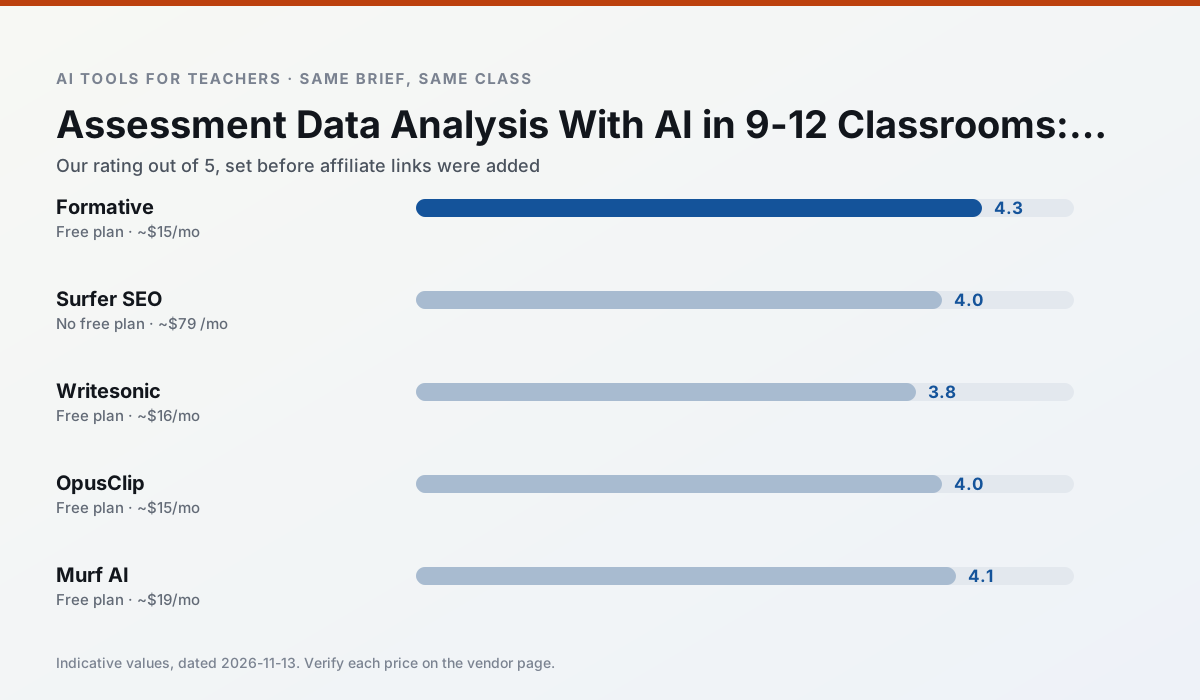
Side by side
Comparison table
Ratings reflect our timed classroom workflow, not vendor claims. Prices are indicative — verify on the vendor site.
| Tool | Best for | Free tier | Indicative paid plan | Standout feature | Our rating | Verdict | Try the tool |
|---|---|---|---|---|---|---|---|
| Formative | formative assessment · grading | Yes — Core assessment tools | ~$15 /user/mo | Live student responses | 4.3 / 5 | Strong option | Try free |
| Surfer SEO | teacher bloggers · resource sellers | No ongoing free plan | ~$79 /mo | Content Editor | 4.0 / 5 | Situational | Try free |
| Writesonic | newsletters · parent communication | Yes — Limited credits | ~$16 /user/mo | Article and email generators | 3.8 / 5 | Situational | Try free |
| OpusClip | PD materials · flipped lessons | Yes — Limited monthly clips | ~$15 /user/mo | Auto captions | 4.0 / 5 | Situational | Try free |
| Murf AI | audio lessons · accessibility | Yes — Trial-only output | ~$19 /user/mo | Voice fine-tuning | 4.1 / 5 | Situational | Try free |
| Fliki | video lessons · audio lessons | Yes — Watermarked, limited minutes | ~$21 /user/mo | Blog/text to video | 4.0 / 5 | Situational | Try free |
Match your situation
Best for X
Different jobs need different tools. Here is what we would open first in each case.
Formative runs in a browser tab with no extension, no student accounts and no onboarding call, so you can test it in a free period.
Surfer SEO is the option IT is least likely to block: single sign-on, admin removal of AI features and an agreement on file.
Nothing on Writesonic's free tier is a teaser demo; the limits are documented and a normal week fits inside them.
On the daily cycle, OpusClip saves the most edit time per task; the paid tier mostly buys more runs rather than better ones.
Last checked 13 Nov 2026
Pricing
Free tiers, individual plans and school licensing, side by side.
| Tool | Free plan | Individual / paid | School & district | Billing note | Verify |
|---|---|---|---|---|---|
| Formative | $0 — Core assessment tools | ~$15 /user/mo | Custom quote | Indicative — verify on vendor site | Vendor |
| Surfer SEO | No ongoing free tier | ~$79 /mo | Custom quote | Indicative — verify on vendor site | Vendor |
| Writesonic | $0 — Limited credits | ~$16 /user/mo | ~$49 /user/mo | Indicative — verify on vendor site | Vendor |
| OpusClip | $0 — Limited monthly clips | ~$15 /user/mo | ~$29 /user/mo | Indicative — verify on vendor site | Vendor |
| Murf AI | $0 — Trial-only output | ~$19 /user/mo | ~$39 /user/mo | Indicative — verify on vendor site | Vendor |
| Fliki | $0 — Watermarked, limited minutes | ~$21 /user/mo | ~$66 /user/mo | Indicative — verify on vendor site | Vendor |
Editorial rule: pricing is re-checked every 2–3 months and the top 50 pages are refreshed every 6 months. See our funding policy.
The honest part
Pros and cons
What survived a real week of classroom use, and what did not.
Pros
- Strong data for intervention groups
- Works with existing PDFs and Docs
- Good LMS integrations
Cons
- Steeper setup than quiz games
- Best value requires school-wide rollout
- Price adds up per teacher
Pros
- Best-in-class on-page guidance
- Useful for TpT / resource-shop content
- Clear scoring
Cons
- Expensive for individual teachers
- Not a classroom tool
- Requires SEO basics
Pros
- Cheaper than enterprise writing suites
- Many templates
- Reasonable free trial
Cons
- Generic classroom output
- Credit system is confusing
- Limited education context
Pros
- Turns a recorded lesson into review clips
- Excellent captions
- Fast
Cons
- Optimised for social formats
- Not a lesson design tool
- Free plan is restrictive
Pros
- Very clean audio
- Good pacing controls
- Easy slide integration
Cons
- Commercial licensing rules matter
- Free tier is not usable long-term
- Single-purpose
In the classroom
Use cases
Five concrete workflows, with the tool we would open for each one.
A parent email in two languages
Draft in plain, warm language with no names, translate, then back-translate the important sentences to check meaning. Keep specific incidents out of the prompt and add them yourself.
Recommended: FormativeRubric and feedback comments in one pass
Reorder the workflow so the rubric is yours and the comments are generated. Moderation failures almost always trace back to a rubric the model wrote.
Recommended: Surfer SEOThree reading levels from one source text
Paste a vetted text, ask for supported, core and extension versions, then check the vocabulary list by hand. Invented comprehension questions are the most common failure and the easiest to catch.
Recommended: WritesonicA Monday morning lesson plan in twelve minutes
The twelve minutes come from not rewriting the skeleton. Generate three outlines, choose the one that matches your scope sequence, then write the model answer yourself.
Recommended: OpusClipA question bank from a PDF or article
Feed a non-identifiable source and ask for items tagged by difficulty with the misconception behind each distractor. Spot-check every answer key; numerical items are least reliable.
Recommended: Murf AI
Questions teachers ask us
FAQ
Direct answers, also published as FAQPage structured data for search and AI assistants.
Can AI do data analysis at 9-12 level?
Which tool is best for data analysis?
What is the biggest risk?
Sources & further reading
Our recommendation
Try Surfer SEO free for your next data analysis task
Content optimisation for teacher-creators who publish resources online. Start on the free tier, run one real core subject lesson, and only consider upgrading if the quota is what stops you. Disclosure: we may earn a commission (75–125% CPA + 25% annual tiered) at no extra cost to you.
Some links on this page are affiliate links. We may earn a commission at no extra cost to you. Our rankings are editorial and never pay-to-play. Never enter student PII into a free consumer account.
Keep reading
Related comparisons in this cluster.
Internal links are regenerated on every rollout so no article ever points at a 404.