The short answer
- Quizizz is our default pick for teachers who need to draft observable, measurable goals quickly; Kahoot! is better when differentiation is the bottleneck.
- Quizizz handles the broad case; Kahoot! handles the narrow one. Anything beyond that pair should be justified by a recurring weekly job, not a feature demo.
- Every AI output for behavior plans needs a teacher review, especially standards codes, core subject accuracy, and anything in an IEP, assessment or family message.
- Trial one tool for a week of real behavior plans work before any purchase conversation; the quota is the honest test.
Start with MagicSchool AI on its free plan.
At 2:45 PM on a Tuesday, I was staring at a blank behavior intervention plan for an eighth grader who had flipped three desks that morning, and my mind was as empty as the document. Middle school is an awkward battleground. We spend hours documenting off-task behavior, arguing with kids who refuse to open their Chromebooks, and trying to write legally defensible documentation that actually helps a child stay in the room. When you need AI behavior plans for 6-8 teachers, you are usually looking past the generic edtech hype and searching for something that stops a crisis before it starts.
Most generic AI tools fail here because they do not understand the volatile ecosystem of an intermediate school. They give you vague platitudes like "encourage positive choices" instead of operational definitions. If you want to make AI pull its weight in middle school classroom management, you have to treat it like a very literal, slightly naive assistant who needs strict parameters. For broader instructional support, check out our guide on the best AI tools for teachers 2026, which looks at how planning and management overlap.
Writing IEP Present Levels Without Violating Privacy
The first place I started using platforms like MagicSchool AI (paid tier around $12 per user per month, with a robust free tier) was for IEP present-levels drafts. Middle school case managers want data, but translating three weeks of behavioral tallies into formal prose takes hours. The trick is feeding the tool aggregated, anonymised data only, keeping student names out of the prompt entirely. You ask the generator for observable, measurable statements, but you must be prepared to replace every single generated number with your own hard classroom logs before a case manager lays eyes on it.
Prompt: Write a formal present-levels draft for an 8th-grade student based on these anonymised frequency counts: 4 instance/week of leaving assigned seat without permission during independent work, usually occurring during silent reading. Trigger appears to be reading-level frustration. Provide three positive replacement behaviors.
First pass: The student frequently abandons their seat during literacy tasks due to text complexity, displaying avoidance tactics. Replacement behaviors include asking for help, taking a three-minute break, or reading a graphic novel.
Two edits that made it usable:
- Changed "frequently abandons their seat" to "exits the instructional zone an average of four times weekly during independent reading blocks."
- Removed the generic graphic novel suggestion and replaced it with "accessing pre-screened audio-supported text at their independent lexile level."
Structuring Substitute Folders That Survive Reality
Middle school subs face a special kind of dread, and our emergency absence folders often sit gathering dust because updating them feels like a second job. The secret to a working sub plan is structure over creativity. Tools like Eduaide.Ai (priced around $10 per user per month with a daily generation cap) excel at generating clean worksheets and routines, though you have to watch out for its smaller template set compared to all-in-one suites. You prompt the system for timings, specific material lists, and clear transition notes. Then, you inject the one piece of context only you know, like where the seating charts are hidden or which student will try to sneak into the hallway.
If your sub plan relies on independent digital work to keep the peace, you can also lean on tools like Curipod (priced around $12 per user per month with a limited free tier) to build interactive lessons that run themselves without requiring student login accounts. This keeps the room moving when you are out sick, though you need reliable district Wi-Fi for it to hold up.
Grouping Students After Formative Data
Managing behavior often starts with eliminating academic frustration before it boils over into acting out. When students act up in sixth grade, half the time they are just lost. I started feeding anonymised exit ticket scores into Diffit (priced around $15 per user per month with a limited free tier) to parse my classes into three skill groups and generate distinct practice materials for each. Diffit is our top pick for daily use because it handles mixed-ability classes gracefully, though heavy use will burn through your free generation quota fast.
Two things went wrong during my first week using it this way. First, I trusted the AI's automated text-leveling blindly, which resulted in a passage that was still too dense for my lowest readers. Second, I let the system generate too many tiered worksheets, creating a grading nightmare for myself on Friday. Now, I use the AI exclusively for the instructional grouping and the primary text modification, while keeping my own grading rubric locked down in my physical gradebook. For more ideas on managing diverse learners, read our breakdown on AI accommodations for middle school classrooms.
Generating Five-Minute Exit Tickets
Getting middle schoolers to settle down during the final minutes of class is notoriously difficult. A well-designed exit ticket acts as both a formative assessment and a transition anchor. When using Quizizz (paid tier around $15 per user per month alongside a robust core free quiz creator) or Kahoot! (priced around $10 per user per month with limited free player counts), you have to push past the gamification distractions. Students love the live games, but writing high-quality AI questions requires a sharp eye.
Prompt: Create a three-question exit ticket on identifying author's bias for an 8th-grade history class. Include one recall, one application, and one reasoning question.
First pass: Q1 (Recall): What is bias? Q2 (Application): Identify if this short paragraph is biased. Q3 (Reasoning): Why did the author write this?
Two edits that made it usable:
- Deleted the second recall question that the generator snuck in to pad out the set, because checking basic definitions at the door is a waste of paper.
- Rewrote Q3 to demand specific textual evidence: "Cite one loaded word from the excerpt and explain how it reveals the author's underlying point of view."
Managing Parent-Facing Communication
Behavior plans mean nothing if home and school are reading from different scripts. Newsletters and parent emails fail on length rather than tone. When communicating about behavioral interventions, families do not want a novel; they want a clear action item and a supportive tone. You can drop bullet points of weekly progress into an AI tool, set a strict word limit of one hundred words, and demand one clear call to action. The resulting draft usually hits about eighty percent usability immediately.
Middle school behavior interventions are messy, unpredictable, and deeply human. AI will never replace the trust you build with an eighth grader who finally feels understood after a rough class period. But it can take the administrative friction out of the paperwork, leaving you with a bit more energy to handle the actual kids in the room.
FAQ
Can AI do behavior plans at 6-8 level?
It can produce a first draft and a structure. The level judgement, the standards check and the tone are teacher decisions.
Which tool is best for behavior plans?
Quizizz on the evidence in this article, with Kahoot! as the second opinion. Neither replaces the review step.
What is the biggest risk?
A confident, plausible output that nobody checked. The five checks below exist for that reason.
Sources
- Quizizz Vendor Pricing and Features: https://quizizz.com/
- Kahoot! Educator Plans and Limits: https://kahoot.com/
- MagicSchool AI Platform Overview: https://www.magicschool.ai/
- Diffit Product Data and Tiers: https://diffit.me/
- Eduaide.Ai Resource Library Specifications: https://eduaide.ai/
- Curipod Interactive Lesson Data: https://curipod.com/
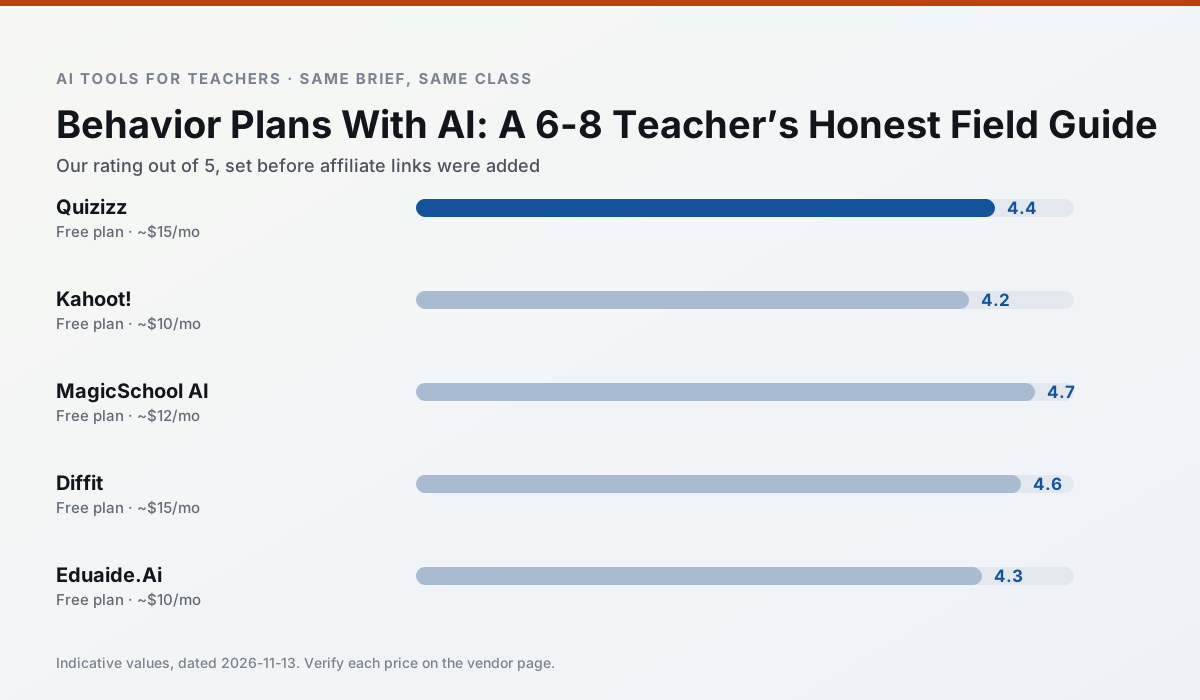
Side by side
Comparison table
Ratings reflect our timed classroom workflow, not vendor claims. Prices are indicative — verify on the vendor site.
| Tool | Best for | Free tier | Indicative paid plan | Standout feature | Our rating | Verdict | Try the tool |
|---|---|---|---|---|---|---|---|
| Quizizz | quiz generation · formative assessment | Yes — Core quiz creation | ~$15 /user/mo | AI question generator | 4.4 / 5 | Strong option | Try free |
| Kahoot! | quiz generation · review lessons | Yes — Limited player count | ~$10 /user/mo | AI question builder | 4.2 / 5 | Strong option | Try free |
| MagicSchool AI | lesson planning · differentiation | Yes — Core generators with monthly usage limits | ~$12 /user/mo | 80+ teacher-specific tools | 4.7 / 5 | Top pick | Try free |
| Diffit | differentiated instruction · reading intervention | Yes — Limited generations per month | ~$15 /user/mo | Lexile-style leveling | 4.6 / 5 | Top pick | Try free |
| Eduaide.Ai | lesson planning · rubric creation | Yes — Daily generation cap | ~$10 /user/mo | Resource library | 4.3 / 5 | Strong option | Try free |
| Curipod | formative assessment · exit tickets | Yes — Limited lessons per month | ~$12 /user/mo | Live polls and word clouds | 4.4 / 5 | Strong option | Try free |
Match your situation
Best for X
Different jobs need different tools. Here is what we would open first in each case.
Quizizz keeps the same task across levels, which is what makes a differentiated set defensible in moderation.
Family-facing drafts from Kahoot! need the fewest rewrites for warmth without overpromising, which is the usual failure mode.
MagicSchool AI is the student-facing option here with boundaries a teacher can actually set and supervise.
Diffit is the one we would open on a normal planning day because the first output is editable rather than restructurable, and the free plan covers a single teacher's routine.
Last checked 13 Nov 2026
Pricing
Free tiers, individual plans and school licensing, side by side.
| Tool | Free plan | Individual / paid | School & district | Billing note | Verify |
|---|---|---|---|---|---|
| Quizizz | $0 — Core quiz creation | ~$15 /user/mo | Custom quote | Indicative — verify on vendor site | Vendor |
| Kahoot! | $0 — Limited player count | ~$10 /user/mo | Custom quote | Indicative — verify on vendor site | Vendor |
| MagicSchool AI | $0 — Core generators with monthly usage limits | ~$12 /user/mo | Custom quote | Indicative — verify on vendor site | Vendor |
| Diffit | $0 — Limited generations per month | ~$15 /user/mo | Custom quote | Indicative — verify on vendor site | Vendor |
| Eduaide.Ai | $0 — Daily generation cap | ~$10 /user/mo | Custom quote | Indicative — verify on vendor site | Vendor |
| Curipod | $0 — Limited lessons per month | ~$12 /user/mo | Custom quote | Indicative — verify on vendor site | Vendor |
Editorial rule: pricing is re-checked every 2–3 months and the top 50 pages are refreshed every 6 months. See our funding policy.
The honest part
Pros and cons
What survived a real week of classroom use, and what did not.
Pros
- Students already know the interface
- Good reporting
- Works on low-end devices
Cons
- Writing high-quality AI questions still needs review
- Gamification can distract
- Advanced analytics are paid
Pros
- Instant engagement
- Very low training time
- Strong brand familiarity
Cons
- Less depth for higher-order assessment
- Paid tiers needed for larger classes
- Time pressure suits recall more than reasoning
Pros
- Widest purpose-built template library
- Strong free tier for individual teachers
- Fast to learn with almost no prompting skill
Cons
- Outputs still need standards review
- Best features sit behind the paid tier
- District approval can be slow
Pros
- Excellent for mixed-ability classes
- Produces printable and digital versions
- Minimal setup
Cons
- Narrower scope than all-in-one suites
- Leveling is approximate, not a formal assessment
- Heavy use burns through the free quota
Pros
- Very low entry price
- Good worksheet and rubric output
- Clean, uncluttered UI
Cons
- Smaller template set than MagicSchool
- Less polished export options
- Limited integrations
In the classroom
Use cases
Five concrete workflows, with the tool we would open for each one.
A weekly family newsletter from bullet notes
Newsletters fail on length, not tone. Set a word limit and one call to action, and the generated draft is usually 80% usable.
Recommended: QuizizzRegrouping students after an assessment
Summarise anonymised results into skill groups, then generate one activity per group. Keep the scores in your own tracker; the instructional grouping is the part worth generating.
Recommended: Kahoot!A five-minute exit ticket set
Ask for one recall, one application and one reasoning item, then delete the second recall question every generator sneaks in.
Recommended: MagicSchool AIAn IEP present-levels first draft
Use aggregated, anonymised data only. Ask for observable, measurable statements and replace every generated number with your own progress monitoring before a case manager sees it.
Recommended: DiffitA substitute folder that needs no context
The value here is structure, not creativity. Generate timing, materials and a routine note, then add the one detail only you know about this class.
Recommended: Eduaide.Ai
Questions teachers ask us
FAQ
Direct answers, also published as FAQPage structured data for search and AI assistants.
Can AI do behavior plans at 6-8 level?
Which tool is best for behavior plans?
What is the biggest risk?
Sources & further reading
Our recommendation
Try MagicSchool AI free for your next behavior plans task
A large library of teacher-specific AI generators in one dashboard. Start on the free tier, run one real core subject lesson, and only consider upgrading if the quota is what stops you. Disclosure: we may earn a commission (30% recurring) at no extra cost to you.
Some links on this page are affiliate links. We may earn a commission at no extra cost to you. Our rankings are editorial and never pay-to-play. Never enter student PII into a free consumer account.
Keep reading
Related comparisons in this cluster.
Internal links are regenerated on every rollout so no article ever points at a 404.