The short answer
- Diffit is our default pick for teachers who need to build levelled passages and word work quickly; ElevenLabs is better when differentiation is the bottleneck.
- All 3 shortlisted tools are priced for one teacher first and a school second. Diffit and ElevenLabs are the two worth trialling on a real task before any purchase conversation.
- Every AI output for reading intervention needs a teacher review, especially standards codes, core subject accuracy, and anything in an IEP, assessment or family message.
- Trial one tool for a week of real reading intervention work before any purchase conversation; the quota is the honest test.
Start with ElevenLabs on its free plan.
At 8:40 AM on a Tuesday, I had five first-graders sitting at my small group table, a text about seed germination that was far too dense for three of them, and zero time to rewrite it. Standard differentiation in primary grades usually means spending your Sunday afternoon cutting paragraphs apart with scissors, rewriting vocabulary words on index cards, and praying that the kids on the independent reading rug do not tear the remaining leveled readers. When you are hunting for AI reading intervention for k-2 teachers, you are not looking for a chatbot that writes generic poetry. You need specific tools that can take a single source text and turn it into three distinct reading levels before the morning bell rings.
The reality of early elementary intervention is that reading levels span a wider gap than at any other point in school. If you want to see how these systems hold up under real classroom pressure, you have to test them across planning, direct intervention, and assessment. If you are comparing broader workflows, our guide on AI accommodations for K-2 classrooms covers the setup fundamentals, but let us look specifically at how these six platforms handle the daily grind of early reading support.
Leveling Text Without Losing Meaning
Diffit is the best overall tool for daily intervention use because it solves the exact problem I faced with that seed text. You paste an article, a video transcript, or a URL, and the platform generates differentiated reading materials with vocabulary lists and comprehension checks. The paid tier runs about $15 per user per month, while the free tier gives you a limited number of generations that you will burn through quickly if you rely on it every day.
Working with primary text requires vigilance because AI leveling software sometimes strips out critical sight words or replaces them with vocabulary that is actually harder for six-year-olds to decode. You also need to keep student names out of the prompt entirely to maintain privacy compliance.
Prompt: "Take this paragraph about plant stems and adapt it into three versions for first-grade readers: Level 1 with simple CVC words and high-frequency sight words, Level 2 at a standard first-grade text level, and Level 3 with stretch vocabulary about vascular tubes."
First output: The model returned three decent passages, but Level 1 included the word "photosynthesis" right next to simple three-letter words, which defeats the purpose of decodable text.
Two edits for usability:
- Added an explicit instruction to restrict Level 1 to short vowels and the Dolch pre-primer word list.
- Manually deleted two invented comprehension questions that asked about concepts not mentioned in the source passage.
Bringing Print to Life With Audio
ElevenLabs is the best free option when you need natural-sounding voiceover and text-to-speech for your intervention station. It operates on a monthly character quota on its free tier, with paid plans sitting around $5 per user per month. In a kindergarten or first-grade room, listening centers are only effective if the audio model pronounces phonics patterns correctly and does not sound like a hollow robot from 2005.
The strength here is speed and low entry cost. You can drop a leveled passage into the generator, export an MP3 file in under a minute, and load it onto a classroom tablet for your struggling decoders to follow along with their fingers. The main limitation is quota management, as heavy use exhausts the free allowance before the end of the month. Never attempt to clone a student's or a colleague's voice without written consent, and stick to the pre-made natural voices provided by the platform.
Inline Feedback and Document Workflows
Brisk Teaching is our top pick for schools and districts, running as a browser extension that brings AI assistance straight into Google Docs, Slides, and web articles. At roughly $10 per user per month with a limited free tier, it eliminates the tedious habit of copy-pasting text between tabs when you are trying to build intervention scripts or modify student worksheets.
The extension reads document content to provide fast inline feedback on drafts, but this means your IT department must approve the extension permissions and review the data privacy agreement carefully. If your school runs on a Chrome-first workflow, Brisk fits neatly into existing routines without requiring teachers to learn a brand-new dashboard. Just watch out for the tight limits on the free tier, which will prompt a sudden upgrade conversation halfway through your planning period.
Gamified Assessment and Quick Checks
Quizizz remains the best tool for quick setup when you need to check if your intervention group actually understood the morning's phonics rule. Priced at about $15 per user per month with a robust free core quiz creation tier, students already know the interface well, and it runs smoothly on low-end school tablets that crash when loading heavier web applications.
Writing high-quality AI questions still requires a careful teacher review, because automated generators love to include trick answers that test reading comprehension of the question rather than mastery of the targeted phonics skill. The gamification keeps kids engaged, though the visual noise can distract students who struggle with focus. Pair these quizzes with targeted resources like those found in our master breakdown of the best AI tools for teachers to round out your data collection.
Interactive Lessons and Grouping
Curipod and ChatGPT round out the toolkit for whole-class setup and flexible assistance. Curipod turns any topic into an interactive, student-response lesson in minutes for around $12 per user per month on its paid tier, offering high engagement and anonymous student responses by default. It is fantastic for launching a shared reading session, though it focuses purely on delivery rather than long-term planning.
ChatGPT serves as the general-purpose assistant for everything else, costing about $20 per user per month for advanced model access. You can use it to summarize anonymized assessment data into skill groups, then generate one targeted activity per group. Keep the scores in your own gradebook, and let the model handle the instructional grouping. Remember that consumer tiers require strict attention to data privacy, and you should never enter student PII into a general chat window.
FAQ
Can AI do reading intervention at K-2 level?
It can produce a first draft and a structure. The level judgement, the standards check and the tone are teacher decisions.
Which tool is best for reading intervention?
Diffit on the evidence in this article, with ElevenLabs as the second opinion. Neither replaces the review step.
What is the biggest risk?
A confident, plausible output that nobody checked. The five checks below exist for that reason.
Sources
- Diffit product overview and pricing: https://diffit.me
- ElevenLabs text-to-speech features: https://elevenlabs.io
- Brisk Teaching extension details: https://briskteaching.com
- Quizizz platform capabilities: https://quizizz.com
- Curipod interactive lessons: https://curipod.com
- OpenAI ChatGPT business and privacy standards: https://openai.com
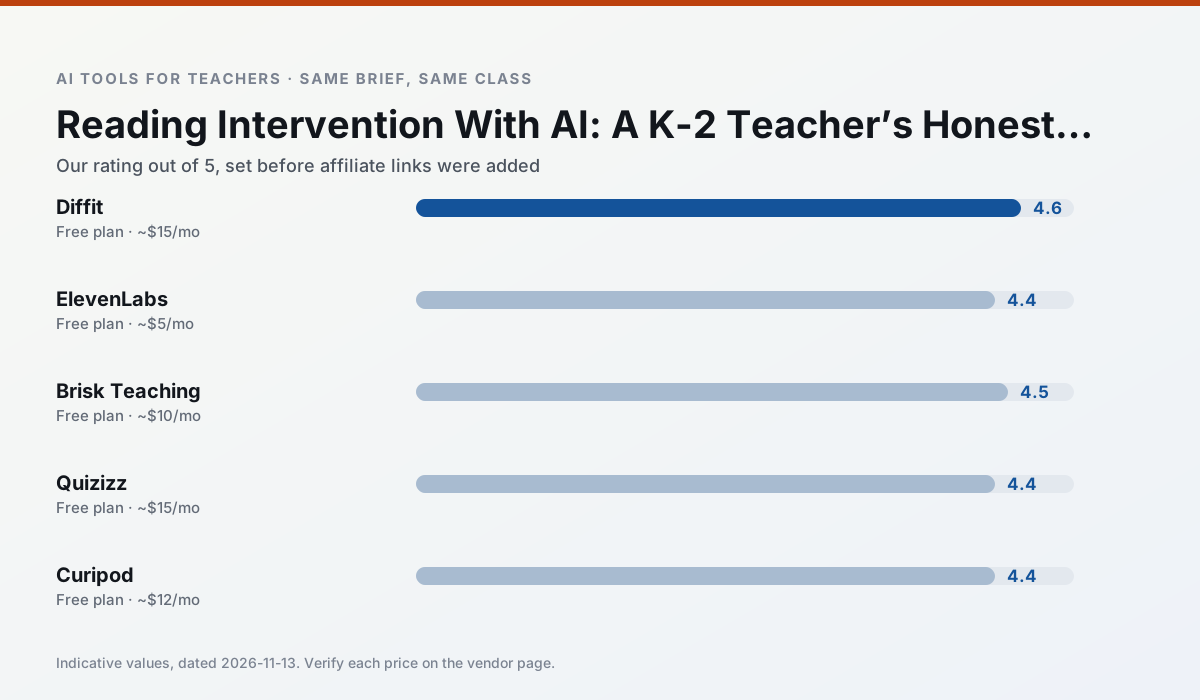
Side by side
Comparison table
Ratings reflect our timed classroom workflow, not vendor claims. Prices are indicative — verify on the vendor site.
| Tool | Best for | Free tier | Indicative paid plan | Standout feature | Our rating | Verdict | Try the tool |
|---|---|---|---|---|---|---|---|
| Diffit | differentiated instruction · reading intervention | Yes — Limited generations per month | ~$15 /user/mo | Lexile-style leveling | 4.6 / 5 | Top pick | Try free |
| ElevenLabs | accessibility · reading intervention | Yes — Monthly character quota | ~$5 /user/mo | Very natural voices | 4.4 / 5 | Strong option | Try free |
| Brisk Teaching | feedback on writing · grading | Yes — Limited actions per month | ~$10 /user/mo | Works inside Google Docs | 4.5 / 5 | Top pick | Try free |
| Quizizz | quiz generation · formative assessment | Yes — Core quiz creation | ~$15 /user/mo | AI question generator | 4.4 / 5 | Strong option | Try free |
| Curipod | formative assessment · exit tickets | Yes — Limited lessons per month | ~$12 /user/mo | Live polls and word clouds | 4.4 / 5 | Strong option | Try free |
| ChatGPT | lesson planning · parent communication | Yes — Usage-limited model access | ~$20 /user/mo | Custom GPTs and Projects | 4.5 / 5 | Top pick | Try free |
Match your situation
Best for X
Different jobs need different tools. Here is what we would open first in each case.
Diffit wins on the default path: fewer clicks to a usable draft, and the interface does not get in the way at 7:40am.
If there is no budget, start with ElevenLabs: free plan with clearest quota is the least punishing free tier here.
Brisk Teaching is the option IT is least likely to block: single sign-on, admin removal of AI features and an agreement on file.
Quizizz runs in a browser tab with no extension, no student accounts and no onboarding call, so you can test it in a free period.
Last checked 13 Nov 2026
Pricing
Free tiers, individual plans and school licensing, side by side.
| Tool | Free plan | Individual / paid | School & district | Billing note | Verify |
|---|---|---|---|---|---|
| Diffit | $0 — Limited generations per month | ~$15 /user/mo | Custom quote | Indicative — verify on vendor site | Vendor |
| ElevenLabs | $0 — Monthly character quota | ~$5 /user/mo | ~$22 /user/mo | Indicative — verify on vendor site | Vendor |
| Brisk Teaching | $0 — Limited actions per month | ~$10 /user/mo | Custom quote | Indicative — verify on vendor site | Vendor |
| Quizizz | $0 — Core quiz creation | ~$15 /user/mo | Custom quote | Indicative — verify on vendor site | Vendor |
| Curipod | $0 — Limited lessons per month | ~$12 /user/mo | Custom quote | Indicative — verify on vendor site | Vendor |
| ChatGPT | $0 — Usage-limited model access | ~$20 /user/mo | ~$25+ /user/mo | Indicative — verify on vendor site | Vendor |
Editorial rule: pricing is re-checked every 2–3 months and the top 50 pages are refreshed every 6 months. See our funding policy.
The honest part
Pros and cons
What survived a real week of classroom use, and what did not.
Pros
- Excellent for mixed-ability classes
- Produces printable and digital versions
- Minimal setup
Cons
- Narrower scope than all-in-one suites
- Leveling is approximate, not a formal assessment
- Heavy use burns through the free quota
Pros
- Excellent for accessible audio versions
- Low entry price
- Fast generation
Cons
- Quota-based billing
- Voice cloning consent considerations
- Not a teaching platform
Pros
- No copy-paste between tools
- Fast inline feedback on student drafts
- Gentle learning curve
Cons
- Chrome-first workflow
- Extension permissions need IT approval
- Free quota is tight
Pros
- Students already know the interface
- Good reporting
- Works on low-end devices
Cons
- Writing high-quality AI questions still needs review
- Gamification can distract
- Advanced analytics are paid
Pros
- High student engagement out of the box
- Great for quick checks for understanding
- No student accounts required for basic use
Cons
- Focused on delivery, not planning
- Requires reliable classroom devices
- Free tier is restrictive
In the classroom
Use cases
Five concrete workflows, with the tool we would open for each one.
A weekly family newsletter from bullet notes
Newsletters fail on length, not tone. Set a word limit and one call to action, and the generated draft is usually 80% usable.
Recommended: DiffitRegrouping students after an assessment
Summarise anonymised results into skill groups, then generate one activity per group. Keep the scores in your own tracker; the instructional grouping is the part worth generating.
Recommended: ElevenLabsA Monday morning lesson plan in twelve minutes
The twelve minutes come from not rewriting the skeleton. Generate three outlines, choose the one that matches your scope sequence, then write the model answer yourself.
Recommended: Brisk TeachingThree reading levels from one source text
Paste a vetted text, ask for supported, core and extension versions, then check the vocabulary list by hand. Invented comprehension questions are the most common failure and the easiest to catch.
Recommended: QuizizzRubric and feedback comments in one pass
Reorder the workflow so the rubric is yours and the comments are generated. Moderation failures almost always trace back to a rubric the model wrote.
Recommended: Curipod
Questions teachers ask us
FAQ
Direct answers, also published as FAQPage structured data for search and AI assistants.
Can AI do reading intervention at K-2 level?
Which tool is best for reading intervention?
What is the biggest risk?
Sources & further reading
Our recommendation
Try ElevenLabs free for your next reading intervention task
Natural-sounding AI voiceover and text-to-speech for learning materials. Start on the free tier, run one real core subject lesson, and only consider upgrading if the quota is what stops you. Disclosure: we may earn a commission (22% recurring) at no extra cost to you.
Some links on this page are affiliate links. We may earn a commission at no extra cost to you. Our rankings are editorial and never pay-to-play. Never enter student PII into a free consumer account.
Keep reading
Related comparisons in this cluster.
Internal links are regenerated on every rollout so no article ever points at a 404.