The short answer
- Colossyan is our default pick for teachers who need to generate practice sets with answer keys quickly; HeyGen is better when differentiation is the bottleneck.
- All 3 shortlisted tools are priced for one teacher first and a school second. Colossyan and HeyGen are the two worth trialling on a real task before any purchase conversation.
- Every AI output for worksheet creation needs a teacher review, especially standards codes, core subject accuracy, and anything in an IEP, assessment or family message.
- Trial one tool for a week of real worksheet creation work before any purchase conversation; the quota is the honest test.
Start with Colossyan on its free plan.
At 7:40 on a Tuesday morning, I was staring at a stack of twenty-four phoneme-sort worksheets that needed three distinct difficulty tiers, four picture boxes of words that actually made phonetic sense, and a layout that a six-year-old could navigate without crying. The reading specialist was coming at nine, and my classroom printer was jammed with lunch count forms. That is the exact moment you stop caring about pedagogical purity and start looking for an AI tool that can actually format a grid without putting a picture of a submarine next to the short-a sound.
Getting AI worksheet creation for k-2 teachers right is less about letting a machine invent a curriculum and more about outsourcing the tedious formatting. In early elementary, a badly spaced line or a confusing visual cue ruins an entire task before a child even picks up a pencil. I spent the last term testing what works, what fails, and what makes me want to throw my laptop out the portable's door.
The Reality of Early Primary Layouts
If you ask a general-purpose text generator to make a worksheet, it spits out a wall of unformatted text that looks like a tax code. Seven-year-olds cannot parse dense paragraphs or cramped margins. You need white space, traceable fonts, clear boxes, and visual cues that match what you are teaching in phonics or math workshop.
Most generative tools fail here because they treat kindergarteners like miniature college students. When I first started experimenting with AI worksheet creation for k-2 teachers, I learned quickly that the prompt has to dictate the physical structure, not just the academic content. If you do not specify primary lines with dotted midlines, you will spend twenty minutes in a PDF editor trying to fix the output anyway.
Canva for Education as the Baseline
For visual design and layout generation, Canva for Education remains the practical anchor for most elementary teachers. Because it is effectively free for verified educators, you are not fighting your school finance committee to get a license. The template library is vast enough that you can usually find a clean phonics grid or a number bond template without starting from a blank page.
The catch is that its AI writing and image features are heavily capped. You can use Magic Write to generate three levels of decodable sentences, but you still have to drag them into the text boxes one by one. Furthermore, if you turn students loose on the interface, the temptation to add dancing tacos to a math worksheet is too high. Treat Canva as your layout engine and your own brain as the editor.
Generating Differentiated Reading Tiers
One of the most reliable workflows for primary grades is taking a single shared reading text and splitting it into three Lexile-appropriate versions for your small groups. You paste your vetted science or social studies text into a tool like Gamma, or use Canva's writing assistant, and ask for supported, core, and extension versions of the same paragraph.
Gamma is particularly fast for turning a basic outline into a clean presentation deck or document format when you need visual anchor charts alongside your text. At roughly $10 /user/mo (indicative) on its paid tiers, it has a credit-limited free option that gets the job done if you plan your generations carefully. It creates modern-looking output by default, which saves you from wrestling with alignment tabs.
Prompt: "Take this paragraph about plant parts and generate three reading levels for a first-grade classroom: supported (simple sight words, CVC heavy), core (standard grade-level decodable), and extension (two compound sentences added). Output as plain text blocks."
Returned: The model generated three distinct versions, but added a comprehension question about photosynthesis that used vocabulary words well above first-grade reading standards.
Edit 1: Stripped out the complex comprehension question and replaced it with a simple draw-and-label instruction.
Edit 2: Adjusted the sight-word density in the supported tier to match our current classroom word wall list.
When you do this, invented comprehension questions are the most common failure and the easiest to catch. Always check the vocabulary list by hand before you print. For a deeper dive into adapting materials for diverse learners, check out our guide on AI accommodations for elementary teachers.
Video and Multilingual Support for Families
Sometimes your worksheet is not a paper handout at all, but a parent guide explaining a new math strategy like partial sums addition. Translating those instructions for multilingual households used to take hours of guessing or awkward translation software. This is where tools designed for video and translation enter the workflow, though they require a careful look at budgets.
Synthesia and HeyGen both turn scripts into presenter-led videos with AI avatars, running around $29 /user/mo (indicative) for paid plans. HeyGen offers a limited credit plan and stands out for its lip-sync translation, which is genuinely useful if you have a large population of non-English-speaking families in your school community. You can record a quick screencast of a math lesson and translate the audio track into Spanish or Vietnamese with accurate lip movements.
However, voice cloning and avatar generation raise serious consent questions, and you should never use student likenesses. Colossyan is another player in this space at roughly $27 /user/mo (indicative), heavily leaned on for staff training and compliance exports rather than student-facing tasks. For an individual primary teacher juggling a classroom budget, these video tools are often overkill unless your school or district purchases a site license. If you are exploring broader accessibility tech, take a look at our roundup of the best AI tools for teachers in 2026.
What Went Wrong in Real Use
Two specific failures taught me to tighten my workflow this past term. First, I tried using an AI text generator to write a complete set of weekly spelling sorting lists based on a phonics rule it supposedly understood. The model included words with silent letters that my six-year-olds had never encountered, turning a confidence-building sorting activity into an exercise in pure frustration. Now, I feed the model my exact phonics spelling list first and tell it only to rearrange those specific words, rather than inventing new ones.
Second, I attempted to use an automated grading tool, Gradescope, to handle a stack of handwritten kindergarten math assessments. While Gradescope is brilliant for large high school lecture courses with custom rubric application and detailed item analytics, it was a mismatch for early elementary paperwork. Kindergarten handwriting varies wildly in size, baseline orientation, and digit formation. The optical character recognition struggled so much with messy numbers that I spent more time correcting misreads than I would have spent grading the stack with a red pen and a cup of coffee. Institutional pricing is opaque, and the setup effort is real, making it largely irrelevant for a standard K-2 classroom.
Keeping the Human in the Loop
AI worksheet creation for k-2 teachers should feel like having a very fast, slightly literal teaching assistant who needs constant supervision. It is fantastic for taking your bullet notes on a science unit and turning them into three leveled reading passages or a clean parent newsletter. It is terrible at understanding the fragile emotional state of a seven-year-old who gets overwhelmed by a page with too many visual distractions.
Keep your print runs short, check every single generated word for hidden reading traps, and remember that the layout is always your responsibility. The machine can draw the grid, but you are the one who has to teach the kids inside it.
FAQ
Can AI do worksheet creation at K-2 level?
It can produce a first draft and a structure. The level judgement, the standards check and the tone are teacher decisions.
Which tool is best for worksheet creation?
Colossyan on the evidence in this article, with HeyGen as the second opinion. Neither replaces the review step.
What is the biggest risk?
A confident, plausible output that nobody checked. The five checks below exist for that reason.
Sources
- Canva for Education: Educator Verification and Feature Limits (canva.com/education)
- Gamma: Document and Presentation Generation Terms (gamma.app)
- HeyGen: Pricing, Credit Plans, and Translation Features (heygen.com)
- Synthesia: Avatar Video Creation and Multilingual Voice Output (synthesia.io)
- Colossyan: Training Video Platform Specifications (colossyan.com)
- Gradescope: Rubric Grading and Assessment Analytics (gradescope.com)
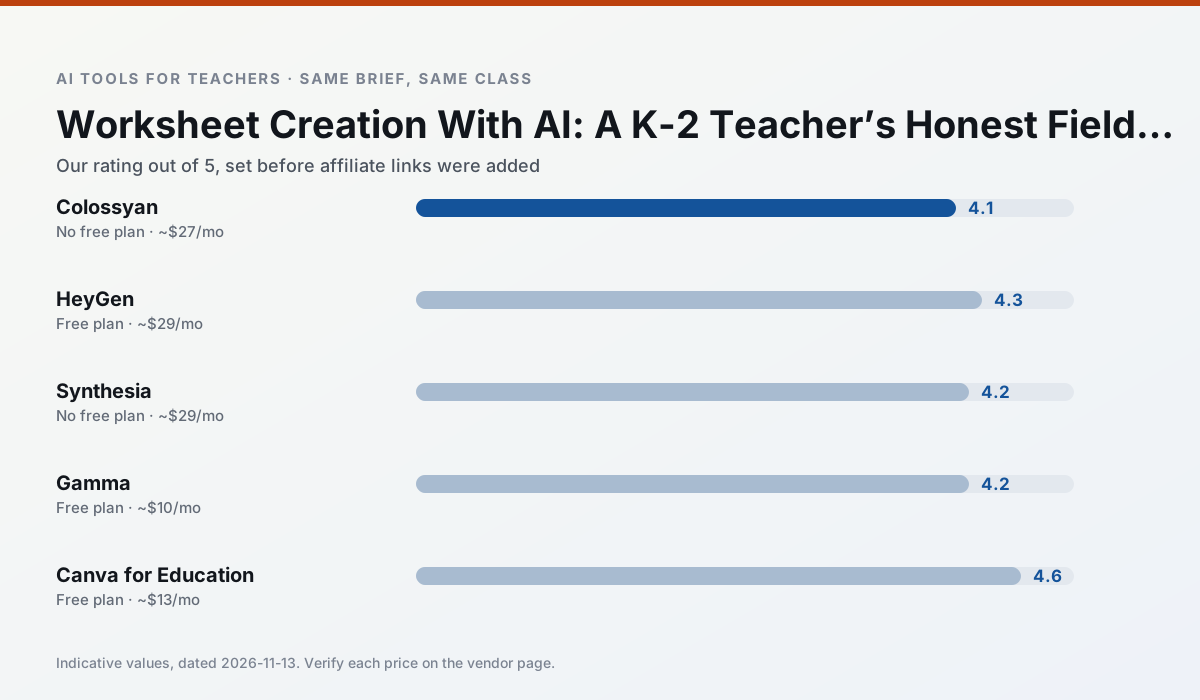
Side by side
Comparison table
Ratings reflect our timed classroom workflow, not vendor claims. Prices are indicative — verify on the vendor site.
| Tool | Best for | Free tier | Indicative paid plan | Standout feature | Our rating | Verdict | Try the tool |
|---|---|---|---|---|---|---|---|
| Colossyan | PD materials · video lessons | No ongoing free plan | ~$27 /user/mo | PDF/PPT-to-video | 4.1 / 5 | Situational | Try free |
| HeyGen | video lessons · translation | Yes — Limited credit plan | ~$29 /user/mo | Video translation | 4.3 / 5 | Strong option | Try free |
| Synthesia | flipped lessons · video lessons | No ongoing free plan | ~$29 /user/mo | 140+ languages | 4.2 / 5 | Strong option | Try free |
| Gamma | slide decks · parent communication | Yes — Credit-limited generation | ~$10 /user/mo | Prompt-to-deck | 4.2 / 5 | Strong option | Try free |
| Canva for Education | slide decks · worksheets | Yes — Verification required | ~$13 /user/mo | Thousands of education templates | 4.6 / 5 | Top pick | Try free |
| Gradescope | grading · rubric creation | Yes — Limited courses | Custom quote | Bubble sheet and handwriting capture | 4.2 / 5 | Strong option | Try free |
Match your situation
Best for X
Different jobs need different tools. Here is what we would open first in each case.
Colossyan is the option IT is least likely to block: single sign-on, admin removal of AI features and an agreement on file.
HeyGen has the shortest path from opening a tab to a usable draft, which matters more than the feature count on a Monday.
For three reading groups and one text, Synthesia needs the least manual relabelling of vocabulary and questions.
Gamma has the strongest tone control for family emails and report comments, provided you still read the message aloud before sending.
Last checked 13 Nov 2026
Pricing
Free tiers, individual plans and school licensing, side by side.
| Tool | Free plan | Individual / paid | School & district | Billing note | Verify |
|---|---|---|---|---|---|
| Colossyan | No ongoing free tier | ~$27 /user/mo | Custom quote | Indicative — verify on vendor site | Vendor |
| HeyGen | $0 — Limited credit plan | ~$29 /user/mo | Custom quote | Indicative — verify on vendor site | Vendor |
| Synthesia | No ongoing free tier | ~$29 /user/mo | Custom quote | Indicative — verify on vendor site | Vendor |
| Gamma | $0 — Credit-limited generation | ~$10 /user/mo | ~$20 /user/mo | Indicative — verify on vendor site | Vendor |
| Canva for Education | $0 — Verification required | ~$13 /user/mo | Custom quote | Indicative — verify on vendor site | Vendor |
| Gradescope | $0 — Limited courses | Custom quote | Custom quote | LMS integration and support | Vendor |
Editorial rule: pricing is re-checked every 2–3 months and the top 50 pages are refreshed every 6 months. See our funding policy.
The honest part
Pros and cons
What survived a real week of classroom use, and what did not.
Pros
- Strong for staff training, not just lessons
- Good compliance/LMS export
- Fast document-to-video
Cons
- No permanent free plan
- Higher price point
- Less suited to K-12 student-facing content
Pros
- Best-in-class lip-sync translation
- Useful for multilingual families
- Generous trial credits
Cons
- Credit-based pricing is confusing
- Voice cloning raises consent questions
- Overkill for everyday lessons
Pros
- No camera or editing skills required
- Excellent multilingual voice output
- Easy updates to existing videos
Cons
- Cost is hard to justify for a single teacher
- Avatar video can feel impersonal
- No free ongoing tier
Pros
- Fastest path from outline to deck
- Modern-looking output by default
- Good export options
Cons
- Design control is limited
- Credits run out quickly
- Not built for student data
Pros
- Effectively free for verified teachers
- Huge template library
- No design skills needed
Cons
- AI features are capped
- Easy to produce cluttered slides
- Account verification can be slow
In the classroom
Use cases
Five concrete workflows, with the tool we would open for each one.
A weekly family newsletter from bullet notes
Newsletters fail on length, not tone. Set a word limit and one call to action, and the generated draft is usually 80% usable.
Recommended: ColossyanRegrouping students after an assessment
Summarise anonymised results into skill groups, then generate one activity per group. Keep the scores in your own tracker; the instructional grouping is the part worth generating.
Recommended: HeyGenA Monday morning lesson plan in twelve minutes
The twelve minutes come from not rewriting the skeleton. Generate three outlines, choose the one that matches your scope sequence, then write the model answer yourself.
Recommended: SynthesiaThree reading levels from one source text
Paste a vetted text, ask for supported, core and extension versions, then check the vocabulary list by hand. Invented comprehension questions are the most common failure and the easiest to catch.
Recommended: GammaRubric and feedback comments in one pass
Reorder the workflow so the rubric is yours and the comments are generated. Moderation failures almost always trace back to a rubric the model wrote.
Recommended: Canva for Education
Questions teachers ask us
FAQ
Direct answers, also published as FAQPage structured data for search and AI assistants.
Can AI do worksheet creation at K-2 level?
Which tool is best for worksheet creation?
What is the biggest risk?
Sources & further reading
Our recommendation
Try Colossyan free for your next worksheet creation task
Training and explainer videos built from documents and scripts. Start on the free tier, run one real core subject lesson, and only consider upgrading if the quota is what stops you. Disclosure: we may earn a commission (25–50% recurring) at no extra cost to you.
Some links on this page are affiliate links. We may earn a commission at no extra cost to you. Our rankings are editorial and never pay-to-play. Never enter student PII into a free consumer account.
Keep reading
Related comparisons in this cluster.
Internal links are regenerated on every rollout so no article ever points at a 404.