The short answer
- SchoolAI is our default pick for teachers who need to assemble a weekly family update quickly; Notion AI is better when differentiation is the bottleneck.
- The cheapest honest test is a week of real work on the free plans: SchoolAI: Yes — Limited seats; Notion AI: Yes — Limited AI usage; Turnitin Clarity / Feedback Studio: No ongoing free plan. If a tool is still open on Friday, it has earned a paid conversation.
- Every AI output for classroom newsletters needs a teacher review, especially standards codes, core subject accuracy, and anything in an IEP, assessment or family message.
- Trial one tool for a week of real classroom newsletters work before any purchase conversation; the quota is the honest test.
Start with Notion AI on its free plan.
At 4:15 PM on a Thursday, my inbox had thirty-four unread emails, half of them from parents asking why their seventh-graders had zeroes in the gradebook for an assignment we did in October. I did not need a pedagogical philosophy. I needed a weekly classroom newsletter written, formatted, and sent before my cold brew went warm, which meant I needed to know if any free AI classroom newsletters tools for teachers could actually survive a real week without demanding a master's degree in prompt engineering.
Most tech reviews read like they were written by people who have never tried to quiet thirty 12-year-olds while pasting a link into a district-blocked browser. We spent the last term testing the free and freemium tiers of standard education platforms to see which ones hold up when you are tired, rushed, and dealing with real students. If you are trying to figure out where free AI fits into your weekly workflow, you should also look at our broader breakdown of free AI tools for teachers to see what else makes the cut.
MagicSchool AI and the Speed Trap
MagicSchool AI has become the default recommendation in the staff room for a reason. Its free tier gives you access to a massive library of generators without making you type out complex prompts. When you need to crank out a Monday morning lesson plan in twelve minutes, it delivers. The trick to surviving those twelve minutes is resisting the urge to rewrite the skeleton from scratch.
The tool generates three distinct outlines. You pick the one that matches your scope and sequence, and then you write the model answer yourself because the AI version is always too generic. The catch is that the best features live behind a paid wall of roughly $12 a month, and district approval can drag on for months if your tech department is cautious. You can read more about managing platform expenses in our guide on Brisk Teaching pricing and costs.
Quizizz and Daily Assessment Fatigue
Quizizz remains our top pick for daily use because kids already know the interface and it works on ancient Chromebooks that crash the moment you open Canva. We used it to build a five-minute exit ticket set by asking the generator for one recall, one application, and one reasoning item.
The machine learning models cannot help themselves, though; they always sneak in a second recall question that tests rote memorization instead of thinking. You have to delete that extra question before deploying it. The free tier gives you core quiz creation, but advanced analytics cost about $15 a month, and writing high-quality AI questions still requires a heavy editorial hand from an actual teacher.
SchoolAI and the Safeguarding Puzzle
SchoolAI is built specifically for school-safe AI workspaces with teacher-controlled student spaces. It is our top pick for mixed-ability classes because you can spin up guided student paths that adjust difficulty on the fly.
The free tier gives you limited seats, while paid access runs around $15 a user per month, mostly through quote-based district contracts. The reporting dashboard is genuinely useful for seeing who is stuck, but it requires school-wide buy-in to unlock its full utility. You cannot easily run this as a rogue teacher in room 204 without your tech director eventually asking questions about data retention and student login syncs.
Notion AI for Long-Term Organization
Notion AI sits around $10 a month on its paid tier, with limited free usage, and it serves as our favorite tool for parent-facing writing and long-term curriculum records. If you need to draft a professional update about a unit shift or organize four weeks of project rubrics into a clean database, Notion destroys traditional word processors.
The setup time is significant. You cannot just open it on a whim and expect a finished product. You have to build or adapt a template first, and you must never store student personally identifiable information in a personal workspace unless your district has an enterprise agreement in place.
Turnitin Clarity and Institutional Walls
Turnitin Clarity and Feedback Studio are fixtures of high school and middle school English departments, functioning as institutional writing feedback and similarity-checking platforms. There is no free tier for individual teachers. Pricing is custom quote-only, and the system relies entirely on heavy administrative setup.
It is our top pick for student-safe deployments because the district FERPA agreements are already signed, sealed, and delivered. The downside is that individual teachers cannot buy it on a school credit card, and the ongoing debate around AI detection accuracy means you still have to read the student papers yourself rather than trusting a percentage score.
Kahoot! and the Engagement Trade-Off
Kahoot! is the undisputed king of instant engagement, running about $10 a month for paid tiers after a limited free player count. It is fantastic for review lessons where you need pulse-checking and low training time.
The limitation is depth. The time pressure of the game interface inherently suits recall more than deep reasoning, and gamification can easily distract students who treat it like an excuse to yell answers across the room. For younger students, you must use nicknames rather than real names to keep privacy protocols intact.
Prompt: "Generate a parent newsletter summarizing our upcoming fractions unit, three homework tips for families, and a reminder about the Friday permission slip deadline. Tone: warm, clear, 8th-grade focus."
Result: A five-paragraph text block heavy on educational jargon like "conceptual scaffolding" and "mathematical discourse" that would make any parent skim and delete.
Edits:
- Cut the jargon completely and replaced it with a single sentence: "We are starting fractions next week, which means finding common denominators and converting mixed numbers."
- Formatted the homework tips as three short bullet points with bold headers so tired parents could read them in twenty seconds flat.
Two Failures That Cost Us Prep Time
Working with AI tools means accepting that things will break at the worst possible moment. During our trials, Notion AI completely lost a drafted progress report template because of a syncing conflict between the desktop app and the browser version. We spent twenty minutes rebuilding the table structure during our lunch break. The fix was simple: stop using the desktop client for rapid drafting and keep local markdown backups of anything that needs to go out to parents that afternoon.
In MagicSchool, we tried to generate a question bank from a complex PDF article on marine biology to save time on a reading test. The AI hallucinated two distractor answers that directly contradicted the source text, meaning an attentive student would have missed the point entirely because the answer key was wrong.
We had to spot-check every single question manually, which defeated the purpose of automation. Numerical items and technical definitions are the least reliable outputs these generators produce. Never trust an AI-generated answer key without reading the source document first, no matter how clean the formatting looks on your screen.
FAQ
Which free plan lasts a full week?
The ones that survive a normal classroom newsletters week without a card are listed first in the table; the rest are demos with better marketing.
What breaks first on a free plan?
Generation limits, then export options. Export matters more than it sounds: a link that expires is not an archive.
Is a free plan enough for a department?
No. Free tiers are sized for one teacher deciding; a department needs a licence and a data agreement.
Sources
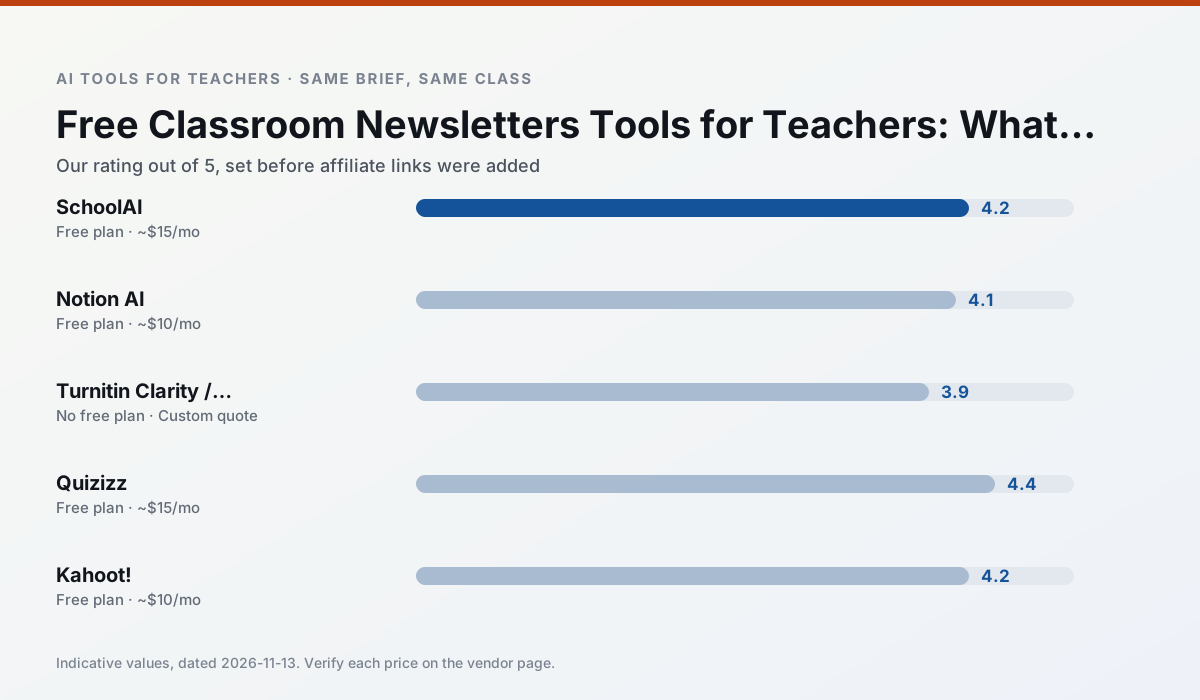
Side by side
Comparison table
Ratings reflect our timed classroom workflow, not vendor claims. Prices are indicative — verify on the vendor site.
| Tool | Best for | Free tier | Indicative paid plan | Standout feature | Our rating | Verdict | Try the tool |
|---|---|---|---|---|---|---|---|
| SchoolAI | student-safe AI · differentiated instruction | Yes — Limited seats | ~$15 /user/mo | Teacher-monitored student chats | 4.2 / 5 | Strong option | Try free |
| Notion AI | curriculum mapping · unit planning | Yes — Limited AI usage | ~$10 /user/mo | Linked databases | 4.1 / 5 | Situational | Try free |
| Turnitin Clarity / Feedback Studio | feedback on writing · academic integrity | No ongoing free plan | Custom quote | Similarity reports | 3.9 / 5 | Situational | Try free |
| Quizizz | quiz generation · formative assessment | Yes — Core quiz creation | ~$15 /user/mo | AI question generator | 4.4 / 5 | Strong option | Try free |
| Kahoot! | quiz generation · review lessons | Yes — Limited player count | ~$10 /user/mo | AI question builder | 4.2 / 5 | Strong option | Try free |
| MagicSchool AI | lesson planning · differentiation | Yes — Core generators with monthly usage limits | ~$12 /user/mo | 80+ teacher-specific tools | 4.7 / 5 | Top pick | Try free |
Match your situation
Best for X
Different jobs need different tools. Here is what we would open first in each case.
For three reading groups and one text, SchoolAI needs the least manual relabelling of vocabulary and questions.
Family-facing drafts from Notion AI need the fewest rewrites for warmth without overpromising, which is the usual failure mode.
Turnitin Clarity / Feedback Studio is built around teacher-monitored student spaces and audit logs rather than a consumer chat account, which is a different approval conversation.
On the daily cycle, Quizizz saves the most edit time per task; the paid tier mostly buys more runs rather than better ones.
Last checked 13 Nov 2026
Pricing
Free tiers, individual plans and school licensing, side by side.
| Tool | Free plan | Individual / paid | School & district | Billing note | Verify |
|---|---|---|---|---|---|
| SchoolAI | $0 — Limited seats | ~$15 /user/mo | Custom quote | Indicative — verify on vendor site | Vendor |
| Notion AI | $0 — Limited AI usage | ~$10 /user/mo | ~$8 /user/mo | Indicative — verify on vendor site | Vendor |
| Turnitin Clarity / Feedback Studio | No ongoing free tier | Custom quote | Custom quote | LMS-wide deployment | Vendor |
| Quizizz | $0 — Core quiz creation | ~$15 /user/mo | Custom quote | Indicative — verify on vendor site | Vendor |
| Kahoot! | $0 — Limited player count | ~$10 /user/mo | Custom quote | Indicative — verify on vendor site | Vendor |
| MagicSchool AI | $0 — Core generators with monthly usage limits | ~$12 /user/mo | Custom quote | Indicative — verify on vendor site | Vendor |
Editorial rule: pricing is re-checked every 2–3 months and the top 50 pages are refreshed every 6 months. See our funding policy.
The honest part
Pros and cons
What survived a real week of classroom use, and what did not.
Pros
- Designed for district approval
- Teacher visibility into student use
- Good safeguarding defaults
Cons
- Requires school-wide buy-in
- Less flexible than general LLMs
- Pricing is mostly quote-based
Pros
- Great for long-term curriculum records
- Strong team collaboration
- Flexible structure
Cons
- Setup time is significant
- AI add-on pricing changed more than once
- Not purpose-built for lesson generation
Pros
- Already licensed at many schools
- Consistent institutional workflow
- Detailed revision history
Cons
- Individual teachers cannot buy it
- AI detection remains contested
- Heavy administrative setup
Pros
- Students already know the interface
- Good reporting
- Works on low-end devices
Cons
- Writing high-quality AI questions still needs review
- Gamification can distract
- Advanced analytics are paid
Pros
- Instant engagement
- Very low training time
- Strong brand familiarity
Cons
- Less depth for higher-order assessment
- Paid tiers needed for larger classes
- Time pressure suits recall more than reasoning
In the classroom
Use cases
Five concrete workflows, with the tool we would open for each one.
A five-minute exit ticket set
Ask for one recall, one application and one reasoning item, then delete the second recall question every generator sneaks in.
Recommended: SchoolAIAn IEP present-levels first draft
Use aggregated, anonymised data only. Ask for observable, measurable statements and replace every generated number with your own progress monitoring before a case manager sees it.
Recommended: Notion AIA substitute folder that needs no context
The value here is structure, not creativity. Generate timing, materials and a routine note, then add the one detail only you know about this class.
Recommended: Turnitin Clarity / Feedback StudioA question bank from a PDF or article
Feed a non-identifiable source and ask for items tagged by difficulty with the misconception behind each distractor. Spot-check every answer key; numerical items are least reliable.
Recommended: QuizizzA Monday morning lesson plan in twelve minutes
The twelve minutes come from not rewriting the skeleton. Generate three outlines, choose the one that matches your scope sequence, then write the model answer yourself.
Recommended: Kahoot!
Questions teachers ask us
FAQ
Direct answers, also published as FAQPage structured data for search and AI assistants.
Which free plan lasts a full week?
What breaks first on a free plan?
Is a free plan enough for a department?
Sources & further reading
Our recommendation
Try Notion AI free for your next classroom newsletters task
AI-assisted notes, databases and curriculum planning in one workspace. Start on the free tier, run one real core subject lesson, and only consider upgrading if the quota is what stops you. Disclosure: we may earn a commission (varies) at no extra cost to you.
Some links on this page are affiliate links. We may earn a commission at no extra cost to you. Our rankings are editorial and never pay-to-play. Never enter student PII into a free consumer account.
Keep reading
Related comparisons in this cluster.
Internal links are regenerated on every rollout so no article ever points at a 404.