The short answer
- Claude is our default pick for teachers who need to draft a standards-aware lesson plan quickly; Kahoot! is better when differentiation is the bottleneck.
- Start with Claude on its free plan, keep Kahoot! as the second opinion, and do not open a card until the quota, not the feature list, is what stops you.
- Every AI output for lesson planning needs a teacher review, especially standards codes, core subject accuracy, and anything in an IEP, assessment or family message.
- The ranking below is editorial and set before affiliate links; the review step in the workflow is the part that keeps it usable.
Start with ElevenLabs on its free plan.
At four o'clock on a Tuesday afternoon, my desk is covered in thirty-two diagnostic essays, a cold cup of tea, and a sticky note reminding me to call a parent before five. That is when I usually open an AI tab to help clear the pile. If you are looking at claude pro for teachers for teachers to survive this kind of workload, the first thing to know is that paying for AI requires a careful look at your own wallet and your district's rules. Not every tool on the market is built for the realities of a K-12 classroom, and the price tags add up fast if you subscribe to everything.
When we talk about the best free option, Claude stands out for heavy document work. The free tier is usage-limited, but its long-context window means you can dump an entire three-week unit plan or a stack of dense reading passages into the prompt box without crashing its memory. The paid tier sits at roughly $20 per user per month, which is steep for a teacher paying out of pocket. It does not have teacher-specific templates or classroom integrations, but its prose sounds less generic than other models. Just remember that the consumer plan is not suitable for student data, so keep names and identifiers out of your prompts entirely.
Building Lessons and Managing Plans
Planning a Monday morning lesson in twelve minutes is entirely possible if you stop trying to write every slide from scratch. The secret is that the twelve minutes come from refusing to rewrite the skeleton. You generate three outlines, choose the one that actually matches your scope and sequence, and then write the model answer yourself. For quick review sessions, teachers often turn to Kahoot! or Quizizz. Kahoot! is the best overall for daily use, offering instant engagement and very low training time for about $10 per user per month on its paid tier, though the free tier limits your player count.
Quizizz takes the crown for quick setup because of its massive question bank and live games, running around $15 per user per month for the paid version while the core quiz creation remains free. Both gamified tools have limits. The time pressure in a live quiz suits recall far more than reasoning, and writing high-quality AI questions still requires a careful human review before you project it to the room. If you are trying to make sense of assessment data, you can ask Claude to help by pasting anonymised results into the prompt. Summarise the scores into skill groups and ask the assistant to generate one targeted activity per group, making sure to keep the actual grade tracker on your own secure device.
Creating Accessible Materials and Presentations
If your students struggle with reading stamina, turning text into audio changes how they access complex material. ElevenLabs is our pick for schools and districts, offering natural-sounding text-to-speech starting at roughly $5 per user per month on its paid tier, alongside a monthly character quota on the free plan. It is fantastic for creating accessible audio versions of reading materials quickly, though it is fundamentally a voice engine rather than a teaching platform. You must never clone a student or colleague's voice without written consent, and you should always check your district's digital citizenship policies before rolling out audio files.
When you need to turn an outline into a slide deck before the morning bell, Gamma is the fastest path from concept to presentation at an indicative price of $10 per user per month after its credit-limited free tier. It builds modern-looking decks instantly, but its design controls are somewhat limited, and the generation credits run out faster than you expect. Treat Gamma strictly as a content tool and do not upload student work into it. For more ideas on how different platforms handle budgets, take a look at our breakdown of brisk-teaching-pricing-teachers-cost.
Communicating with Families and Refining Tone
High-stakes parent emails can take twenty minutes of anxious editing to get the tone right. Grammarly helps cut that down by catching errors and adjusting tone, sitting at about $12 per user per month for its paid features, while the free tier handles core grammar. It works everywhere you already type, but it can flatten your natural teacher voice if you rely too heavily on its automated rewrites. To see how these options compare with other popular suites, read our guide on canva-education-pricing-teachers-cost.
Prompt: Act as an experienced middle school teacher. Draft a short, warm family newsletter based on these three bullet points: science fair projects due next Friday, permission slips for the science museum trip, and after-school tutoring on Tuesdays. Keep it under 150 words and include one clear call to action.
First output: The generated draft was polite and structured well, but used overly corporate phrases like "synergistic learning opportunities" and "kindly ensure compliance."
Edits made:
- Replaced the corporate jargon with direct, plain sentences about the project deadline and the permission slip return date.
- Added a bolded sentence at the bottom explicitly stating the single call to action: sign and return the blue museum slip by Thursday.
Newsletters almost always fail on length rather than tone, so setting a strict word limit saves everyone time. If you need to translate that same message into two languages, draft it first in plain, warm English with no student names. Translate the text, and then back-translate the most important sentences to double-check that the meaning held up in transit.
What District Leaders Should Consider
Deciding whether to pay for software out of your own pocket is a frustrating rite of passage in education. If your school has not purchased enterprise licenses, you have to weigh the monthly subscription costs against the hours of planning time you might claw back. Consumer tools like Claude Pro or Gamma are powerful, but they require strict discipline regarding data privacy. Never paste identifiable student records, IEP details, or sensitive disciplinary notes into consumer-tier AI models.
For a broader look at how classrooms are adapting to these technologies this year, explore our comprehensive guide on the best ai tools for teachers 2026. When districts invest in tools like ElevenLabs or Quizizz at an institutional level, they clear the hurdle of student data privacy compliance. Until then, free tiers and individual subscriptions demand caution, a sharp eye for generated errors, and a commitment to keeping human judgment at the center of every classroom decision.
FAQ
What does Claude cost per teacher?
The individual plan is the public number; the school plan is a quote. Both are shown with the date read, and neither is a live price.
Is there a free plan?
No ongoing free tier, only a trial. Check the free-tier column in the table for the current limits.
What does a district pay for?
Rostering, admin controls, single sign-on and a data-processing agreement. None of those can be trialled by an individual teacher.
Sources
- Anthropic. "Claude Pricing and Plan Details." Consumer and Workspace Tier Documentation, 2026.
- Kahoot! "Education Plans and Pricing for Teachers." Kahoot! Pricing Overview, 2026.
- Quizizz. "Plans for Teachers, Schools, and Districts." Quizizz Educator Hub, 2026.
- ElevenLabs. "Text to Speech Pricing and Character Quotas." ElevenLabs Plans, 2026.
- Grammarly. "Grammarly Pro and Education Features." Grammarly Plans, 2026.
- Gamma. "Gamma App Pricing and Credit Limits." Gamma Documentation, 2026.
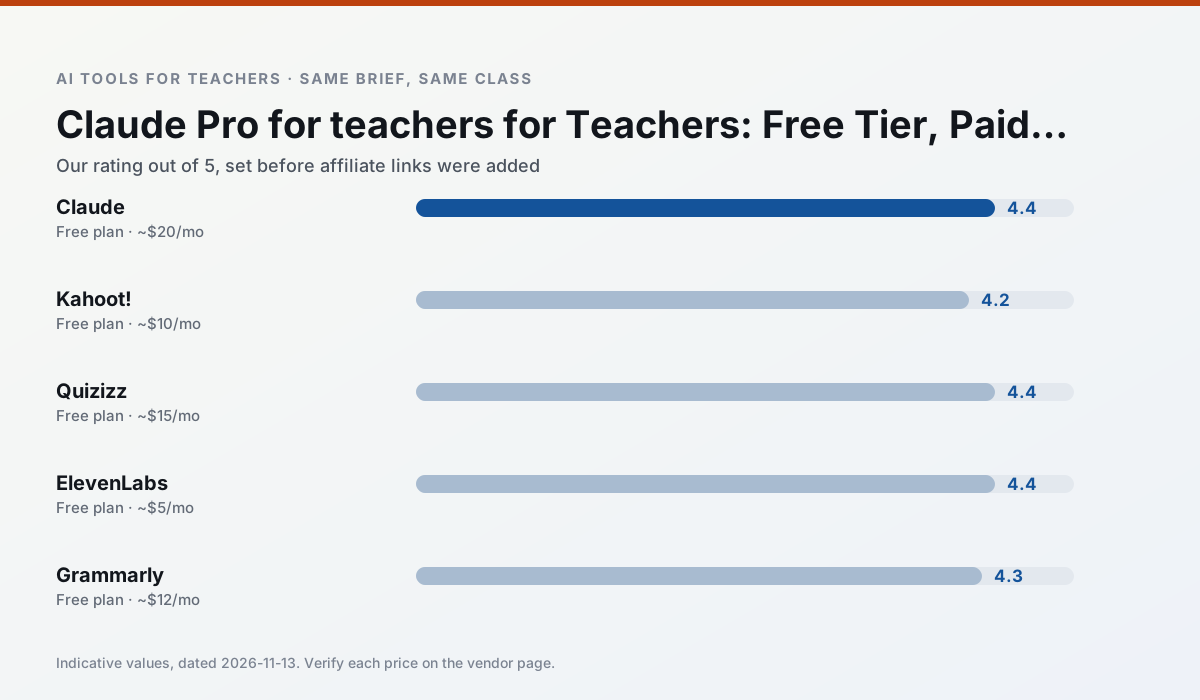
Side by side
Comparison table
Ratings reflect our timed classroom workflow, not vendor claims. Prices are indicative — verify on the vendor site.
| Tool | Best for | Free tier | Indicative paid plan | Standout feature | Our rating | Verdict | Try the tool |
|---|---|---|---|---|---|---|---|
| Claude | rubric creation · feedback on writing | Yes — Usage-limited | ~$20 /user/mo | Very large context window | 4.4 / 5 | Strong option | Try free |
| Kahoot! | quiz generation · review lessons | Yes — Limited player count | ~$10 /user/mo | AI question builder | 4.2 / 5 | Strong option | Try free |
| Quizizz | quiz generation · formative assessment | Yes — Core quiz creation | ~$15 /user/mo | AI question generator | 4.4 / 5 | Strong option | Try free |
| ElevenLabs | accessibility · reading intervention | Yes — Monthly character quota | ~$5 /user/mo | Very natural voices | 4.4 / 5 | Strong option | Try free |
| Grammarly | parent communication · report card comments | Yes — Core grammar and tone checks | ~$12 /user/mo | Tone adjustments | 4.3 / 5 | Strong option | Try free |
| Gamma | slide decks · parent communication | Yes — Credit-limited generation | ~$10 /user/mo | Prompt-to-deck | 4.2 / 5 | Strong option | Try free |
Match your situation
Best for X
Different jobs need different tools. Here is what we would open first in each case.
If there is no budget, start with Claude: free plan with clearest quota is the least punishing free tier here.
Kahoot! wins on the default path: fewer clicks to a usable draft, and the interface does not get in the way at 7:40am.
Quizizz runs in a browser tab with no extension, no student accounts and no onboarding call, so you can test it in a free period.
ElevenLabs is the option IT is least likely to block: single sign-on, admin removal of AI features and an agreement on file.
Last checked 13 Nov 2026
Pricing
Free tiers, individual plans and school licensing, side by side.
| Tool | Free plan | Individual / paid | School & district | Billing note | Verify |
|---|---|---|---|---|---|
| Claude | $0 — Usage-limited | ~$20 /user/mo | ~$25+ /user/mo | Indicative — verify on vendor site | Vendor |
| Kahoot! | $0 — Limited player count | ~$10 /user/mo | Custom quote | Indicative — verify on vendor site | Vendor |
| Quizizz | $0 — Core quiz creation | ~$15 /user/mo | Custom quote | Indicative — verify on vendor site | Vendor |
| ElevenLabs | $0 — Monthly character quota | ~$5 /user/mo | ~$22 /user/mo | Indicative — verify on vendor site | Vendor |
| Grammarly | $0 — Core grammar and tone checks | ~$12 /user/mo | ~$15 /user/mo | Indicative — billed annually | Vendor |
| Gamma | $0 — Credit-limited generation | ~$10 /user/mo | ~$20 /user/mo | Indicative — verify on vendor site | Vendor |
Editorial rule: pricing is re-checked every 2–3 months and the top 50 pages are refreshed every 6 months. See our funding policy.
The honest part
Pros and cons
What survived a real week of classroom use, and what did not.
Pros
- Handles full unit plans and long rubrics
- Nuanced, less generic prose
- Good at structured document output
Cons
- No teacher-specific templates
- Fewer classroom integrations
- Consumer plan not suitable for student data
Pros
- Instant engagement
- Very low training time
- Strong brand familiarity
Cons
- Less depth for higher-order assessment
- Paid tiers needed for larger classes
- Time pressure suits recall more than reasoning
Pros
- Students already know the interface
- Good reporting
- Works on low-end devices
Cons
- Writing high-quality AI questions still needs review
- Gamification can distract
- Advanced analytics are paid
Pros
- Excellent for accessible audio versions
- Low entry price
- Fast generation
Cons
- Quota-based billing
- Voice cloning consent considerations
- Not a teaching platform
Pros
- Catches errors in high-stakes parent emails
- Works everywhere you already write
- Very low learning curve
Cons
- Not education-specific
- Can flatten teacher voice
- Premium needed for tone rewriting
In the classroom
Use cases
Five concrete workflows, with the tool we would open for each one.
Regrouping students after an assessment
Summarise anonymised results into skill groups, then generate one activity per group. Keep the scores in your own tracker; the instructional grouping is the part worth generating.
Recommended: ClaudeA weekly family newsletter from bullet notes
Newsletters fail on length, not tone. Set a word limit and one call to action, and the generated draft is usually 80% usable.
Recommended: Kahoot!Three reading levels from one source text
Paste a vetted text, ask for supported, core and extension versions, then check the vocabulary list by hand. Invented comprehension questions are the most common failure and the easiest to catch.
Recommended: QuizizzA Monday morning lesson plan in twelve minutes
The twelve minutes come from not rewriting the skeleton. Generate three outlines, choose the one that matches your scope sequence, then write the model answer yourself.
Recommended: ElevenLabsA parent email in two languages
Draft in plain, warm language with no names, translate, then back-translate the important sentences to check meaning. Keep specific incidents out of the prompt and add them yourself.
Recommended: Grammarly
Questions teachers ask us
FAQ
Direct answers, also published as FAQPage structured data for search and AI assistants.
What does Claude cost per teacher?
Is there a free plan?
What does a district pay for?
Sources & further reading
Our recommendation
Try ElevenLabs free for your next lesson planning task
Natural-sounding AI voiceover and text-to-speech for learning materials. Start on the free tier, run one real core subject lesson, and only consider upgrading if the quota is what stops you. Disclosure: we may earn a commission (22% recurring) at no extra cost to you.
Some links on this page are affiliate links. We may earn a commission at no extra cost to you. Our rankings are editorial and never pay-to-play. Never enter student PII into a free consumer account.
Keep reading
Related comparisons in this cluster.
Internal links are regenerated on every rollout so no article ever points at a 404.