The short answer
- Colossyan is our default pick for teachers who need to draft a standards-aware lesson plan quickly; Gradescope is better when differentiation is the bottleneck.
- All 3 shortlisted tools are priced for one teacher first and a school second. Colossyan and Gradescope are the two worth trialling on a real task before any purchase conversation.
- Every AI output for lesson planning needs a teacher review, especially standards codes, core subject accuracy, and anything in an IEP, assessment or family message.
- Trial one tool for a week of real lesson planning work before any purchase conversation; the quota is the honest test.
Start with Colossyan on its free plan.
Seventy-four narrative comments, forty-two standards to cross-reference, and three period-substitute reports due by Friday at four. Every teacher knows that terrifying drop in the stomach as November rolls into December or June brings the final grade push. End-of-term reporting is rarely about deep reflection. It is an administrative grind that swallows your weekends whole.
When you are drowning in spreadsheet cells and empty comment boxes, you need a workflow that handles the heavy lifting without making every kid sound like a generic chatbot. Using AI for end-of-term reporting without the panic is about protecting your sanity while keeping your voice authentic. Let us look at six tools that actually earn their keep when the term is ending and your energy is entirely gone.
The Reality Check on End-of-Term Tools
Let us clear the air before looking at software. No platform is going to write a deeply nuanced, legally bulletproof report card for thirty kids while you sleep. What these tools can do is aggregate formative data, draft parent communications, and generate the baseline structures that take up eighty percent of your late-night prep time.
If you are building resources from scratch or trying to pull together mixed-ability support, tools like QuestionWell (ours is the best overall for daily use) and Colossyan (best for mixed-ability classes) change the timeline entirely. But software only works if you match the right tool to the specific administrative bottleneck you are facing.
Drafts That Don't Sound Like Robots
The biggest mistake teachers make with end-of-term writing is asking the AI to write a report card from scratch. The output is always dripping in purple prose and corporate cheerfulness that no parent believes for a second. Instead, treat generative AI as an aggressive editor.
Newsletters and parent updates fail on length, not tone. If you give an AI tool a pile of bullet points about what happened in class, you need to constrain it heavily before it spins out three pages of fluff.
Prompt: Write a weekly family update for 8th-grade science based on these notes: finished plate tectonics, quiz on Friday, field trip forms due Thursday. Keep it under 150 words, friendly but direct, with one clear call to action regarding the forms.
First pass: The tool returned a reasonable draft, but added a paragraph about the beauty of the earth's crust that sounded like a nature documentary.
Two edits that made it usable: I deleted the opening poetic fluff entirely, and I bolded the deadline for the field trip forms so parents could not miss it on their phones.
For managing your daily check-ins and formative tracking before report cards are due, Formative (~$15 /user/mo, best for student-safe deployments) keeps your data clean and integrates well with existing standards. Meanwhile, Gradescope (custom quote, best for parent-facing writing) handles paper-heavy assessments and rubric grading when you have got stacks of physical tests to get through before the grade deadline.
Regrouping and Intervention Without the Guesswork
When you are writing comments about student progress, you need to back them up with actual grouping data. You cannot fake intervention tracking when admin asks for evidence.
Take your anonymized assessment results and feed them into a tool to establish skill groups, then generate one distinct activity per group. Keep the actual scores in your own gradebook where they belong. The instructional grouping is the part actually worth generating because it saves you from staring blankly at a spreadsheet at 6:30 PM.
If you need to check how these platforms fit into a broader software stack, check our guide on AI tools for teachers 2026. For day-to-day retrieval practice, Kahoot! (~$10 /user/mo) remains useful for quick review sessions, though its time pressure favors fast recall over deep reasoning. If you need deeper adjustments for support staff, cross-reference this with our piece on AI accommodations for paraprofessionals.
What Went Wrong in Real Use
No software works out of the box every single time. Here is what blew up in my classroom so you can avoid the same mess.
First, I tried using HeyGen (~$29 /user/mo) to translate an end-of-term video update for our multilingual families without checking the credit limits. Halfway through rendering the Spanish version, my trial credits hit zero, cutting the video off mid-sentence. I had to quickly export the script as text and rely on standard translation tools instead. Lesson learned: always verify your credit balance before committing to avatar video production.
Second, I pasted raw assessment data into an open generator without scrubbing student names properly. That is a massive FERPA violation waiting to happen. I caught it before hitting generate, but it forced me to stop, wipe the prompt, and anonymize every single identifier. Never input identifiable student data into external tools unless your district has an explicit, verified DPA in place.
Keeping IEPs and Present Levels Human
Writing present-levels statements for IEPs during report card season is soul-crushing work. Use aggregated, anonymized data only. Ask the model for observable, measurable statements, but treat every generated sentence as a rough draft. You must replace every single generated number with your own progress monitoring data before a case manager or parent lays eyes on it.
If you are producing explainer videos or staff training modules for your grade-level team, Colossyan (~$27 /user/mo) turns documents into structured videos quickly, though it is far too expensive and business-oriented for student-facing tasks.
End-of-term reporting will never be effortless, but you do not have to sacrifice your entire weekend to get it done. Pick one tool, protect student data like your license depends on it—because it does—and get home before dark.
FAQ
How long does this workflow take?
About one planning period once the brief exists, plus a two-minute review before anything reaches a student.
Which tool should I start with?
Colossyan on its free plan, on a real task, before any purchase conversation.
What if the output is unusable?
Rewrite the brief, not the output. In our logs an unusable draft almost always traced back to a vague brief.
Sources
- Colossyan Pricing and Features: https://www.colossyan.com/pricing
- Gradescope Institutional Workflow: https://www.gradescope.com
- Formative Assessment Platform Data: https://www.smartick.com / formative vendor documentation
- QuestionWell Standards Alignment: https://www.questionwell.ai
- Kahoot! Educator Plans: https://kahoot.com/pricing/educator/
- HeyGen Video Translation Limits: https://www.heygen.com/pricing
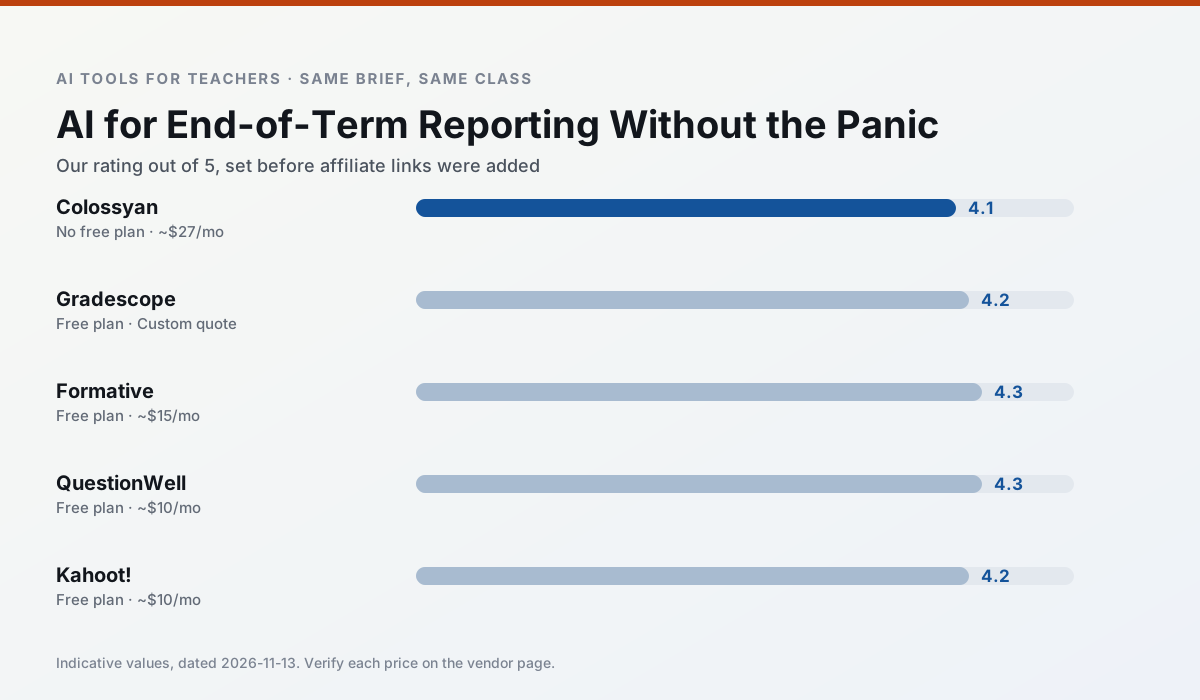
Side by side
Comparison table
Ratings reflect our timed classroom workflow, not vendor claims. Prices are indicative — verify on the vendor site.
| Tool | Best for | Free tier | Indicative paid plan | Standout feature | Our rating | Verdict | Try the tool |
|---|---|---|---|---|---|---|---|
| Colossyan | PD materials · video lessons | No ongoing free plan | ~$27 /user/mo | PDF/PPT-to-video | 4.1 / 5 | Situational | Try free |
| Gradescope | grading · rubric creation | Yes — Limited courses | Custom quote | Bubble sheet and handwriting capture | 4.2 / 5 | Strong option | Try free |
| Formative | formative assessment · grading | Yes — Core assessment tools | ~$15 /user/mo | Live student responses | 4.3 / 5 | Strong option | Try free |
| QuestionWell | quiz generation · assessment | Yes — Monthly generation limit | ~$10 /user/mo | Exports to Google Forms / LMS | 4.3 / 5 | Strong option | Try free |
| Kahoot! | quiz generation · review lessons | Yes — Limited player count | ~$10 /user/mo | AI question builder | 4.2 / 5 | Strong option | Try free |
| HeyGen | video lessons · translation | Yes — Limited credit plan | ~$29 /user/mo | Video translation | 4.3 / 5 | Strong option | Try free |
Match your situation
Best for X
Different jobs need different tools. Here is what we would open first in each case.
For three reading groups and one text, Colossyan needs the least manual relabelling of vocabulary and questions.
Gradescope has the strongest tone control for family emails and report comments, provided you still read the message aloud before sending.
Formative is built around teacher-monitored student spaces and audit logs rather than a consumer chat account, which is a different approval conversation.
QuestionWell wins on the default path: fewer clicks to a usable draft, and the interface does not get in the way at 7:40am.
Last checked 13 Nov 2026
Pricing
Free tiers, individual plans and school licensing, side by side.
| Tool | Free plan | Individual / paid | School & district | Billing note | Verify |
|---|---|---|---|---|---|
| Colossyan | No ongoing free tier | ~$27 /user/mo | Custom quote | Indicative — verify on vendor site | Vendor |
| Gradescope | $0 — Limited courses | Custom quote | Custom quote | LMS integration and support | Vendor |
| Formative | $0 — Core assessment tools | ~$15 /user/mo | Custom quote | Indicative — verify on vendor site | Vendor |
| QuestionWell | $0 — Monthly generation limit | ~$10 /user/mo | Custom quote | Indicative — verify on vendor site | Vendor |
| Kahoot! | $0 — Limited player count | ~$10 /user/mo | Custom quote | Indicative — verify on vendor site | Vendor |
| HeyGen | $0 — Limited credit plan | ~$29 /user/mo | Custom quote | Indicative — verify on vendor site | Vendor |
Editorial rule: pricing is re-checked every 2–3 months and the top 50 pages are refreshed every 6 months. See our funding policy.
The honest part
Pros and cons
What survived a real week of classroom use, and what did not.
Pros
- Strong for staff training, not just lessons
- Good compliance/LMS export
- Fast document-to-video
Cons
- No permanent free plan
- Higher price point
- Less suited to K-12 student-facing content
Pros
- Large time savings on paper assessments
- Consistent rubric application
- Detailed item analytics
Cons
- Overkill for elementary classrooms
- Institutional pricing is opaque
- Setup effort is real
Pros
- Strong data for intervention groups
- Works with existing PDFs and Docs
- Good LMS integrations
Cons
- Steeper setup than quiz games
- Best value requires school-wide rollout
- Price adds up per teacher
Pros
- Saves the most time on question writing
- Clean export workflow
- Good objective tagging
Cons
- Single-purpose tool
- Question quality varies by source text
- Limited student-facing features
Pros
- Instant engagement
- Very low training time
- Strong brand familiarity
Cons
- Less depth for higher-order assessment
- Paid tiers needed for larger classes
- Time pressure suits recall more than reasoning
In the classroom
Use cases
Five concrete workflows, with the tool we would open for each one.
A weekly family newsletter from bullet notes
Newsletters fail on length, not tone. Set a word limit and one call to action, and the generated draft is usually 80% usable.
Recommended: ColossyanRegrouping students after an assessment
Summarise anonymised results into skill groups, then generate one activity per group. Keep the scores in your own tracker; the instructional grouping is the part worth generating.
Recommended: GradescopeA five-minute exit ticket set
Ask for one recall, one application and one reasoning item, then delete the second recall question every generator sneaks in.
Recommended: FormativeAn IEP present-levels first draft
Use aggregated, anonymised data only. Ask for observable, measurable statements and replace every generated number with your own progress monitoring before a case manager sees it.
Recommended: QuestionWellA substitute folder that needs no context
The value here is structure, not creativity. Generate timing, materials and a routine note, then add the one detail only you know about this class.
Recommended: Kahoot!
Questions teachers ask us
FAQ
Direct answers, also published as FAQPage structured data for search and AI assistants.
How long does this workflow take?
Which tool should I start with?
What if the output is unusable?
Sources & further reading
Our recommendation
Try Colossyan free for your next lesson planning task
Training and explainer videos built from documents and scripts. Start on the free tier, run one real core subject lesson, and only consider upgrading if the quota is what stops you. Disclosure: we may earn a commission (25–50% recurring) at no extra cost to you.
Some links on this page are affiliate links. We may earn a commission at no extra cost to you. Our rankings are editorial and never pay-to-play. Never enter student PII into a free consumer account.
Keep reading
Related comparisons in this cluster.
Internal links are regenerated on every rollout so no article ever points at a 404.