The short answer
- Curipod is our default pick for teachers who need to write five-minute wrap-up prompts quickly; Quizizz is better when differentiation is the bottleneck.
- All 3 shortlisted tools are priced for one teacher first and a school second. Curipod and Quizizz are the two worth trialling on a real task before any purchase conversation.
- Every AI output for exit tickets needs a teacher review, especially standards codes, core subject accuracy, and anything in an IEP, assessment or family message.
- Everything on this page dates from 2026-11-13; where a price could not be re-read, the row says so.
Start with HeyGen on its free plan.
At 2:45 PM on a Tuesday, my second graders are staring at me while I try to figure out which six of them actually understood what a two-digit regrouping meant and which ones were just copying their tablemates. Traditional exit tickets in K-2 are a bit of a disaster. Six-year-olds cannot write paragraphs, handing out loose paper means half of them end up in the recycling bin before dismissal, and trying to read handwriting written with fat pencils while standing at the door is a form of torture. That is why finding reliable AI exit tickets for k-2 teachers matters so much more than adding another flashy app to the cart. You need something that turns a messy roomful of half-formed math concepts into actionable data before you lock the classroom door.
Why K-2 Exit Tickets Need a Different Approach
Most instructional design advice assumes students can read a prompt, type an answer, or click through a multiple-choice grid without reading fatigue. In early elementary, none of those assumptions hold. If you ask a room of seven-year-olds to type a sentence into an unfamiliar interface, you spend twenty minutes troubleshooting passwords and watching kids mash the spacebar. We need tools that capture understanding through visuals, quick taps, or whole-class responses where the teacher acts as the pilot. When you use AI to build these checks, the goal is not to hand the kids a screen and walk away. The goal is to offload the question-writing and data-sorting burden so you can spend your energy looking at actual student work. If you are exploring broader ways to support young learners, take a look at our guide on ai accommodations for k-2 classrooms for foundational setup tips.
Curipod for Whole-Class Checks
Curipod is the best choice for schools and districts wanting a turnkey interactive lesson that ends with a check for understanding. You type in a topic or a standard, and the system generates a slide deck with open-ended drawing prompts, polls, and word clouds. In a second-grade room, the drawing prompts are where the magic happens. Instead of asking children to write down why a character was upset, you prompt the AI to create a slide where students draw the character's face and tap a color to show their mood.
Prompt: Create a 3-slide interactive check on the life cycle of a frog for second-grade students using simple vocabulary and drawing prompts.
First response: Generated complex text paragraphs with multiple-choice questions about scientific classification terms like "amphibian metamorphosis."
Two edits:
- Added the constraint: "Use single-sentence prompts and visual drawing tools for K-2 students."
- Removed the multiple-choice section and replaced it with a three-step drawing sequence for the tadpole, froglet, and adult frog.
The free tier gives you a limited number of lessons per month, while the paid tier sits around $12 per user per month. The big win here is that basic use requires no student accounts, which saves you from dealing with IT tickets for six-year-old login credentials. Just project the screen, have kids join via code on whatever devices you have, and watch the anonymous responses pop up live.
Quizizz for Fast Setup and Familiar Game Loops
If you need something built in under five minutes, Quizizz is the best for quick setup. It has a massive question bank and uses AI to assist in drafting quizzes from a simple topic or standard. Older kids love the gamification, but in K-2, you have to be careful. The flashy animations and timers can easily overwhelm a six-year-old who is still getting used to standardized testing formats.
The trick is to use the read-aloud features and keep the game mode turned off in favor of classic mode or teacher-paced presentation. The AI question generator sometimes drafts questions that are way too wordy, so you always have to edit the text down to simple, direct phrasing. Core quiz creation is free, while the paid tier runs around $15 per user per month. Students often already know the interface from older siblings, which cuts down onboarding time to zero. The reporting gives you a clean breakdown of who missed what, making it simple to group kids for small-group intervention the next morning.
Formative for Deep Data and Free Flexibility
Formative stands out as the best free option because its core assessment tools give you robust data without forcing an immediate district-wide purchase. You can upload existing PDFs or worksheets, and the AI helps you convert static pages into live digital assessments where students can draw, type, or record audio answers. Audio recording is a major improvement for kindergarteners and first graders who can explain their thinking out loud long before they can write it down on a keyboard.
The setup is steeper than a simple quiz game, and getting the most out of the standards tracking usually requires a school-wide rollout where the paid tier costs about $15 per user per month. In daily practice, I use Formative to pull in our weekly phonics worksheet and add a quick audio-response question at the bottom. Listening to twenty kids say a phoneme into a tablet while I pack up supplies gives me better data than any written exit ticket ever could. For a broader look at how these tools fit into your weekly routine, consult our master index of the best ai tools for teachers.
QuestionWell and Canva for Static Materials
When you are planning your week ahead, QuestionWell acts as a reliable back-of-house generator. It saves the most time on question writing by taking any text or objective and spitting out standards-aligned question banks. You can export these straight into your preferred platform. It is a single-purpose tool, running around $10 per user per month for the paid version, and you must remember to only paste non-identifiable source text.
Meanwhile, Canva for Education is effectively free once your school email is verified, offering an endless library of templates. You can use its AI writing and image features to whip up visual exit ticket cards that you can print out and cut into half-sheets. Sometimes, old-school paper is still the best tool for the job. You hand every child a half-sheet with a single math problem and a smiley face scale, they draw their answer with a crayon, and you drop the stack into three separate bins based on their confidence level.
What Went Wrong in Real Use
Two distinct failures taught me how to handle these tools in a primary setting. First, I tried using HeyGen, which is known for its best-in-class lip-sync translation and instructional video creation at around $29 per user per month, to generate a translated video exit ticket for a new English Language Learner. The translation was flawless, but the credit-based pricing model ran out halfway through my trial, and the synthetic voice sounded jarringly unnatural to a child who needed warm, human inflection. I learned quickly that avatar videos are overkill for everyday exit tickets; keep those for rare family announcements where you need multilingual translation.
Second, I once trusted a completely unedited AI quiz from Quizizz for a Friday geometry check. The model generated questions with confusing negative phrasing, like "Which shape is NOT a non-quadrilateral?" which caused a total meltdown among my first graders. I spent twenty minutes comforting confused seven-year-olds instead of celebrating the end of the week. Now, I never push an AI-generated assessment live without reading every single word out loud in my best teacher voice. If it sounds clunky to me, it will be impossible for them. AI exit tickets for k-2 teachers are powerful assistants, but they are terrible instructional designers. Let them format the data and draft the skeleton, but keep your thumb firmly on the final edit button.
FAQ
Can AI do exit tickets at K-2 level?
It can produce a first draft and a structure. The level judgement, the standards check and the tone are teacher decisions.
Which tool is best for exit tickets?
Curipod on the evidence in this article, with Quizizz as the second opinion. Neither replaces the review step.
What is the biggest risk?
A confident, plausible output that nobody checked. The five checks below exist for that reason.
Sources
- Curipod Pricing and Features: https://curipod.com/pricing
- Quizizz Educator Plans: https://quizizz.com/home/pricing
- HeyGen Enterprise and Education Data: https://www.heygen.com/pricing
- Formative Assessment Tools Overview: https://www.formative.com/
- QuestionWell Documentation: https://www.questionwell.ai/
- Canva for Education Verification: https://www.canva.com/education/
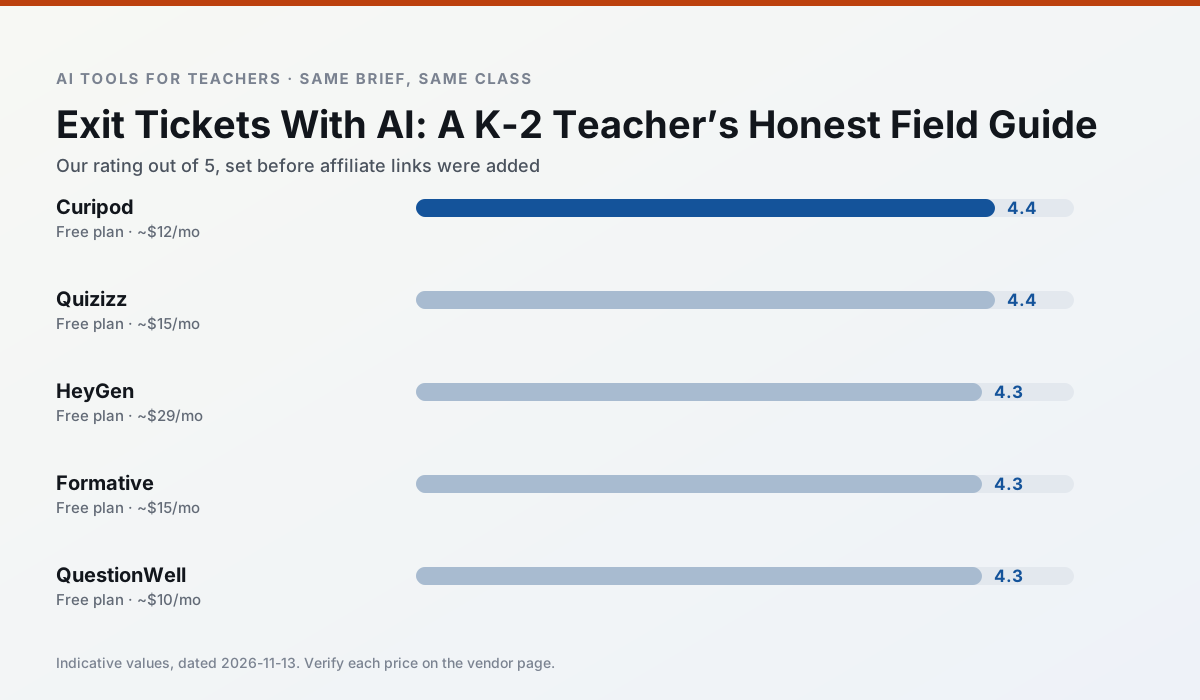
Side by side
Comparison table
Ratings reflect our timed classroom workflow, not vendor claims. Prices are indicative — verify on the vendor site.
| Tool | Best for | Free tier | Indicative paid plan | Standout feature | Our rating | Verdict | Try the tool |
|---|---|---|---|---|---|---|---|
| Curipod | formative assessment · exit tickets | Yes — Limited lessons per month | ~$12 /user/mo | Live polls and word clouds | 4.4 / 5 | Strong option | Try free |
| Quizizz | quiz generation · formative assessment | Yes — Core quiz creation | ~$15 /user/mo | AI question generator | 4.4 / 5 | Strong option | Try free |
| HeyGen | video lessons · translation | Yes — Limited credit plan | ~$29 /user/mo | Video translation | 4.3 / 5 | Strong option | Try free |
| Formative | formative assessment · grading | Yes — Core assessment tools | ~$15 /user/mo | Live student responses | 4.3 / 5 | Strong option | Try free |
| QuestionWell | quiz generation · assessment | Yes — Monthly generation limit | ~$10 /user/mo | Exports to Google Forms / LMS | 4.3 / 5 | Strong option | Try free |
| Canva for Education | slide decks · worksheets | Yes — Verification required | ~$13 /user/mo | Thousands of education templates | 4.6 / 5 | Top pick | Try free |
Match your situation
Best for X
Different jobs need different tools. Here is what we would open first in each case.
Curipod answers the three questions a district actually asks: rostering, admin controls and a data-processing agreement. That is usually what decides a school purchase.
Setup cost is one login for Quizizz; everything else can wait until you know the tool is useful.
On the daily cycle, HeyGen saves the most edit time per task; the paid tier mostly buys more runs rather than better ones.
Formative's free plan is the most usable in this comparison: a quota that survives a normal week. Not enough for a department, enough for one teacher to decide.
Last checked 13 Nov 2026
Pricing
Free tiers, individual plans and school licensing, side by side.
| Tool | Free plan | Individual / paid | School & district | Billing note | Verify |
|---|---|---|---|---|---|
| Curipod | $0 — Limited lessons per month | ~$12 /user/mo | Custom quote | Indicative — verify on vendor site | Vendor |
| Quizizz | $0 — Core quiz creation | ~$15 /user/mo | Custom quote | Indicative — verify on vendor site | Vendor |
| HeyGen | $0 — Limited credit plan | ~$29 /user/mo | Custom quote | Indicative — verify on vendor site | Vendor |
| Formative | $0 — Core assessment tools | ~$15 /user/mo | Custom quote | Indicative — verify on vendor site | Vendor |
| QuestionWell | $0 — Monthly generation limit | ~$10 /user/mo | Custom quote | Indicative — verify on vendor site | Vendor |
| Canva for Education | $0 — Verification required | ~$13 /user/mo | Custom quote | Indicative — verify on vendor site | Vendor |
Editorial rule: pricing is re-checked every 2–3 months and the top 50 pages are refreshed every 6 months. See our funding policy.
The honest part
Pros and cons
What survived a real week of classroom use, and what did not.
Pros
- High student engagement out of the box
- Great for quick checks for understanding
- No student accounts required for basic use
Cons
- Focused on delivery, not planning
- Requires reliable classroom devices
- Free tier is restrictive
Pros
- Students already know the interface
- Good reporting
- Works on low-end devices
Cons
- Writing high-quality AI questions still needs review
- Gamification can distract
- Advanced analytics are paid
Pros
- Best-in-class lip-sync translation
- Useful for multilingual families
- Generous trial credits
Cons
- Credit-based pricing is confusing
- Voice cloning raises consent questions
- Overkill for everyday lessons
Pros
- Strong data for intervention groups
- Works with existing PDFs and Docs
- Good LMS integrations
Cons
- Steeper setup than quiz games
- Best value requires school-wide rollout
- Price adds up per teacher
Pros
- Saves the most time on question writing
- Clean export workflow
- Good objective tagging
Cons
- Single-purpose tool
- Question quality varies by source text
- Limited student-facing features
In the classroom
Use cases
Five concrete workflows, with the tool we would open for each one.
A weekly family newsletter from bullet notes
Newsletters fail on length, not tone. Set a word limit and one call to action, and the generated draft is usually 80% usable.
Recommended: CuripodRegrouping students after an assessment
Summarise anonymised results into skill groups, then generate one activity per group. Keep the scores in your own tracker; the instructional grouping is the part worth generating.
Recommended: QuizizzRubric and feedback comments in one pass
Reorder the workflow so the rubric is yours and the comments are generated. Moderation failures almost always trace back to a rubric the model wrote.
Recommended: HeyGenA parent email in two languages
Draft in plain, warm language with no names, translate, then back-translate the important sentences to check meaning. Keep specific incidents out of the prompt and add them yourself.
Recommended: FormativeA Monday morning lesson plan in twelve minutes
The twelve minutes come from not rewriting the skeleton. Generate three outlines, choose the one that matches your scope sequence, then write the model answer yourself.
Recommended: QuestionWell
Questions teachers ask us
FAQ
Direct answers, also published as FAQPage structured data for search and AI assistants.
Can AI do exit tickets at K-2 level?
Which tool is best for exit tickets?
What is the biggest risk?
Sources & further reading
Our recommendation
Try HeyGen free for your next exit tickets task
AI avatar video and video translation for instructional content. Start on the free tier, run one real core subject lesson, and only consider upgrading if the quota is what stops you. Disclosure: we may earn a commission (35% recurring) at no extra cost to you.
Some links on this page are affiliate links. We may earn a commission at no extra cost to you. Our rankings are editorial and never pay-to-play. Never enter student PII into a free consumer account.
Keep reading
Related comparisons in this cluster.
Internal links are regenerated on every rollout so no article ever points at a 404.