The short answer
- ChatGPT is the first tool to open for teachers with ai.
- Free tiers are quota-limited; check the comparison table before assuming a tool is free forever.
- Every AI output needs a teacher review before it reaches a student.
- Prices are indicative and dated; verify on the vendor page before buying.
Start with ChatGPT on its free plan.
By October of your first year using AI, you have either quit or you have stopped trying to generate entire units from scratch. The panic that made you paste a vague standard into a prompt box at midnight has worn off, replaced by the quiet realization that the machine still does not know your third period. Last term, I watched a colleague try to run five different platforms at once. She was generating slides in Canva, leveling articles in Diffit, building quizzes in Quizizz, and drafting feedback in Claude, while managing ChatGPT on her phone. By Thanksgiving, she had deleted every single tab. She went back to a paper planner for three weeks because the cognitive load of managing the tools outweighed the time they saved.
If you are looking at the landscape of teachers with ai options, the trick is knowing what actually survives contact with a real classroom. We look at these platforms through the lens of daily survival, not tech demos. You can read our broader take on the best AI tools for teachers to see how the landscape shifts, but here is what the first year actually looks like when the novelty fades.
The first month: pick one task and nothing else
The biggest mistake teachers make in September is trying to overhaul their workflow overnight. You do not need an assistant for everything. Pick the single task you repeat every single week and automate only that. If you teach high school English, maybe your weekly mountain is finding a supplemental text and writing five discussion questions. If you teach middle school science, it is formatting lab safety quizzes.
When you start here, ChatGPT is the best overall for daily use because it adapts to almost any classroom task without locking you into rigid templates. You have to write decent prompts to get useful results, and it lacks built-in standards alignment, but its flexibility makes it the easiest anvil to shape to your habits. If you prefer long-form drafting and heavy document work without wrestling a generic chat interface, Claude stands out as the best free option for raw text quality. Its consumer tier has usage limits, and it requires an approved workspace tier for any school documents, but its prose sounds less like a robot and more like a tired human who actually read the rubric.
The third month: the review habit and the hidden traps
By November, you are fast. You can whip out a reading passage and ten comprehension checks in thirty seconds. This is where the third month traps you, because the checking matters more than the writing. AI models love to hallucinate state standard alignment codes and fabricate reading level metrics that look official until you check them against an actual lexile chart.
Prompt: Act as a veteran 8th-grade science teacher. Create a 3-question formative check on plate tectonics aligned to NGSS MS-ESS2-3. Keep the reading level accessible for an ELD level 2 student.
First output: A generic multiple-choice quiz about earthquakes with standard codes that belonged to a different grade band and vocabulary that tripped up every non-native speaker in the room.
Teacher edits:
- Stripped out the fake standard code and inserted the exact district-mandated wording from the curriculum map.
- Replaced abstract geographical terms with concrete local examples of fault lines that students had actually discussed the day before.
MagicSchool AI solves part of this friction by providing the widest purpose-built template library in one dashboard. It is our top pick for schools and districts because teachers can learn it in five minutes with almost no prompting skill. You do not need to invent a prompt to format a rubric; you just click the rubric button. You still have to review the outputs for standards alignment, and the best features sit behind the paid tier at roughly $12 per user per month, but it saves hours of mental math on formatting.
The mid-year pivot: differentiation without burnout
By January, the mixed-ability classroom reality hits hardest. You have kids reading at a third-grade level sitting next to kids who need high school extension work. This is where Diffit shines as the best tool for quick setup. You paste in an article or drop a URL, and it levels the text into differentiated reading materials with printable and digital versions in minutes.
It has a narrower scope than all-in-one suites, and heavy use burns through the free quota quickly before you hit the paid tier at roughly $15 per user per month, but the time saved on modifying texts is unmatched. If you want to check out more granular classroom workflows, our guide on AI in the classroom examples breaks down how teachers use these exact outputs without losing their weekends.
For visual design and formative checks, teachers tend to drift toward Canva for Education and Quizizz by the second semester. Canva is effectively free for verified teachers, offering a massive template library where you do not need design skills to make clean slides, though the AI features are capped and easy to abuse if you love cluttered layouts. Quizizz relies on student familiarity; kids already know the interface, the live games work on low-end devices, and the AI quiz generation from text sources is fast, even if writing high-quality questions still requires a human eye to filter out weird distractors.
The end of year one: what stayed and what went
By June, the honest end state of a year of AI experimentation looks remarkably sparse. You do not use six apps. You usually keep two tools and one local folder of prompt files that actually work for your specific subject.
ChatGPT remains on your dock for general brainstorming and quick emails to parents. MagicSchool or Claude sits in a bookmark tab for generating structured templates. The rest of the noise falls away because teaching is about relationships and management, not prompt engineering. AI is a decent stapler. It is not the curriculum.
FAQ
Is AI making teachers faster?
Yes on preparation, no on judgement. The measurable gain is in first drafts and differentiation, not in grading or parent relationships.
What do teachers with AI actually stop doing?
Writing first drafts by hand and rebuilding the same worksheet every term. The planning conversation with colleagues is what people say they miss.
Sources and further reading
- U.S. Department of Education, Student Privacy (PTAC): FERPA and edtech vendor guidance, the reference we check privacy claims against
- Common Sense Education privacy ratings: independent vendor evaluations
- CAST UDL Guidelines: accessibility and learner variability, used when judging accommodation tools
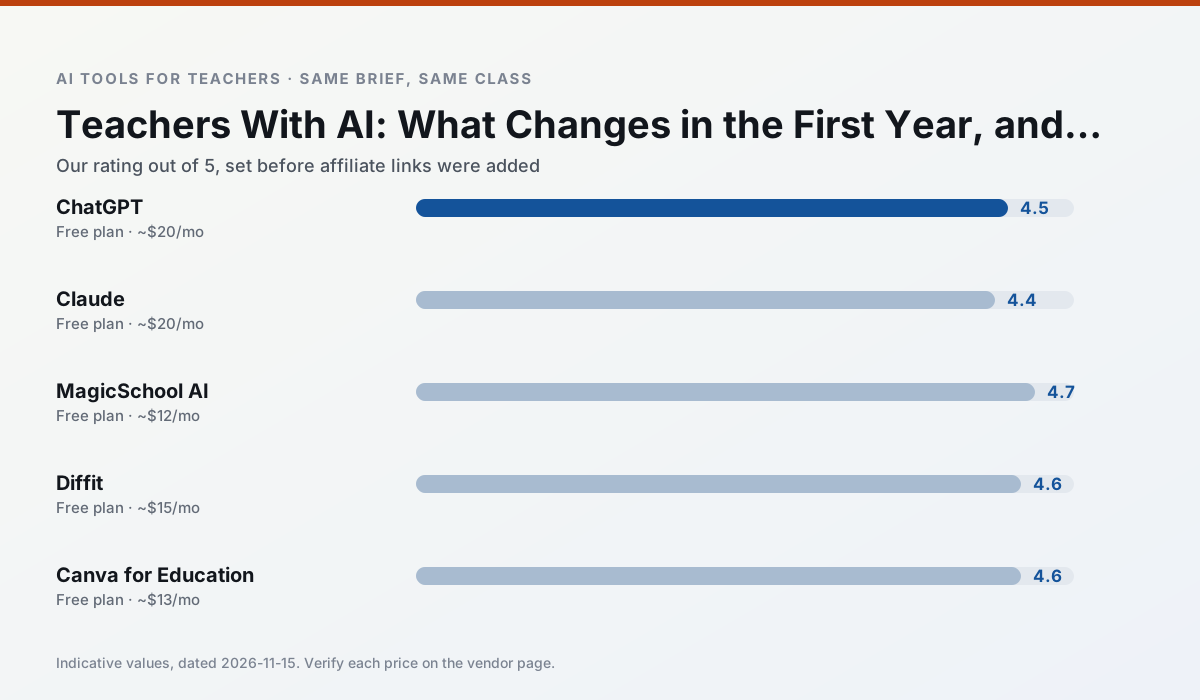
Side by side
Comparison table
Ratings reflect our classroom workflow, not vendor claims. Prices are indicative; verify on the vendor site.
| Tool | Best for | Free tier | Indicative paid plan | Standout feature | Our rating | Verdict | Try the tool |
|---|---|---|---|---|---|---|---|
| ChatGPT | lesson planning · parent communication | Yes — Usage-limited model access | ~$20 /user/mo | Custom GPTs and Projects | 4.5 / 5 | Top pick | Try free |
| Claude | rubric creation · feedback on writing | Yes — Usage-limited | ~$20 /user/mo | Very large context window | 4.4 / 5 | Strong option | Try free |
| MagicSchool AI | lesson planning · differentiation | Yes — Core generators with monthly usage limits | ~$12 /user/mo | 80+ teacher-specific tools | 4.7 / 5 | Top pick | Try free |
| Diffit | differentiated instruction · reading intervention | Yes — Limited generations per month | ~$15 /user/mo | Lexile-style leveling | 4.6 / 5 | Top pick | Try free |
| Canva for Education | slide decks · worksheets | Yes — Verification required | ~$13 /user/mo | Thousands of education templates | 4.6 / 5 | Top pick | Try free |
| Quizizz | quiz generation · formative assessment | Yes — Core quiz creation | ~$15 /user/mo | AI question generator | 4.4 / 5 | Strong option | Try free |
Match your situation
Best for X
Different jobs need different tools. Here is what we would open first in each case.
General-purpose assistant that adapts to almost any classroom task.
Long-context assistant suited to document-heavy planning and feedback.
A large library of teacher-specific AI generators in one dashboard.
Level any text or video into differentiated reading materials.
Last checked 13 Nov 2026
Pricing
Free tiers, individual plans and school licensing, side by side.
| Tool | Free plan | Individual / paid | School & district | Billing note | Verify |
|---|---|---|---|---|---|
| ChatGPT | $0 — Usage-limited model access | ~$20 /user/mo | ~$25+ /user/mo | Indicative — verify on vendor site | Vendor |
| Claude | $0 — Usage-limited | ~$20 /user/mo | ~$25+ /user/mo | Indicative — verify on vendor site | Vendor |
| MagicSchool AI | $0 — Core generators with monthly usage limits | ~$12 /user/mo | Custom quote | Indicative — verify on vendor site | Vendor |
| Diffit | $0 — Limited generations per month | ~$15 /user/mo | Custom quote | Indicative — verify on vendor site | Vendor |
| Canva for Education | $0 — Verification required | ~$13 /user/mo | Custom quote | Indicative — verify on vendor site | Vendor |
| Quizizz | $0 — Core quiz creation | ~$15 /user/mo | Custom quote | Indicative — verify on vendor site | Vendor |
Editorial rule: pricing is re-checked every 2–3 months and the top 50 pages are refreshed every 6 months. See our funding policy.
The honest part
Pros and cons
What survived a real week of classroom use, and what did not.
Pros
- Most flexible option available
- Huge community of teacher prompt libraries
- Strong multilingual support
Cons
- Requires prompt skills for consistent results
- No built-in standards alignment
- District privacy review usually required
Pros
- Handles full unit plans and long rubrics
- Nuanced, less generic prose
- Good at structured document output
Cons
- No teacher-specific templates
- Fewer classroom integrations
- Consumer plan not suitable for student data
Pros
- Widest purpose-built template library
- Strong free tier for individual teachers
- Fast to learn with almost no prompting skill
Cons
- Outputs still need standards review
- Best features sit behind the paid tier
- District approval can be slow
Pros
- Excellent for mixed-ability classes
- Produces printable and digital versions
- Minimal setup
Cons
- Narrower scope than all-in-one suites
- Leveling is approximate, not a formal assessment
- Heavy use burns through the free quota
Pros
- Effectively free for verified teachers
- Huge template library
- No design skills needed
Cons
- AI features are capped
- Easy to produce cluttered slides
- Account verification can be slow
In the classroom
Use cases
Five concrete workflows, with the tool we would open for each one.
The first month: one task only
Pick the task you repeat weekly and automate only that. Teachers who start with five tools stop using all five by half term.
Recommended: ChatGPTThe third month: the review habit
By now the tool is faster but the checking matters more. Standards codes and numbers are where the mistakes hide.
Recommended: ClaudeThe end of year one: what stayed
Usually two tools and one prompt file. That is the honest end state of a year of AI experimentation.
Recommended: MagicSchool AI
Questions teachers ask us
FAQ
Direct answers, also published as FAQPage structured data for search and AI assistants.
Is AI making teachers faster?
What do teachers with AI actually stop doing?
Sources & further reading
Our recommendation
Try ChatGPT free for teachers with ai
General-purpose assistant that adapts to almost any classroom task.
Some links on this page are affiliate links. We may earn a commission at no extra cost to you. Never enter student PII into a free consumer account.
Keep reading
Related comparisons in this cluster.
Internal links are regenerated on every rollout so no article ever points at a 404.