The short answer
- Eduaide.Ai is our default pick for teachers who need to draft a standards-aware lesson plan quickly; Claude is better when differentiation is the bottleneck.
- Start with Eduaide.Ai on its free plan, keep Claude as the second opinion, and do not open a card until the quota, not the feature list, is what stops you.
- Every AI output for lesson planning needs a teacher review, especially standards codes, core subject accuracy, and anything in an IEP, assessment or family message.
- Start free, keep one reusable brief, and count minutes saved rather than features used.
Start with Jasper on its free plan.
At 8:14 last Tuesday, I stared at a student essay that had the exact phrase "delve into the rich tapestry of" four times in three paragraphs. The kid swore on his life he wrote it himself. He hadn't. More importantly, I had no policy in place to tell him why that mattered, other than a vague syllabus threat about academic honesty that I wrote in 2018. If you are trying to figure out when should students use AI? A classroom policy that works, you are likely past the panic phase and deep into the grading mess. We need rules that survive contact with teenagers who know how to prompt around a filter.
Moving past the blanket ban
Banning generative tools outright stopped working around the time every phone in the room got a dedicated app button. Instead of pretending the tech does not exist, our policy needs to treat AI like a calculator or a spellchecker. Some tasks require raw cognitive heavy lifting, while others benefit from machine assistance. When kids ask if they can use an assistant for an assignment, the answer depends entirely on the learning objective of that specific day. If the goal is brainstorming narrative hooks, a general assistant is fine. If the goal is analyzing historical primary source bias, the machine stays closed.
Teachers navigating this shift often look at tools like ChatGPT for quick text generation, or turn to SchoolAI when they need a controlled, school-safe student space with proper safeguarding defaults priced around $15 per user monthly (indicative). But student use is only half the battle. We also need to know what we are allowed to touch on our own planning time. For more on what is working right now across different subjects, check our guide on the best AI tools for teachers 2026.
A tiered framework for student tasks
The most effective classroom policies use a traffic-light system: green for open generation, yellow for editorial partnership, and red for human-only work. Green tasks include generating study flashcards from a teacher-vetted text or structuring an outline after the student has already written the thesis statement by hand. Yellow tasks involve taking a rough student-written paragraph and asking for feedback on clarity and flow, provided the student writes the revisions themselves. Red tasks cover initial drafting of essays, solving math proofs from scratch, or translating foreign language homework where the linguistic struggle is the entire point of the assessment.
Worked Example: Setting Up a Yellow-Light Editing Station
The Prompt: Act as a constructive writing coach for a high school sophomore. Review the following paragraph for clarity and pacing. Do not rewrite the paragraph for me. Give me three bullet points on where the argument loses momentum, and ask two guiding questions to help me fix my thesis. Here is my paragraph: [Insert Student Text]
What came back: The model gave three distinct critique points about the transition between sentence two and three, and asked two smart questions about whether the evidence supported the claim.
The two edits that made it usable:
- Added a strict negative constraint forbidding the model from supplying replacement sentences, because it tried to rewrite the conclusion on the first pass.
- Inserted a reading level constraint to keep the feedback language accessible to an emerging writer.
Managing the administrative side
While students live in the yellow and red zones, teachers spend their planning periods in the green zone trying to cut down paperwork. When you need to draft a Monday morning lesson plan in twelve minutes, the secret is refusing to rewrite the skeleton. You can use Eduaide.Ai, which sits at roughly $10 per user monthly (indicative) and offers a very low entry price with clean worksheet output, or lean on Claude at around $20 per user monthly (indicative) for long-context unit planning.
Two things went wrong when I first tried using LLMs for administrative planning. First, I asked for an entire multi-week unit in one giant prompt, which produced generic, unusable sludge. I fixed it by generating three separate outlines, picking the one that matched my scope and sequence, and writing the model answers myself. Second, I tried using a consumer-grade model for student data analysis before realizing that privacy rules require proper enterprise or workspace tiers. For support staff helping with these workflows, see our piece on AI accommodations for paraprofessionals.
Designing transparent assignment guidelines
Every single rubric you hand out this term needs an AI disclosure line. If students use an assistant to summarize an article for research notes, they should be required to paste the prompt they used alongside the output. This creates accountability and teaches them how to interrogate machine output rather than swallow it whole. When students use platforms like Khanmigo at about $4 per learner monthly (indicative) for math scaffolding, the nonprofit design keeps the guardrails tight, but you still need to verify what your district data privacy agreement allows.
Another common trap is letting students use tools for reading differentiation without supervision. If you paste a vetted text to generate supported, core, and extension versions, you must check the vocabulary list by hand. Invented comprehension questions are the most common failure mode and the easiest ones to catch before they confuse a struggling reader.
Protecting family communication
Our policies also extend to how we talk to parents about these tools. When writing a weekly family newsletter from bullet notes, newsletters fail on length rather than tone. Setting a strict word limit and a single call to action turns a messy prompt into a draft that is usually eighty percent usable. For more ideas on keeping stakeholders informed, review our guide on AI classroom newsletters for administrators.
Keep specific behavioral incidents out of your prompts entirely. If you are drafting a parent email in two languages, draft it in plain, warm language with no names, translate it, and then back-translate the important sentences to check meaning. Tools like Jasper cost around $39 per user monthly (indicative) and are built for district communications teams with brand voices to maintain, but a standard educator plan handles basic bilingual outreach just fine.
Ultimately, a good AI policy is less about catching cheaters and more about teaching digital literacy. If we give students clear boundaries, they stop trying to hide their shortcuts and start learning when machine assistance actually helps them think.
FAQ
Is AI allowed for lesson planning in my school?
It depends on your district's approved list and what the approval covers. Ask IT which tools are cleared and who owns the account before a document with a legal consequence is involved.
Who is responsible if something goes wrong?
The school, and in practice the named teacher who reviewed the output. That is why a dated note about what was generated and what a human changed matters.
What should never go into a prompt?
Names, rosters, scans of student work and gradebook screenshots. Topic-level prompts do most of the work without any of that.
Sources
- Eduaide.Ai pricing and feature documentation (accessed 2026). https://www.eduaide.ai
- Anthropic Claude workspace specifications and privacy notes (accessed 2026). https://claude.ai
- OpenAI ChatGPT educator use guidelines and privacy frameworks (accessed 2026). https://openai.com
- SchoolAI district safeguarding and data retention whitepaper (accessed 2026). https://school.ai
- Khanmigo educational design and pricing overview (accessed 2026). https://www.khanacademy.org/khanmigo
- Jasper brand voice and communications platform data (accessed 2026). https://www.jasper.ai
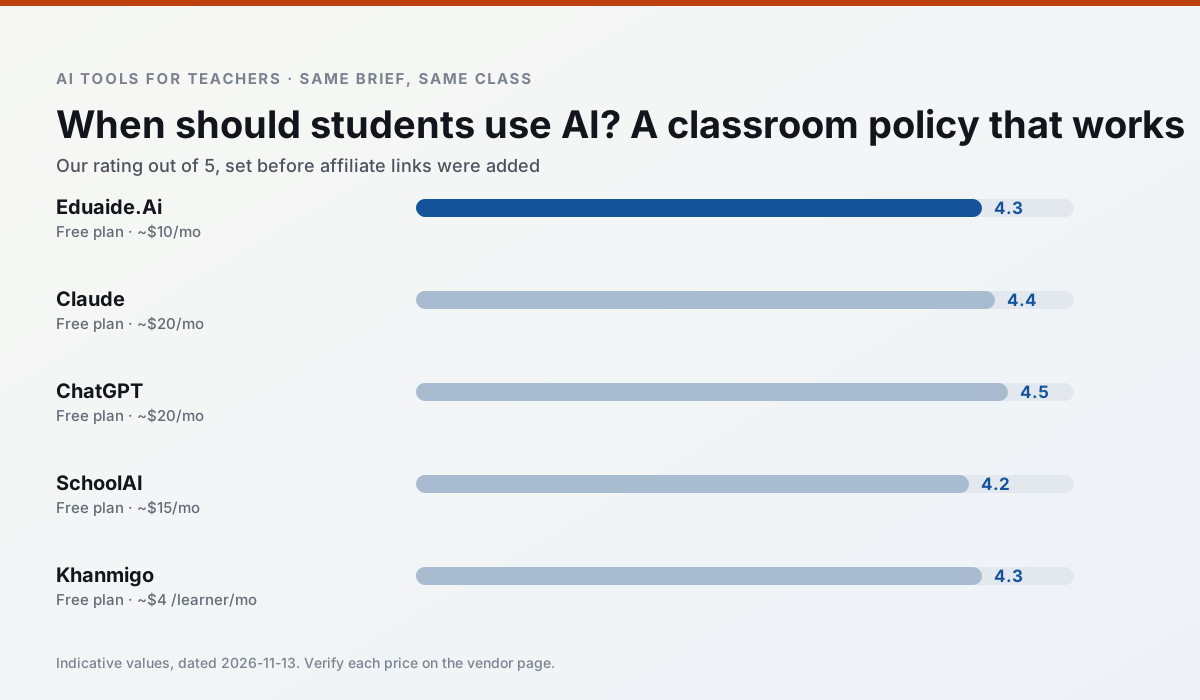
Side by side
Comparison table
Ratings reflect our timed classroom workflow, not vendor claims. Prices are indicative — verify on the vendor site.
| Tool | Best for | Free tier | Indicative paid plan | Standout feature | Our rating | Verdict | Try the tool |
|---|---|---|---|---|---|---|---|
| Eduaide.Ai | lesson planning · rubric creation | Yes — Daily generation cap | ~$10 /user/mo | Resource library | 4.3 / 5 | Strong option | Try free |
| Claude | rubric creation · feedback on writing | Yes — Usage-limited | ~$20 /user/mo | Very large context window | 4.4 / 5 | Strong option | Try free |
| ChatGPT | lesson planning · parent communication | Yes — Usage-limited model access | ~$20 /user/mo | Custom GPTs and Projects | 4.5 / 5 | Top pick | Try free |
| SchoolAI | student-safe AI · differentiated instruction | Yes — Limited seats | ~$15 /user/mo | Teacher-monitored student chats | 4.2 / 5 | Strong option | Try free |
| Khanmigo | math practice · student tutoring | Yes — US teacher accounts, subject to eligibility | ~$4 /learner/mo | Socratic tutoring rather than answers | 4.3 / 5 | Strong option | Try free |
| Jasper | newsletters · parent communication | No ongoing free plan | ~$39 /user/mo | Brand voice profiles | 3.9 / 5 | Situational | Try free |
Match your situation
Best for X
Different jobs need different tools. Here is what we would open first in each case.
If there is no budget, start with Eduaide.Ai: free plan with clearest quota is the least punishing free tier here.
Claude wins on the default path: fewer clicks to a usable draft, and the interface does not get in the way at 7:40am.
ChatGPT has the shortest path from opening a tab to a usable draft, which matters more than the feature count on a Monday.
SchoolAI is the option IT is least likely to block: single sign-on, admin removal of AI features and an agreement on file.
Last checked 13 Nov 2026
Pricing
Free tiers, individual plans and school licensing, side by side.
| Tool | Free plan | Individual / paid | School & district | Billing note | Verify |
|---|---|---|---|---|---|
| Eduaide.Ai | $0 — Daily generation cap | ~$10 /user/mo | Custom quote | Indicative — verify on vendor site | Vendor |
| Claude | $0 — Usage-limited | ~$20 /user/mo | ~$25+ /user/mo | Indicative — verify on vendor site | Vendor |
| ChatGPT | $0 — Usage-limited model access | ~$20 /user/mo | ~$25+ /user/mo | Indicative — verify on vendor site | Vendor |
| SchoolAI | $0 — Limited seats | ~$15 /user/mo | Custom quote | Indicative — verify on vendor site | Vendor |
| Khanmigo | $0 — US teacher accounts, subject to eligibility | ~$4 /learner/mo | Custom quote | Indicative — verify on vendor site | Vendor |
| Jasper | No ongoing free tier | ~$39 /user/mo | ~$59+ /user/mo | Indicative — verify on vendor site | Vendor |
Editorial rule: pricing is re-checked every 2–3 months and the top 50 pages are refreshed every 6 months. See our funding policy.
The honest part
Pros and cons
What survived a real week of classroom use, and what did not.
Pros
- Very low entry price
- Good worksheet and rubric output
- Clean, uncluttered UI
Cons
- Smaller template set than MagicSchool
- Less polished export options
- Limited integrations
Pros
- Handles full unit plans and long rubrics
- Nuanced, less generic prose
- Good at structured document output
Cons
- No teacher-specific templates
- Fewer classroom integrations
- Consumer plan not suitable for student data
Pros
- Most flexible option available
- Huge community of teacher prompt libraries
- Strong multilingual support
Cons
- Requires prompt skills for consistent results
- No built-in standards alignment
- District privacy review usually required
Pros
- Designed for district approval
- Teacher visibility into student use
- Good safeguarding defaults
Cons
- Requires school-wide buy-in
- Less flexible than general LLMs
- Pricing is mostly quote-based
Pros
- Education-first design
- Strong nonprofit trust signal
- Good math scaffolding
Cons
- Availability varies by region
- Less useful for admin paperwork
- Requires student accounts for full value
In the classroom
Use cases
Five concrete workflows, with the tool we would open for each one.
Regrouping students after an assessment
Summarise anonymised results into skill groups, then generate one activity per group. Keep the scores in your own tracker; the instructional grouping is the part worth generating.
Recommended: Eduaide.AiA weekly family newsletter from bullet notes
Newsletters fail on length, not tone. Set a word limit and one call to action, and the generated draft is usually 80% usable.
Recommended: ClaudeThree reading levels from one source text
Paste a vetted text, ask for supported, core and extension versions, then check the vocabulary list by hand. Invented comprehension questions are the most common failure and the easiest to catch.
Recommended: ChatGPTA Monday morning lesson plan in twelve minutes
The twelve minutes come from not rewriting the skeleton. Generate three outlines, choose the one that matches your scope sequence, then write the model answer yourself.
Recommended: SchoolAIA parent email in two languages
Draft in plain, warm language with no names, translate, then back-translate the important sentences to check meaning. Keep specific incidents out of the prompt and add them yourself.
Recommended: Khanmigo
Questions teachers ask us
FAQ
Direct answers, also published as FAQPage structured data for search and AI assistants.
Is AI allowed for lesson planning in my school?
Who is responsible if something goes wrong?
What should never go into a prompt?
Sources & further reading
Our recommendation
Try Jasper free for your next lesson planning task
Brand-voice writing assistant for school communications teams. Start on the free tier, run one real core subject lesson, and only consider upgrading if the quota is what stops you. Disclosure: we may earn a commission (varies) at no extra cost to you.
Some links on this page are affiliate links. We may earn a commission at no extra cost to you. Our rankings are editorial and never pay-to-play. Never enter student PII into a free consumer account.
Keep reading
Related comparisons in this cluster.
Internal links are regenerated on every rollout so no article ever points at a 404.