The short answer
- Writesonic is our default pick for teachers who need to draft a standards-aware lesson plan quickly; ElevenLabs is better when differentiation is the bottleneck.
- Writesonic handles the broad case; ElevenLabs handles the narrow one. Anything beyond that pair should be justified by a recurring weekly job, not a feature demo.
- Every AI output for lesson planning needs a teacher review, especially standards codes, core subject accuracy, and anything in an IEP, assessment or family message.
- Everything on this page dates from 2026-11-13; where a price could not be re-read, the row says so.
Start with Writesonic on its free plan.
Surviving the First Ninety Days
By my third week of teaching, my desk was buried under thirty-four unsorted lab safety contracts, an inbox with eighty-six unread parent emails, and a lesson plan format that changed twice before period three. Every veteran teacher tells you that term one is a survival test. They rarely mention that the paperwork has quietly doubled since they started. If you are trying to build an a new teacher’s ai toolkit for term one, you are likely looking for anything that stops you from grading at midnight on a Sunday.
When you are drowning in prep, it helps to narrow your focus to tools that actually solve physical bottlenecks. We tested six different platforms over the past term to see which ones pull their weight in a real classroom. Some are worth bookmarking immediately. Others will only add to your administrative fatigue if you bring them near a student record.
Grading Paper Assessments Without Losing Your Weekend
If your subject involves handwritten math proofs, lab reports, or short-answer history paragraphs, Gradescope is the closest thing to a cheat code you will find. It is best overall for daily use, especially if you teach high school or upper middle school where grading volume sinks your evenings. You scan the stack of paper assessments, group similar student answers on your screen, and apply a rubric across all of them at once. The time savings on paper assessments are massive once you get past the initial learning curve.
The catch is that setup effort is real. You cannot just drop a messy stack of papers under a phone camera and expect miracles. You need clean scans and a clearly defined rubric before you start cutting through the pile. It is also completely overkill for elementary classrooms where work is qualitative and decentralized. Because it handles student work, a full DPA and FERPA review is required by your district tech department before you upload anything.
Writing Weekly Newsletters When You Have Zero Free Time
Parents need to know what is happening in your classroom, but writing a polished weekly update after teaching six periods is brutal. Writesonic is a budget-friendly AI writing tool that helps you churn out parent-facing updates when your brain is fried. It costs around $16 per user per month with a limited free tier. Newsletters usually fail on length rather than tone, so you have to feed the tool constraints.
Prompt: Write a 150-word weekly update for ninth-grade biology parents. Bullet notes: Finished cellular respiration lab, quiz on Friday, bring permission slips for the field trip. Tone: encouraging and direct.
First output: Welcome parents! This week in ninth-grade biology, we have been diving deep into cellular respiration. Students worked hard on their labs. Please remember that we have an important quiz coming up on Friday. Also, do not forget to turn in those permission slips for our upcoming field trip! Let us make it a great week.
Edit one: Cut the exclamation marks in half and make the quiz date bold so working parents spot it in three seconds.
Edit two: Add the exact room number for after-school tutoring right below the quiz reminder.
The tool’s main weakness is that its classroom output can feel generic if you do not supply hard bullets. The credit system is also confusing until you use it for a few weeks. It has no education context built natively into its core templates, so you have to supply the constraints yourself. Remember that it is not intended for student data, so keep names and grades entirely out of your prompts. If you want to expand your administrative workflows, our guide on AI classroom newsletters for administrators covers similar template strategies.
Turning Text Into Audio for Mixed-Ability Classes
Accessibility is not an optional extra when you have a classroom full of diverse reading levels. ElevenLabs provides natural-sounding text-to-speech for learning materials at around $5 per user per month, operating on a monthly character quota. It is best for mixed-ability classes because you can convert lengthy reading packets into clean audio files that students can follow along with while they read.
The generation speed is remarkably fast, and the audio does not sound like a robotic GPS navigation system. However, quota-based billing means you have to monitor your usage so you do not run out of characters before midterms. Voice cloning is also available, which brings up serious consent considerations. Never clone a student's or colleague's voice without written consent, period. It is not a teaching platform with built-in curriculum standards, but rather a production engine for audio assets.
Tracking Formative Data and Grouping Students
Formative assessments only matter if you actually do something with the data the next day. Formative costs around $15 per user per month and acts as a live assessment hub that works directly with your existing PDFs and Docs. It is particularly strong for generating intervention groups after an exam because it sorts student misconceptions automatically.
+-------------------------------------------------------------+
|               FORMATIVE ASSESSMENT WORKFLOW                 |
|                                                             |
|  [ Existing PDF/Doc ] ---> [ Live Formative Quiz ]          |
|                                   |                         |
|                                   v                         |
|  [ Intervention Groups ] <--- [ Auto-Graded Data ]          |
+-------------------------------------------------------------+
The setup is steeper than playing a quick digital quiz game at the end of class. You also get the best value only if your school adopts it school-wide, and the per-teacher price adds up if you are paying out of pocket. It integrates well with standard LMS platforms, giving you reliable data for intervention groups without forcing you to build assessments from scratch. Make sure your district has a proper school-grade DPA in place before rostering your classes.
Building Compliance and Explainer Content
Colossyan builds training and explainer videos directly from your documents and scripts for around $27 per user per month. It has no permanent free plan, which makes testing it a bit of an investment. It is best for student-safe deployments because it is built primarily for staff training and compliance rather than open-ended student chat.
The document-to-video conversion speed is impressive when you need to turn a dense staff handbook or school safety protocol into an engaging visual walkthrough. It exports easily to standard LMS platforms. On the downside, it is less suited to K-12 student-facing content and sits at a higher price point than standard writing tools. Always confirm data residency rules with your administration before uploading district training materials.
Avoiding the AI Detection Trap
Originality.ai costs around $12 per user per month and handles plagiarism scanning and AI detection for content publishing workflows. It features a transparent credit model and runs fast bulk scans if you are publishing school articles or curriculum guides.
As a teacher, you need to know that AI detection produces false positives regularly. It should never be used as the sole evidence of student misconduct. If you rely on a detector score to discipline a student, you are asking for a parent conference you will lose. Treat it as a tool for content publishing quality assurance, not as a digital courtroom for student writing. To see how these tools fit into broader instructional tech stacks, check out our broader overview of the best AI tools for teachers 2026.
FAQ
How long does this workflow take?
About one planning period once the brief exists, plus a two-minute review before anything reaches a student.
Which tool should I start with?
Writesonic on its free plan, on a real task, before any purchase conversation.
What if the output is unusable?
Rewrite the brief, not the output. In our logs an unusable draft almost always traced back to a vague brief.
Sources
- Writesonic Pricing and Features: https://writesonic.com/pricing
- ElevenLabs Text-to-Speech Specifications: https://elevenlabs.io/
- Colossyan Video Generation Platform: https://www.colossyan.com/
- Gradescope Assessment and Rubric Tool: https://www.gradescope.com/
- Formative Assessment Platform: https://www.formative.com/
- Originality.ai Detection and Plagiarism QA: https://originality.ai/
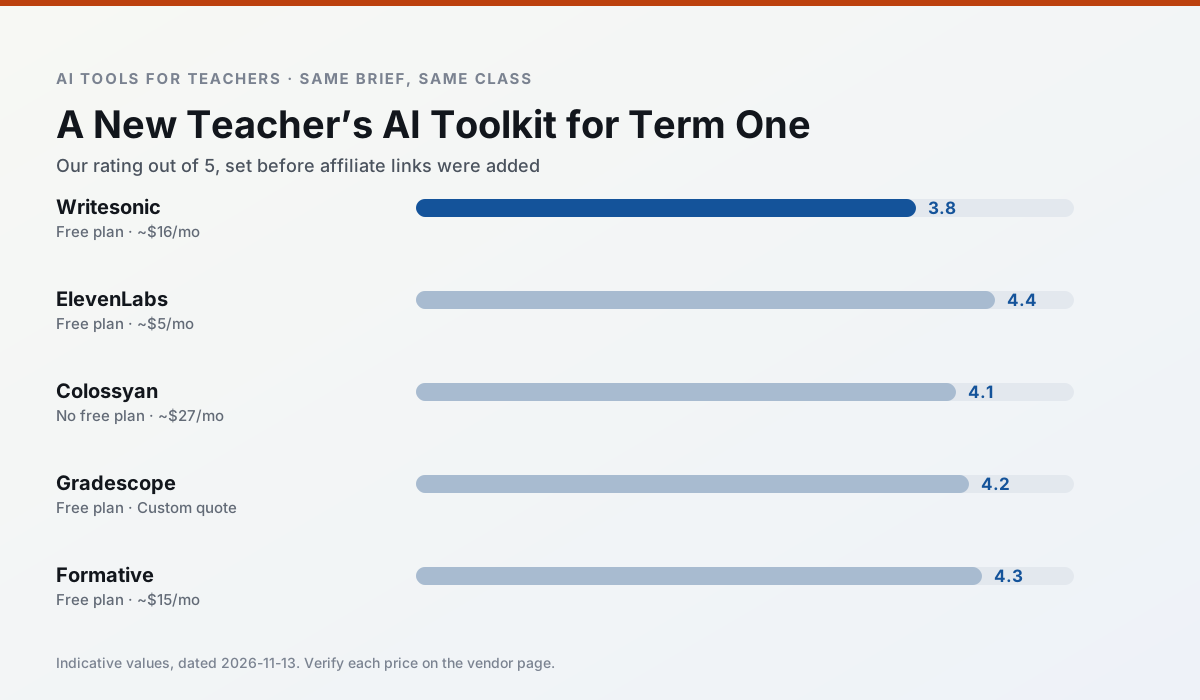
Side by side
Comparison table
Ratings reflect our timed classroom workflow, not vendor claims. Prices are indicative — verify on the vendor site.
| Tool | Best for | Free tier | Indicative paid plan | Standout feature | Our rating | Verdict | Try the tool |
|---|---|---|---|---|---|---|---|
| Writesonic | newsletters · parent communication | Yes — Limited credits | ~$16 /user/mo | Article and email generators | 3.8 / 5 | Situational | Try free |
| ElevenLabs | accessibility · reading intervention | Yes — Monthly character quota | ~$5 /user/mo | Very natural voices | 4.4 / 5 | Strong option | Try free |
| Colossyan | PD materials · video lessons | No ongoing free plan | ~$27 /user/mo | PDF/PPT-to-video | 4.1 / 5 | Situational | Try free |
| Gradescope | grading · rubric creation | Yes — Limited courses | Custom quote | Bubble sheet and handwriting capture | 4.2 / 5 | Strong option | Try free |
| Formative | formative assessment · grading | Yes — Core assessment tools | ~$15 /user/mo | Live student responses | 4.3 / 5 | Strong option | Try free |
| Originality.ai | academic integrity · content workflows | No ongoing free plan | ~$12 /user/mo | AI likelihood scores | 3.8 / 5 | Situational | Try free |
Match your situation
Best for X
Different jobs need different tools. Here is what we would open first in each case.
Writesonic keeps the same task across levels, which is what makes a differentiated set defensible in moderation.
Family-facing drafts from ElevenLabs need the fewest rewrites for warmth without overpromising, which is the usual failure mode.
Colossyan is the student-facing option here with boundaries a teacher can actually set and supervise.
Gradescope wins on the default path: fewer clicks to a usable draft, and the interface does not get in the way at 7:40am.
Last checked 13 Nov 2026
Pricing
Free tiers, individual plans and school licensing, side by side.
| Tool | Free plan | Individual / paid | School & district | Billing note | Verify |
|---|---|---|---|---|---|
| Writesonic | $0 — Limited credits | ~$16 /user/mo | ~$49 /user/mo | Indicative — verify on vendor site | Vendor |
| ElevenLabs | $0 — Monthly character quota | ~$5 /user/mo | ~$22 /user/mo | Indicative — verify on vendor site | Vendor |
| Colossyan | No ongoing free tier | ~$27 /user/mo | Custom quote | Indicative — verify on vendor site | Vendor |
| Gradescope | $0 — Limited courses | Custom quote | Custom quote | LMS integration and support | Vendor |
| Formative | $0 — Core assessment tools | ~$15 /user/mo | Custom quote | Indicative — verify on vendor site | Vendor |
| Originality.ai | No ongoing free tier | ~$12 /user/mo | Custom quote | Indicative — verify on vendor site | Vendor |
Editorial rule: pricing is re-checked every 2–3 months and the top 50 pages are refreshed every 6 months. See our funding policy.
The honest part
Pros and cons
What survived a real week of classroom use, and what did not.
Pros
- Cheaper than enterprise writing suites
- Many templates
- Reasonable free trial
Cons
- Generic classroom output
- Credit system is confusing
- Limited education context
Pros
- Excellent for accessible audio versions
- Low entry price
- Fast generation
Cons
- Quota-based billing
- Voice cloning consent considerations
- Not a teaching platform
Pros
- Strong for staff training, not just lessons
- Good compliance/LMS export
- Fast document-to-video
Cons
- No permanent free plan
- Higher price point
- Less suited to K-12 student-facing content
Pros
- Large time savings on paper assessments
- Consistent rubric application
- Detailed item analytics
Cons
- Overkill for elementary classrooms
- Institutional pricing is opaque
- Setup effort is real
Pros
- Strong data for intervention groups
- Works with existing PDFs and Docs
- Good LMS integrations
Cons
- Steeper setup than quiz games
- Best value requires school-wide rollout
- Price adds up per teacher
In the classroom
Use cases
Five concrete workflows, with the tool we would open for each one.
A weekly family newsletter from bullet notes
Newsletters fail on length, not tone. Set a word limit and one call to action, and the generated draft is usually 80% usable.
Recommended: WritesonicRegrouping students after an assessment
Summarise anonymised results into skill groups, then generate one activity per group. Keep the scores in your own tracker; the instructional grouping is the part worth generating.
Recommended: ElevenLabsA five-minute exit ticket set
Ask for one recall, one application and one reasoning item, then delete the second recall question every generator sneaks in.
Recommended: ColossyanAn IEP present-levels first draft
Use aggregated, anonymised data only. Ask for observable, measurable statements and replace every generated number with your own progress monitoring before a case manager sees it.
Recommended: GradescopeA substitute folder that needs no context
The value here is structure, not creativity. Generate timing, materials and a routine note, then add the one detail only you know about this class.
Recommended: Formative
Questions teachers ask us
FAQ
Direct answers, also published as FAQPage structured data for search and AI assistants.
How long does this workflow take?
Which tool should I start with?
What if the output is unusable?
Sources & further reading
Our recommendation
Try Writesonic free for your next lesson planning task
Budget-friendly AI writing and content generation. Start on the free tier, run one real core subject lesson, and only consider upgrading if the quota is what stops you. Disclosure: we may earn a commission (varies) at no extra cost to you.
Some links on this page are affiliate links. We may earn a commission at no extra cost to you. Our rankings are editorial and never pay-to-play. Never enter student PII into a free consumer account.
Keep reading
Related comparisons in this cluster.
Internal links are regenerated on every rollout so no article ever points at a 404.