The short answer
- Eduaide.Ai is our default pick for teachers who need to write criterion-referenced rubrics quickly; Claude is better when differentiation is the bottleneck.
- The cheapest honest test is a week of real work on the free plans: Eduaide.Ai: Yes — Daily generation cap; Claude: Yes — Usage-limited; Gradescope: Yes — Limited courses. If a tool is still open on Friday, it has earned a paid conversation.
- Every AI output for rubric creation needs a teacher review, especially standards codes, core subject accuracy, and anything in an IEP, assessment or family message.
- Everything on this page dates from 2026-11-13; where a price could not be re-read, the row says so.
Start with Notion AI on its free plan.
By eleven o'clock on a Tuesday during junior English draft season, I am usually staring at a blank rubric table wondering if "synthesizes effectively" means anything to a seventeen-year-old. Last term, I spent four hours building a four-tier analytical grid for a comparative essay, only to watch half my classes ignore the descriptors and ask if they could just use MLA format. AI rubric creation for high school teachers is supposed to fix this drudgery. If you are exploring the best options listed in our guide to the best AI tools for teachers, you already know that generic generation leaves you with a grid full of empty pedagogical buzzwords. Let's look at what actually works when you need an assessment tool that survives a real classroom.
Why Eduaide.Ai Leads Daily Planning
For general high school use, Eduaide.Ai takes the top spot for daily planning and resource generation. It costs around $10 per user per month on its paid tier, with a daily generation cap on the free option. The interface is clean and uncluttered, which matters when you are trying to spin up a quick formative assessment between passing periods. The platform shines when you need a worksheet and rubric combo that aligns with standard high school scopes. The template set is smaller than some competitors, and export options can feel a bit rigid, but it avoids the clutter that bogs down general-purpose LLMs. Just remember to confirm data retention settings if you happen to input any identifying student context, though standard rubrics require no student PII anyway.
Claude for Deep Structural Drafting
When I need a rubric that handles complex, multi-layered high school writing prompts, I turn to Claude. It operates on a usage-limited free tier, with a paid option running around $20 per user per month. It stands out as our top free option because its long-context window allows you to paste an entire released state exam rubric alongside your prompt and get back genuinely nuanced prose. Consumer plans are not suitable for student data, so keep student names out of the prompt window, but for drafting the actual assessment criteria, its ability to separate "exceeds" from "proficient" without defaulting to empty filler is unmatched.
Gradescope for Large-Scale Paper Assessments
High school departments dealing with hundreds of scanned essays or math assessments need institutional power. Gradescope uses AI-assisted rubric grading for scanned and handwritten work, operating on custom institutional quotes. It saves massive amounts of time on paper assessments by grouping similar student answers together, letting you apply rubric deductions across dozens of papers at once. The setup effort is real, and the pricing is opaque, but the consistency it brings to grading a 150-student AP history rotation is hard to overstate. Because it handles actual student work, a full DPA and FERPA review with your district administration is mandatory before rollout.
Class Companion for Fast Formative Loops
If your students still do a lot of work on paper or require rapid feedback on open-ended problem sets, Class Companion offers a strong setup for about $12 per user per month, alongside a limited assignments free tier. It provides fast, specific comments on scanned work and handles math notation better than many general tools. Scan quality directly dictates accuracy, so if a student writes in faint pencil, the OCR stumbles. It is a narrow use case, but for quick homework checks where you want AI to flag conceptual gaps before you step back in front of the room, it cuts grading time in half. As with any tool processing student artifacts, a data privacy agreement is required.
SchoolAI and Notion AI for District and Curriculum Work
When looking at school-wide adoption, SchoolAI provides a district-approved workspace with strict safeguarding defaults for roughly $15 per user per month on its paid tier, though it requires institutional buy-in. It gives teachers direct visibility into student AI use, making it ideal for monitored in-class tasks. Meanwhile, Notion AI costs around $10 per user per month and acts as a master database for long-term curriculum records and team collaboration. It is not built for quick lesson generation, but it keeps multi-year course maps organized. If you are adapting materials across grade bands, check out our guide on AI accommodations for middle school classrooms to keep your vertical alignment tight.
Prompt: Create a four-tier analytic rubric for an eleventh-grade argumentative research essay focusing on source integration, counterargument handling, and MLA citation accuracy.
First return: A generic four-column table with headings "Advanced, Proficient, Developing, Beginning" and vague descriptions like "Demonstrates good use of sources."
Two teacher edits:
- Added strict criteria requiring three peer-reviewed sources and direct attribution phrasing for the top tier.
- Replaced the generic citation row with specific penalties for missing in-text parentheticals on block quotes.
Two Ways Rubric Generation Fails in Practice
The most common failure in AI rubric creation is asking the model to write the grading criteria and the feedback comments in the exact same pass. When I tried this on a persuasive speech assessment, the rubric was so loose that the generated comments contradicted my own grading standards during moderation. Reorder your workflow so the rubric is strictly yours or heavily vetted, and use the AI only to generate variations of formative feedback once the grid is locked.
The second trap is ignoring the specific vocabulary your students use daily. If the AI generates descriptors that sound like a university syllabus, your high schoolers will not read them. Always do a quick lexical pass to ensure terms match the language you used during direct instruction. Pair this workflow with our sibling resource on ai accommodations for elementary teachers if you are supporting struggling readers in inclusion classes, ensuring your rubrics remain accessible across diverse learning profiles.
FAQ
Can AI do rubric creation at High School level?
It can produce a first draft and a structure. The level judgement, the standards check and the tone are teacher decisions.
Which tool is best for rubric creation?
Eduaide.Ai on the evidence in this article, with Claude as the second opinion. Neither replaces the review step.
What is the biggest risk?
A confident, plausible output that nobody checked. The five checks below exist for that reason.
Sources
- Eduaide.Ai feature overview and pricing: eduaide.ai
- Anthropic Claude usage tiers and context limits: anthropic.com
- Gradescope institutional assessment workflows: gradescope.com
- Class Companion AI feedback specifications: classcompanion.com
- SchoolAI safety and district compliance details: school.ai
- Notion AI workspace and curriculum planning documentation: notion.so
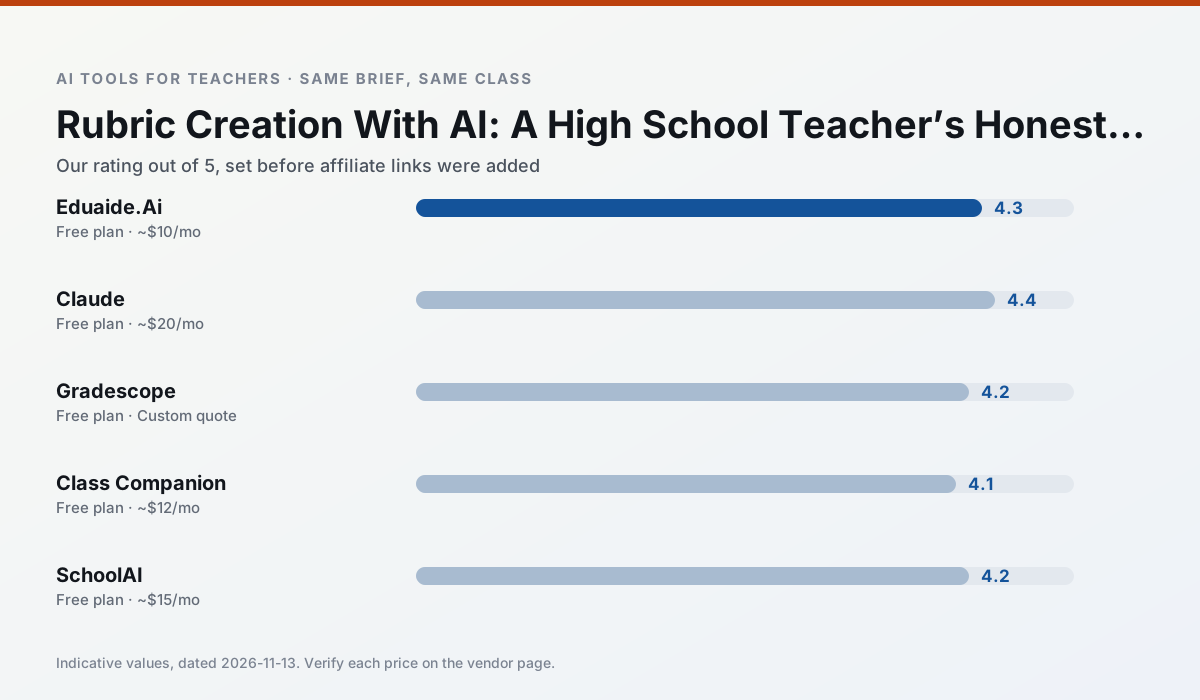
Side by side
Comparison table
Ratings reflect our timed classroom workflow, not vendor claims. Prices are indicative — verify on the vendor site.
| Tool | Best for | Free tier | Indicative paid plan | Standout feature | Our rating | Verdict | Try the tool |
|---|---|---|---|---|---|---|---|
| Eduaide.Ai | lesson planning · rubric creation | Yes — Daily generation cap | ~$10 /user/mo | Resource library | 4.3 / 5 | Strong option | Try free |
| Claude | rubric creation · feedback on writing | Yes — Usage-limited | ~$20 /user/mo | Very large context window | 4.4 / 5 | Strong option | Try free |
| Gradescope | grading · rubric creation | Yes — Limited courses | Custom quote | Bubble sheet and handwriting capture | 4.2 / 5 | Strong option | Try free |
| Class Companion | grading · feedback on writing | Yes — Limited assignments | ~$12 /user/mo | Handwriting recognition | 4.1 / 5 | Situational | Try free |
| SchoolAI | student-safe AI · differentiated instruction | Yes — Limited seats | ~$15 /user/mo | Teacher-monitored student chats | 4.2 / 5 | Strong option | Try free |
| Notion AI | curriculum mapping · unit planning | Yes — Limited AI usage | ~$10 /user/mo | Linked databases | 4.1 / 5 | Situational | Try free |
Match your situation
Best for X
Different jobs need different tools. Here is what we would open first in each case.
Eduaide.Ai wins on the default path: fewer clicks to a usable draft, and the interface does not get in the way at 7:40am.
Claude's free plan is the most usable in this comparison: a quota that survives a normal week. Not enough for a department, enough for one teacher to decide.
Gradescope answers the three questions a district actually asks: rostering, admin controls and a data-processing agreement. That is usually what decides a school purchase.
Class Companion has the shortest path from opening a tab to a usable draft, which matters more than the feature count on a Monday.
Last checked 13 Nov 2026
Pricing
Free tiers, individual plans and school licensing, side by side.
| Tool | Free plan | Individual / paid | School & district | Billing note | Verify |
|---|---|---|---|---|---|
| Eduaide.Ai | $0 — Daily generation cap | ~$10 /user/mo | Custom quote | Indicative — verify on vendor site | Vendor |
| Claude | $0 — Usage-limited | ~$20 /user/mo | ~$25+ /user/mo | Indicative — verify on vendor site | Vendor |
| Gradescope | $0 — Limited courses | Custom quote | Custom quote | LMS integration and support | Vendor |
| Class Companion | $0 — Limited assignments | ~$12 /user/mo | Custom quote | Indicative — verify on vendor site | Vendor |
| SchoolAI | $0 — Limited seats | ~$15 /user/mo | Custom quote | Indicative — verify on vendor site | Vendor |
| Notion AI | $0 — Limited AI usage | ~$10 /user/mo | ~$8 /user/mo | Indicative — verify on vendor site | Vendor |
Editorial rule: pricing is re-checked every 2–3 months and the top 50 pages are refreshed every 6 months. See our funding policy.
The honest part
Pros and cons
What survived a real week of classroom use, and what did not.
Pros
- Very low entry price
- Good worksheet and rubric output
- Clean, uncluttered UI
Cons
- Smaller template set than MagicSchool
- Less polished export options
- Limited integrations
Pros
- Handles full unit plans and long rubrics
- Nuanced, less generic prose
- Good at structured document output
Cons
- No teacher-specific templates
- Fewer classroom integrations
- Consumer plan not suitable for student data
Pros
- Large time savings on paper assessments
- Consistent rubric application
- Detailed item analytics
Cons
- Overkill for elementary classrooms
- Institutional pricing is opaque
- Setup effort is real
Pros
- Useful where work is done on paper
- Fast, specific comments
- Good math support
Cons
- Scan quality affects accuracy
- Narrow use case
- Feedback still needs teacher review
Pros
- Designed for district approval
- Teacher visibility into student use
- Good safeguarding defaults
Cons
- Requires school-wide buy-in
- Less flexible than general LLMs
- Pricing is mostly quote-based
In the classroom
Use cases
Five concrete workflows, with the tool we would open for each one.
A weekly family newsletter from bullet notes
Newsletters fail on length, not tone. Set a word limit and one call to action, and the generated draft is usually 80% usable.
Recommended: Eduaide.AiRegrouping students after an assessment
Summarise anonymised results into skill groups, then generate one activity per group. Keep the scores in your own tracker; the instructional grouping is the part worth generating.
Recommended: ClaudeA Monday morning lesson plan in twelve minutes
The twelve minutes come from not rewriting the skeleton. Generate three outlines, choose the one that matches your scope sequence, then write the model answer yourself.
Recommended: GradescopeThree reading levels from one source text
Paste a vetted text, ask for supported, core and extension versions, then check the vocabulary list by hand. Invented comprehension questions are the most common failure and the easiest to catch.
Recommended: Class CompanionRubric and feedback comments in one pass
Reorder the workflow so the rubric is yours and the comments are generated. Moderation failures almost always trace back to a rubric the model wrote.
Recommended: SchoolAI
Questions teachers ask us
FAQ
Direct answers, also published as FAQPage structured data for search and AI assistants.
Can AI do rubric creation at High School level?
Which tool is best for rubric creation?
What is the biggest risk?
Sources & further reading
Our recommendation
Try Notion AI free for your next rubric creation task
AI-assisted notes, databases and curriculum planning in one workspace. Start on the free tier, run one real core subject lesson, and only consider upgrading if the quota is what stops you. Disclosure: we may earn a commission (varies) at no extra cost to you.
Some links on this page are affiliate links. We may earn a commission at no extra cost to you. Our rankings are editorial and never pay-to-play. Never enter student PII into a free consumer account.
Keep reading
Related comparisons in this cluster.
Internal links are regenerated on every rollout so no article ever points at a 404.