The short answer
- Kahoot! is our default pick for teachers who need to draft observable, measurable goals quickly; Quizizz is better when differentiation is the bottleneck.
- Start with Kahoot! on its free plan, keep Quizizz as the second opinion, and do not open a card until the quota, not the feature list, is what stops you.
- Every AI output for behavior plans needs a teacher review, especially standards codes, core subject accuracy, and anything in an IEP, assessment or family message.
- Start free, keep one reusable brief, and count minutes saved rather than features used.
Start with MagicSchool AI on its free plan.
It was 3:15 PM on a Tuesday in November 2026, and I was staring at a blank behavior intervention plan for an eighth-grader who had flipped three chairs that morning. My district requires a functional behavior assessment write-up, three measurable goals, a de-escalation protocol, and a parent communication log, all before Friday. Generative tools like ChatGPT and Claude have changed how I tackle this paperwork, but getting them to write usable education plans without sounding like a corporate liability waiver takes practice. If you are looking into AI behavior plans for middle school teachers, you need to know which platforms actually handle student support documentation without violating privacy or generating useless fluff.
Why General-Purpose Models Need Strict Guardrails
When you ask a standard model to draft a behavior plan, it usually defaults to generic therapeutic advice. It will suggest a "calm-down corner" for an oversized fourteen-year-old who needs to pace the hallway, or it will write goals so abstract that nobody can measure them. The key is treating the model as a drafting assistant rather than a diagnostician. For heavy document generation, tools like Claude stand out because they handle long context windows, letting you feed in an entire semester of anecdotal notes without running out of memory.
You must anonymize every single input. Never paste student names, local student ID numbers, or specific medical diagnoses into consumer tiers of ChatGPT or Claude. Use pseudonyms like "Student A" and keep your tracking spreadsheet on your local secure district drive. Once you have your anonymized notes, you can structure a prompt that forces the model to stick to observable behaviors rather than subjective labels.
Prompt: Act as a middle school vice-principal with a background in PBIS. Using these anonymized notes for an eighth-grade boy who disrupts class by arguing over seating [PASTE NOTES HERE], draft a Behavior Intervention Plan containing three observable replacement behaviors, a proactive trigger management strategy, and a crisis protocol that does not involve leaving the room unsupervised.
First-pass output: The model suggested a sticker chart and a time-out in the kindergarten room down the hall, which is both developmentally inappropriate for middle school and logistically impossible.
Edits that made it usable:
- Added a strict constraint: "Exclude any rewards younger than grade six and remove all out-of-room isolation steps."
- Forced the format into a table with columns for "Antecedent," "Observed Behavior," and "Proactive Staff Response" so I could paste it directly into our IEP software.
Organizing Interventions and Grouping by Need
Behavior issues often spike right after an assessment when kids who struggle feel exposed. To manage the fallout, I often use Quizizz or Kahoot! for low-stakes review games that surface misconceptions before they turn into behavioral friction. While Kahoot! is great for instant engagement on a free tier, Quizizz works better for daily use because its reporting helps you group students by skill gaps rather than frustration levels.
When you regroup students after an assessment, summarize anonymized results into skill groups, then ask your AI assistant to generate one targeted activity per group. Keep the scores in your own tracker, as the instructional grouping is the only part worth generating. When kids are actively engaged in work matched to their actual level, classroom management practically takes care of itself. For more ideas on differentiation, see our guide on AI accommodations for middle school classrooms.
Streamlining Parent Communication and Family Conferences
Writing home about behavior is exhausting. Newsletters and incident emails fail on length, not tone. If you try to write a weekly family update from bullet notes, you end up with a wall of text that nobody reads. Set a strict word limit and a single call to action in your prompt, and the generated draft is usually eighty percent usable.
When communicating sensitive incidents, use tools like Khanmigo, which offers a strong nonprofit trust signal and an education-first design that helps structure parent-facing writing with appropriate empathy. Draft any parent email in plain, warm language with no names, translate it if necessary, and then back-translate the important sentences to check meaning. Always keep specific, highly charged incidents out of the prompt entirely, adding those details by hand afterward to maintain absolute professional control.
Managing Accommodations and Daily Drafting Workflows
If your school has adopted Brisk Teaching as a browser extension, it changes how you handle daily modifications. Because it brings AI feedback directly into Docs and Slides, you do not have to waste time copy-pasting text between tabs to adjust reading levels or generate inline prompts. You can take a vetted source text and ask the extension to generate supported, core, and extension versions for three different reading tiers in your classroom.
Always check the vocabulary list by hand afterward. Invented comprehension questions are the most common failure mode and the easiest ones to catch before you print. Similarly, if you are building rubrics and behavior checklists, reorder your workflow so the rubric is entirely yours and the feedback comments are generated by the model. Moderation failures in grading almost always trace back to a rubric that the AI wrote from scratch.
Choosing the Right Tool for Your Workflow
Different platforms solve different administrative bottlenecks. If you want a quick breakdown of how these options compare for general instruction, take a look at our comprehensive review of the best AI tools for teachers in 2026. For behavior documentation and structural plans, you need to weigh privacy constraints against output quality.
| Tool | Best Use Case | Indicative Pricing | Primary Limitation |
|---|---|---|---|
| Kahoot! | Quick formative review | Free tier / ~$10/user/mo | Limited depth for complex reasoning |
| Quizizz | Daily gamified practice | Free tier / ~$15/user/mo | Gamification can sometimes distract |
| Brisk Teaching | Inline document feedback | Free tier / ~$10/user/mo | Chrome extension permissions required |
| Khanmigo | Parent-facing writing | Free teacher accounts / ~$4/learner/mo | Student accounts needed for full value |
| Claude | Long-context document planning | Free tier / ~$20/user/mo | No native teacher templates |
| ChatGPT | Flexible general drafting | Free tier / ~$20/user/mo | Requires careful prompt engineering |
Building behavior plans with AI will not cure every middle school crisis, but it stops you from reinventing the wheel at 4:00 PM on a Friday. Keep your human judgment at the center of the process, protect student privacy fiercely, and let the algorithms do the heavy lifting of formatting your paperwork.
FAQ
Can AI do behavior plans at Middle School level?
It can produce a first draft and a structure. The level judgement, the standards check and the tone are teacher decisions.
Which tool is best for behavior plans?
Kahoot! on the evidence in this article, with Quizizz as the second opinion. Neither replaces the review step.
What is the biggest risk?
A confident, plausible output that nobody checked. The five checks below exist for that reason.
Sources
- OpenAI. ChatGPT Pricing and Privacy Documentation. openai.com
- Anthropic. Claude Model Card and Enterprise Privacy Standards. anthropic.com
- Brisk Teaching. Extension Permissions and Features Overview. briskteaching.com
- Khan Academy. Khanmigo for Teachers and Districts. khanacademy.org
- Quizizz. Teacher Plans and Assessment Features. quizizz.com
- Kahoot!. Game-Based Learning and Pricing Tiers. kahoot.com
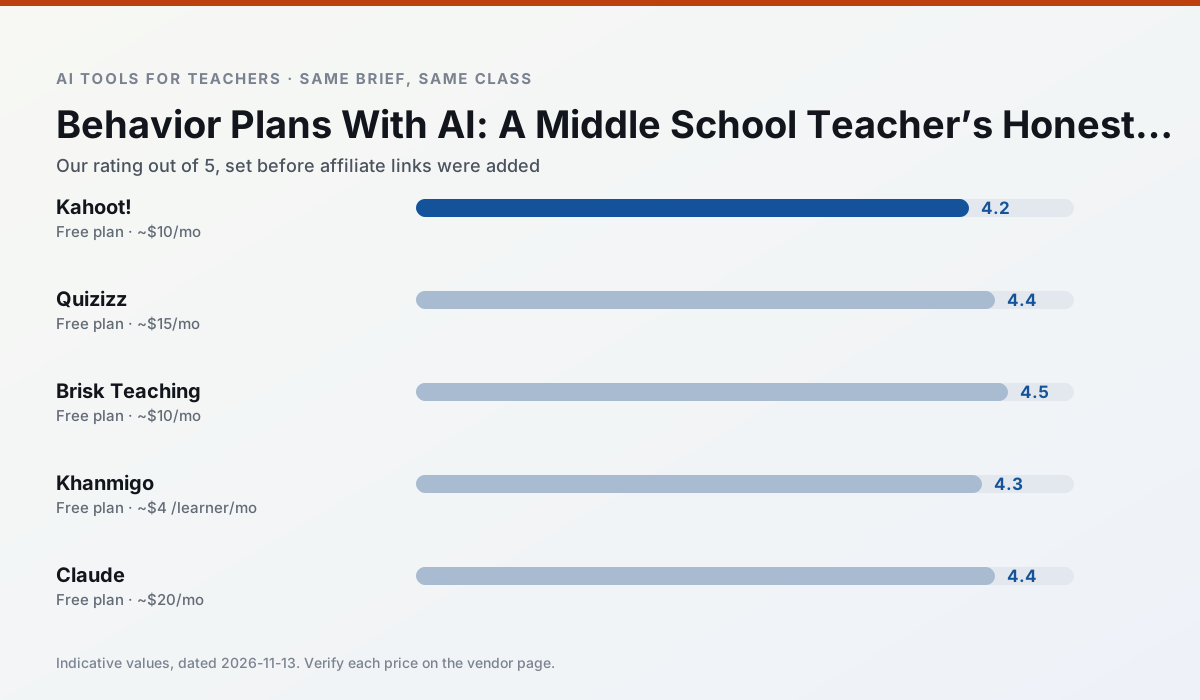
Side by side
Comparison table
Ratings reflect our timed classroom workflow, not vendor claims. Prices are indicative — verify on the vendor site.
| Tool | Best for | Free tier | Indicative paid plan | Standout feature | Our rating | Verdict | Try the tool |
|---|---|---|---|---|---|---|---|
| Kahoot! | quiz generation · review lessons | Yes — Limited player count | ~$10 /user/mo | AI question builder | 4.2 / 5 | Strong option | Try free |
| Quizizz | quiz generation · formative assessment | Yes — Core quiz creation | ~$15 /user/mo | AI question generator | 4.4 / 5 | Strong option | Try free |
| Brisk Teaching | feedback on writing · grading | Yes — Limited actions per month | ~$10 /user/mo | Works inside Google Docs | 4.5 / 5 | Top pick | Try free |
| Khanmigo | math practice · student tutoring | Yes — US teacher accounts, subject to eligibility | ~$4 /learner/mo | Socratic tutoring rather than answers | 4.3 / 5 | Strong option | Try free |
| Claude | rubric creation · feedback on writing | Yes — Usage-limited | ~$20 /user/mo | Very large context window | 4.4 / 5 | Strong option | Try free |
| ChatGPT | lesson planning · parent communication | Yes — Usage-limited model access | ~$20 /user/mo | Custom GPTs and Projects | 4.5 / 5 | Top pick | Try free |
Match your situation
Best for X
Different jobs need different tools. Here is what we would open first in each case.
If there is no budget, start with Kahoot!: free plan with clearest quota is the least punishing free tier here.
On the daily cycle, Quizizz saves the most edit time per task; the paid tier mostly buys more runs rather than better ones.
Brisk Teaching is built around teacher-monitored student spaces and audit logs rather than a consumer chat account, which is a different approval conversation.
Family-facing drafts from Khanmigo need the fewest rewrites for warmth without overpromising, which is the usual failure mode.
Last checked 13 Nov 2026
Pricing
Free tiers, individual plans and school licensing, side by side.
| Tool | Free plan | Individual / paid | School & district | Billing note | Verify |
|---|---|---|---|---|---|
| Kahoot! | $0 — Limited player count | ~$10 /user/mo | Custom quote | Indicative — verify on vendor site | Vendor |
| Quizizz | $0 — Core quiz creation | ~$15 /user/mo | Custom quote | Indicative — verify on vendor site | Vendor |
| Brisk Teaching | $0 — Limited actions per month | ~$10 /user/mo | Custom quote | Indicative — verify on vendor site | Vendor |
| Khanmigo | $0 — US teacher accounts, subject to eligibility | ~$4 /learner/mo | Custom quote | Indicative — verify on vendor site | Vendor |
| Claude | $0 — Usage-limited | ~$20 /user/mo | ~$25+ /user/mo | Indicative — verify on vendor site | Vendor |
| ChatGPT | $0 — Usage-limited model access | ~$20 /user/mo | ~$25+ /user/mo | Indicative — verify on vendor site | Vendor |
Editorial rule: pricing is re-checked every 2–3 months and the top 50 pages are refreshed every 6 months. See our funding policy.
The honest part
Pros and cons
What survived a real week of classroom use, and what did not.
Pros
- Instant engagement
- Very low training time
- Strong brand familiarity
Cons
- Less depth for higher-order assessment
- Paid tiers needed for larger classes
- Time pressure suits recall more than reasoning
Pros
- Students already know the interface
- Good reporting
- Works on low-end devices
Cons
- Writing high-quality AI questions still needs review
- Gamification can distract
- Advanced analytics are paid
Pros
- No copy-paste between tools
- Fast inline feedback on student drafts
- Gentle learning curve
Cons
- Chrome-first workflow
- Extension permissions need IT approval
- Free quota is tight
Pros
- Education-first design
- Strong nonprofit trust signal
- Good math scaffolding
Cons
- Availability varies by region
- Less useful for admin paperwork
- Requires student accounts for full value
Pros
- Handles full unit plans and long rubrics
- Nuanced, less generic prose
- Good at structured document output
Cons
- No teacher-specific templates
- Fewer classroom integrations
- Consumer plan not suitable for student data
In the classroom
Use cases
Five concrete workflows, with the tool we would open for each one.
Regrouping students after an assessment
Summarise anonymised results into skill groups, then generate one activity per group. Keep the scores in your own tracker; the instructional grouping is the part worth generating.
Recommended: Kahoot!A weekly family newsletter from bullet notes
Newsletters fail on length, not tone. Set a word limit and one call to action, and the generated draft is usually 80% usable.
Recommended: QuizizzA parent email in two languages
Draft in plain, warm language with no names, translate, then back-translate the important sentences to check meaning. Keep specific incidents out of the prompt and add them yourself.
Recommended: Brisk TeachingRubric and feedback comments in one pass
Reorder the workflow so the rubric is yours and the comments are generated. Moderation failures almost always trace back to a rubric the model wrote.
Recommended: KhanmigoThree reading levels from one source text
Paste a vetted text, ask for supported, core and extension versions, then check the vocabulary list by hand. Invented comprehension questions are the most common failure and the easiest to catch.
Recommended: Claude
Questions teachers ask us
FAQ
Direct answers, also published as FAQPage structured data for search and AI assistants.
Can AI do behavior plans at Middle School level?
Which tool is best for behavior plans?
What is the biggest risk?
Sources & further reading
Our recommendation
Try MagicSchool AI free for your next behavior plans task
A large library of teacher-specific AI generators in one dashboard. Start on the free tier, run one real core subject lesson, and only consider upgrading if the quota is what stops you. Disclosure: we may earn a commission (30% recurring) at no extra cost to you.
Some links on this page are affiliate links. We may earn a commission at no extra cost to you. Our rankings are editorial and never pay-to-play. Never enter student PII into a free consumer account.
Keep reading
Related comparisons in this cluster.
Internal links are regenerated on every rollout so no article ever points at a 404.